Showing posts with label meat. Show all posts

Wednesday, October 19, 2016

Performance & Carcass Contest

A Performance & Carcass Contest was held in conjunction with the 2016 Western Maryland Pasture-Based Meat Goat Performance Test. Consigners who consigned bucks to the test were eligible to enter a goat in the contest. Fifteen goats were entered from ten states. All of the bucks were Kiko. There were 14 bucks and 1 wether.

Grand Champion Goat

After a 13-day adjustment period, the goats were fed for 87 days. They consumed a hay and grain diet. Hay was fed ad libitum. Grain was limit fed, about 1 pound per head per day. The goats were not fed for maximum gain. They were kept in a 16 ft. x 16 ft pen, with limited grazing. Shelter was provided via a 3-sided shed. Environmental enrichment was provided.

Eleven of the original goats were harvested to collect carcass data. The carcasses were deboned into portions of lean, fat, and bone.  Lean gain per day was the statistic used to rank the goats. It was determined by multiplying yield (lbs. lean ÷ live weight) by ADG (lbs. gain per day).

The Grand Champion goat was a Kiko buck entered by Angie Loos from Illinois. It easily won the competition, excelling in every performance and carcass category. The Reserve Champion was entered by Richard Gamby from Ohio. William Winingear & Brittany White from Missouri had the 3rd place goat. The 4th and 5th place goats were entered by John Smith (Virginia) and Patricia Larr (Indiana), respectively. The wether was the fattest goat in the competition. It did not place in the top 5.

Read full article about contest

Monday, August 4, 2014

Goat Twilight Tour & Tasting

Approximately 80 people attended the Goat Twilight Tour & Tasting, held July 31 at the University of Maryland's Western Maryland Research & Education Center (WMREC) in Keedysville.

The tour highlighted the center's pasture-based meat goat performance test and pen vs. pasture study. In the test, 77, mostly Kiko bucks, are being evaluated for growth, parasite resistance, and parasite resilience. The top-performing bucks will be sold September 6 at the Bluegrass Performance Invitational in Frankfort, Kentucky. All other bucks will be available for sale via private treaty.

In the study, 30 bucks were divided into two groups and are being fed two different diets: pen (hay + grain) and pasture (pasture + soy hulls). All of the study bucks will be harvested to collect carcass data.

For the tasting part, a local chef (Todd Morren) prepared six dishes made from goat  meat (chevon), including Birria Mexican Goat & Chili Stew, Citrus-Cured Goat Salad (Tai De) Jaffna Goat Curry (Sri Lankan) Pappardelle with Goat Ragu, and Roasted Goat for Tacos.


The Goat Twilight Tour & Tasting was sponsored by the Maryland Grain Producers Utilization Board, which funds the pen vs. pasture study. 

Download Recipes

Monday, October 21, 2013

In-defense of On-Farm Slaughter

In the United States, there are four levels of meat inspection: federal (USDA), state, custom-exempt, and personal exemption (on-farm slaughter).

Custom-exempt slaughter
Federal is the "highest" level of inspection. The meat from animals slaughtered in a federally-inspected plant can be sold without restrictions, so long as the meat is properly labeled. Though state-inspection must be "at least equal to" federal inspection, the meat from animals slaughtered in a state-inspected facility is usually limited to sales within the state of slaughter.

Only 27 states have state meat inspection programs.  Custom-exempt slaughter is exempt from continuous inspection. The carcasses and meat from animals slaughtered in a custom-exempt plant are stamped "not for resale" and returned to the owner. Federal and state regulations provide a personal exemption. The personal exemption allows a farmer to slaughter an animal (of his own raising).

States interpret USDA's "personal exemption" differently. Most states take a very strict interpretation and consider the owner of the animal to only be the person who actually raised it. In New York, the owner of the animal is considered to be the owner when they purchase it. The state of Vermont recently passed a law that will allow the on-farm slaughter of up to 25 sheep or no more than 3,500 lbs. (live weight) of any combination of livestock.

Because meat inspection laws vary by state and sometimes county, it is essential that farmers/producers know the laws in their state and how they are interpreted.

Read full article at http://www.sheepandgoat.com/articles/onfarmslaughter.html.

Saturday, August 3, 2013

Goat Twilight Tour Draws Crowd

There was a good turnout at the Goat Twilight Tour held August 1 at the University of Maryland's Western Maryland Research & Education Center in Keedysville.

Loading up for the wagon tour.
Participants learned about the Center's Goat Research and Extension Program, including the Western Maryland Pasture-Based Meat Goat Performance Test and pen vs. pasture study.

Sampling goat meat.
Participants also had the opportunity to sample recipes made with goat meat (chevon). The recipes were prepared by a local chef (Todd Morren). The meat was from two locally-produced Kiko bucks that had been sired by a top-performing buck from a previous performance test.

Bucks in the pen vs. pasture study

Sunday, July 14, 2013

World Consumption of Sheep and Goat Meat

There is a widely-publicized myth that goat meat (chevon) is the most widely-consumed meat in the world. It is not. In fact, it is mathematically impossible, given the number of goats in the world and the yield of an individual goat. Even if you increased world goat population figures by 10-fold, it is still impossible.

In addition, the consumption of sheep and goat meat is usually lumped together. It is often left out of data sets, because it is so minor compared to the major meats. And it is harder to obtain accurate data pertaining to sheep and goat meat consumption, as the animals are often slaughtered on-farm and consumed locally.


The most widely-consumed meats in the world (in order) are pork, poultry, and beef. While it's possible that more people in the world eat goat meat (and sheep meat) than pork, poultry, or beef, most consumers of goat meat live in the developing world, where the per capita meat consumption is very low. It may be their preferred meat, but they don't eat a lot of it.

The table (above) shows the countries of the world that consume the most sheep and goat meat. Some countries probably eat more lamb, others more goat. The data is from 2007. The source is the Food & Agricultural Organization of the United Nations.

In the United States, the per capita consumption of lamb is only about 1 lb. The consumption of goat meat is unknown. On the plus side, the consumption of lamb and goat (in the U.S.) is considerably higher among certain ethnic groups, and demand exceeds supply.

Saturday, June 15, 2013

Pen vs. Pasture Study Underway

For the third year in a row, University of Maryland Extension is conducting a study to compare the performance and carcass characteristics of meat goat bucklings fed in a pen vs. those raised on pasture.

Goats in pen (n=15)
The pen-fed goats (n=15) are being fed a hay and grain diet. Hay is available free choice in hay racks while grain (whole barley) is hand-fed once per day based on appetite. Free choice minerals are also available.

The pasture-fed goats (n=15) are grazing alongside the bucks in the 2013 Western Maryland Pasture-Based Meat Goat Performance Test.  They will not receive any supplemental feed, but have access to free choice minerals.

Goats on pasture (n=15)
After a 13-day adjustment period, the goats will consume their respective diets for 84 days. They will be handled bi-weekly to collect data and fecal samples. At the conclusion of the feeding period, all of the goats will be harvested to collect carcass data. A sample of the longissimus dorsi muscle will be used to determine fatty acid composition of the meat.

All of the goats in this year's study are from the same farm. They are all Kiko.Their average starting weight was 51.6 lbs.

The 2013 study is being funded by the Maryland Grain Producers Utilization Board, which also funded the 2012 study.

Meat Goat Carcass Evaluation

Monday, April 29, 2013

New Processor for Lamb and Goat

Simply Natural is the name of a new company that will begin processing sheep, lambs, goats, and cattle at an abattoir formerly known as Woodlawn Country Meats in Sharpsburg, Maryland. They anticipate a starting date of mid-May (2013).

Simply Natural plans to sell certified-Halal meat products to consumers, restaurants, and retail establishments in the Washington DC Metropolitan area. Customers will be able to order meat online and have it delivered to their homes or businesses. The company will also provide custom slaughter services and facilitate custom slaughter of sheep and goats during various religious observances.

As such, Simply Natural is interested in purchasing naturally-raised sheep, lambs, goats, and cattle from local producers. In the future, the company also hopes to purchase and process locally-raised poultry.

For more information, contact Simply Natural at (202) 656-6328 or visit their web site at www.simplynaturalmeat.com. The web site is currently under construction.

Monday, February 11, 2013

Accuracy of ultrasounding light lambs

Spanish researchers used 124 Spanish pascual-type lambs to determine the accuracy of ultrasounding light lambs. The average carcass weight of the lambs in the study was 29 to 35 lbs.

Ultrasounding
Skin thickness, subcutaneous backfat thickness, and depth, width, and area of the longisimus dorsi muscle were determined via ultrasound. After slaughter, the same measurements were measured directly on the carcass.

Correlations between ultrasound and direct carcass measurements were greater than 0.61 for loin depth, width, and area whereas they fluctuated between 0.32 and 0.60 for subcutaneous backfat thickness. Correlations were greater for transversal vs. longitudinal views.

The researchers concluded that ultrasound can be useful tool for predicting loin measurements in light lambs, but that ultrasound predictions of backfat thickness would be less predictive.

This research is useful to U.S. producers, because ethnic markets usually prefer light weight lambs, similar to those sold in the Mediterranean Basin, where this research was conducted.

Source:  Journal of Animal Science, December 2012.

Friday, April 20, 2012

The truth about "pink slime"

Lean, finely-textured beef (LFTB) is the proper term for the beef product that has been referred to as "pink slime" in the media. It is beef, 100% beef, but in a finely textured version, sort of like baby food.

Making ground chevon
Not all beef can become a steak or roast. When meat cuts are trimmed to remove excess fat, some lean is also removed, resulting in beef trim that has a higher percentage of fat. It would take too much time with a knife to separate this product manually, so it is mechanically separated. During the process, a puff of ammonium hydroxide gas is applied to the beef.

The ammonium hydroxide increases the pH of the meat and creates an environment that does not allow pathogens to survive. Since the ammonium hydroxide evaporates, it is not considered a food additive. Ammonium hydroxide is used in the processing of many food products.

About 10 to 12 pounds of 94-97% lean beef is recovered from each carcass using this process. It is blended with other ground beef at a rate of not more than 15%. LFTB can be added to ground beef with a higher fat content to produce a leaner end product.

Editor's note:  the only thing consumer boycotts of this product will do is drive up already escalating food costs and take away more private sector jobs. Removing LFTB from ground beef will not make it safer.

Read article from MSU Extension

Monday, January 23, 2012

Lamb is for lovers!

Don't forget February is Lamb Lover's Month.  The American Lamb Board is working to spread the word that February is national Lamb Lover's Month.

Visit lambloversmonth.com to learn what's been planned for Lamb Lover's Month.

********************************
The Barbados Blackbelly Sheep Association sells a Lamb Lovers' Cookbook at http://blackbellysheep.org/cookbook.html.

The Lamb Lover's Cookbook contains over 100 mouth-watering ethnic dishes, casseroles, soups and stews, BBQs, crock-pot and pressure cooker recipes, Weight-Watcher recipes, and recipes for every cut of lamb you can imagine. There also are recipes for making sausage (even one that doesn't require any special equipment or casings), marinades, and rubs.

Thursday, October 6, 2011

Pen-fed goats produce superior carcasses

A carcass comparison study is being conducted in association with the 2011 Western Maryland Pasture-Based Meat Goat Performance Test. 

The carcasses of nine goats from the pasture test are being compared to carcasses of nine goats that were pen-fed a diet of hay and grain. Each goat from the pasture test had a companion goat in the pen with similar genetics.

The goats were harvested by Country Foods, a custom-exempt slaughterhouse in Waynesboro, PA, on September 29. The carcasses were deboned and measured on October 5.

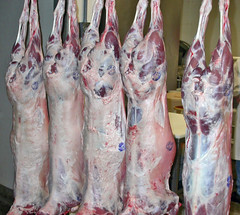
While the carcasses from the pen-fed goats had more kidney and heart fat (KH) and overall fat, their carcasses were heavier-muscled, had a lower percentage of bones, and yielded a higher percentage of boneless meat. According to the meat cutter, the quality (firmness) of their meat was superior to the pasture-raised goats.

In both groups, the highest yielding goat was a Myotonic consigned by Whitmore Farm (MD).  The Myotonic breed is known for having a superior meat-to-bone ratio. While the Myotonic carcasses were shorter, they showed superior conformation, especially in the hindsaddle.


The carcass study will have a second part:  meat quality. A sample of the longissimus dorsi muscle was collected from each carcass. The samples will be sent to the meat lab at The Ohio State University for analysis.

Download carcass data
Download carcass comparison data
Download consigner comparison data

Wednesday, January 12, 2011

Sheep Scanning Demonstration

Have you ever wondered how large the loin eyes are in your lambs? There will be a sheep scanning demonstration on Wednesday, February 2, 2011, 7 to 9 p.m., at the Bedford 4-H Center in Bedford, Pennsylvania.

The featured speakers will be Dr. Andrew Meadows DVM, a certified lamb ultrasound scanner and Melanie Barkley, Bedford County Extension Educator. Please register by January 28 by calling the Bedford County Extension Office at (814) 623-4800.

The registration fee is $20 per adult and $5 for children (18 years of age and younger) and includes speaker fees, handouts, and refreshments.

You may also be able to have your own lambs scanned (first-come, first-serve).  Contact Melanie at meh7@psu.edu for costs and details.

Download flyer
Download registration form

Monday, November 29, 2010

Goat carcass cutting demonstration

At the annual Western Maryland Goat Field Day & Sale (held in October), Paul Kuber showed field day participants how to cut up a goat carcass and prepare chevon (goat meat).  Dr. Kuber is a meat science specialist from The Ohio State University.

Dr. Paul Kuber
If you missed Dr. Kuber's excellent presentation at the goat field day, you'll have another chance to see it.  Dr. Kuber will give a similar presentation during Delaware Ag Week.  He will fabricate a goat carcass into cuts, prepare samples of chevon for tasting, and discuss potential (qualitly) grading standards for goat carcasses.

His presentation is scheduled for Tuesday, January 18, 2011, from 6 p.m. to 9 p.m.  It will be held in the Exhibit Hall Board Room at the Delaware State Fairgrounds in Harrington, Delaware.

For general information regarding Delaware Ag Week, contact Cory Whaley at (302) 856-7303 or whaley@udel.edu.  For information about the small ruminant session (featuring Dr. Kuber), contact Dr. Dahlia O'Brien at (302) 857-6490 or djjackson@desu.edu.

Wednesday, July 21, 2010

Dr. Paul Kuber confirmed as speaker

Dr. Paul Kuber has been confirmed as the keynote speaker for the 2010 Western Maryland Goat Field Day & Sale. The Annual Field Day and Sale will be held on Saturday, October 2nd at the Washington County Agricultural Education Center near Boonsboro, MD.

Dr. Kuber is an Associate Professor in the Department of Animal Science at The Ohio State University. He holds a split appointment that spans teaching, research, and extension (for both adult and youth audiences).

Dr. Paul Kuber
(Ohio State University image)
A native of California, Dr. Kuber received his B.S. from California State University-Fresno and his M.S. from the University of Nebraska. His Ph.D. is in Meat Science from Washington State University. Dr. Kuber has considerable experience in the meat industry, including two years spent in Australia procuring lambs for Superior Farms.

During the field day, Dr. Kuber will demonstrate cuts from a goat carcass, talk about potential standards, and prepare products for tasting. It will be an interactive session that will allow participants to ask questions and discuss potential answers with Dr. Kuber.

The Field Day will be held in conjunction with the sale of the top-performing bucks from the Western Maryland Pasture-Based Meat Goat Performance Test. There will also be an invitational doe sale and a Junior Goat Skillathon. Be sure to mark your calendar.

Visit Dr. Kuber's web page
Go to the Meat Goat Test Blog

Friday, February 5, 2010

Niche meat processing

The purpose of the Niche Meat Processor Assistance Network (NMPAN) is to help very small to mid-sized meat processors.
Online and in-person resources and information can be found on NMPAN's web site at http://www.nichemeatprocessing.org/.

You can sign up for NMPAN updates, including announcements of webinars and new meat processing resources at http://groups.google.com/group/nmpan. 

NMPAN is part of eXtension (http://www.extension.org/), so many of the links on NMPAN's web site will link to eXtension pages.

Thursday, December 10, 2009

New small plant help-desk

USDA's Food Safety and Inspection Service (FSIS) recently announced the opening of its new small plant help-desk, which will provide for operators of small and very small meat, poultry and processed egg products establishments seeking help with agency requirements with direct access to knowledgeable staff specialists.

small lamb and goat processing plantThe help-desk also will provide assistance to state and local food regulatory agencies, FSIS' partners in keeping meat, poultry and egg products safe for consumers.

The new help-desk will support USDA's "Know Your Farmer, Know Your Food" initiative by helping small processors to reduce the time and expense of dealing with agency requirements. "Know Your Farmer, Know Your Food" is designed to continue the national conversation about developing local and regional food systems and finding ways to support small and mid-sized producers.

It emphasizes the need for a fundamental and critical reconnection between producers and consumers, building on the 2008 Farm Bill, which provides additional flexibility for USDA programs to promote local foods. More information on the "Know Your Farmer, Know Your Food" initiative can be found at: www.usda.gov/knowyourfarmer .

The FSIS small plant help-desk will serve as a "one-stop shop" for plant owners and operators with questions. More than 90% of the 6,000 plants inspected by FSIS are small or very small.

The help-desk is open from 8:00 a.m. - 4:00 p.m. EST, Monday through Friday, excluding Federal holidays. To speak to a staff specialist during this time, call 1-877-FSISHelp (1-877-374-7435). Customers may also contact the help-desk by email at InfoSource@fsis.usda.gov.

Source: USDA News Room

Monday, November 2, 2009

Update on state meat inspection

As of August 13, 2007, twenty-seven states had meat inspection programs for products produced and sold within their states. State meat inspection standards must be "at least equal to" federal standards. Most state inspection programs duplicate USDA standards. Yet despite the equality in standards (with USDA), state-inspected meat may not sell in interstate commerce.

Federally-inspected lamb carcassesRecently, USDA’s Food Safety and Inspection Service announced it would publish proposed regulations to implement a new voluntary cooperative program under which selected state-inspected facilities would be eligible to ship meat and poultry products across state lines.

Currently the proposal is in a comment period. Comments must be received on or before Monday, November 16 through the Federal eRulemaking Portal at http://www.regulations.gov or by mail to FSIS Docket Room, USDA, FSIS, OPPD, Docket Clearance Unit, 5601 Sunnyside Avenue, Stop 5272, Beltsville, MD 20705. All comments must identify FSIS and the docket number FSIS-2008-0039.

Tuesday, October 27, 2009

Goat recipes

Getting your goat: the gourmet guideGoats have been a major source of food since time immemorial. Goat meat can be stewed, curried, baked, grilled, barbecued, minced, canned, or made into sausage.

Goat milk and the cheese made from it has remained popular throughout history and still is consumed on a more extensive basis worldwide than cow’s milk.

Getting Your Goat: The Gourmet Guide is the name of a new cook book that contains goat meat and cheese recipes from all over the world. It is written by Patricia Moore and Jill Charlotte Stanford and published by Evertype. The book is available from Amazon.com.

Tuesday, October 20, 2009

Goat carcass study

One of the goals of the Western Maryland Pasture-Based Meat Goat Performance Test is to evaluate and compare carcass characteristics of meat goats consuming a pasture-only diet. This year, nine bucks were selected for harvest.

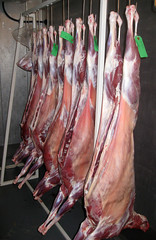
goat carcasses from 2009 W. MD goat testThe bucks were transported from the test site at the University of Maryland’s Western Maryland Research & Education Center to LambCo LLC for humane harvest on October 15.

The carcasses were completely deboned. Fat and lean were separated from the bones, resulting in separate “piles” of bones, fat, and lean, which were weighed to determine carcass percentages.

Next year, the plans to harvest more goats from the test and perhaps incorporate a carcass contest into the performance testing program.

Download PDF file of data
Read full article and view data PDF

Thursday, April 16, 2009

Effect of sex and weight

Portuguese researchers studied the effect of sex and carcass weight on the sensory quality of goat meat.

goat meat for sale in New York CitySensory attributes of toughness, juiciness, flavor intensity, flavor quality, odor intensity, fiber presense (stringy), sweet intensity and overall acceptability were evaluated in 60 males and females allocated to 3 carcass weight groups: 4 (8.8 lbs.), 6 (13.2 lbs.), and 8 (17.6 lbs.) kg. Sensory qualty was evaluated by a trained taste panel of 11 experts.

A sex effect was detected by the panelists as meat from males presented greater juiciness, flavor quality, and general acceptability than did meat from females. The taste panel found differences between animals from distinct carcass weight ranges. Lighter weight carcasses were considered more tender with less flavor and odor intensity than heavier carcasses.

Source: Journal of Animal Science. 2009 . 87:711-715.