This Shepherd's Notebook blog is moving to the Maryland Small Ruminant Page at https://www.sheepandgoat.com/blog. All new posts will be posted to the new blog site effective immediately.
Shepherd's Notebook was created in 2006 to provide timely information to sheep and goat producers and anyone else interested in small ruminants. Since 2006, over 1100 posts have been made.
The old blog site will remain online at https://mdsheepgoat.blogspot.com. Old blog posts will be continue to be catalogued by the search engines. You'll still be able to search old entries via keyword or labels.
Go to the new Shepherd's Notebook blog at https://www.sheepandgoat.com/blog.

Showing posts with label news. Show all posts
Showing posts with label news. Show all posts
Friday, December 1, 2017


Thursday, October 19, 2017
No More Free Plastic Scrapie Tags
As part of efforts to eradicate scrapie, US sheep and goat producers are required to follow federal and state regulations for officially identifying their sheep and goats. Prior to October 1, 2017, the National Scrapie Eradication Program provided free plastic ear tags and applicators. As of October 1, the program will only provide free metal tags.

Producers who already have premise IDs can call 1-888- USDA-TAG to get metal tags free of charge. Producers who don't have a premise ID need to request one from their area APHIS office before ordering tags. Producers who don't want to use the metal tags will need to purchase their own identification tags/devices from approved companies.
According to federal regulations, sheep under 18 months of age that move directly into slaughter channels do not need to be identified. Wethers under 18 months of age do not need to be identified. Low risk commercial goats, slaughter goats, and castrated goats do not need to be identified, according to the federal regulations. State regulations may be stricter than federal requirements and require additional animals to be identified.
Scrapie is a fatal, degenerative disease affecting the central nervous system of sheep and goats. There is no cure or treatment for scrapie. While the incidence of scrapie has been significantly reduced, the goal remains: to have the US eventually declared scrapie-free by international animal health organizations.
Read latest fact sheet regarding scrapie identification and record keeping

Producers who already have premise IDs can call 1-888- USDA-TAG to get metal tags free of charge. Producers who don't have a premise ID need to request one from their area APHIS office before ordering tags. Producers who don't want to use the metal tags will need to purchase their own identification tags/devices from approved companies.
According to federal regulations, sheep under 18 months of age that move directly into slaughter channels do not need to be identified. Wethers under 18 months of age do not need to be identified. Low risk commercial goats, slaughter goats, and castrated goats do not need to be identified, according to the federal regulations. State regulations may be stricter than federal requirements and require additional animals to be identified.
Scrapie is a fatal, degenerative disease affecting the central nervous system of sheep and goats. There is no cure or treatment for scrapie. While the incidence of scrapie has been significantly reduced, the goal remains: to have the US eventually declared scrapie-free by international animal health organizations.
Read latest fact sheet regarding scrapie identification and record keeping
Thursday, October 12, 2017
Fall 2017 Wild & Woolly
The Fall 2017 issue of Wild & Woolly has been published. Wild & Woolly is a quarterly newsletter for sheep and goat producers. It is published by University of Maryland Extension.

Subscribe to the newsletter listserv to receive an email when a new issue of the newsletter has been published. Send an email to listserv@listserv.umd.edu. In the body of the message, write unsubscribe sheepandgoatnews.
PDF file
via ISSUU
Newsletter Archive

Subscribe to the newsletter listserv to receive an email when a new issue of the newsletter has been published. Send an email to listserv@listserv.umd.edu. In the body of the message, write unsubscribe sheepandgoatnews.
PDF file
via ISSUU
Newsletter Archive
Tuesday, October 3, 2017
"Worm Tested" Rams Average $1226
On September 22, 2017, thirty-nine rams from the Southwest AREC Ram Test in Virginia were auctioned off to eager bidders. One hundred and ten rams originating from twenty-six flocks in nine states were delivered to the test site on May 30. Thirty-nine top-performers were selected for the auction. They represented the top 60 percent in performance.
The thirty-nine rams grossed $47,800. Prices ranged from $400 to $3400. The average price was $1226. The mean was $1000. The top-indexing ram sold for $2200. The high-selling ram brought $3400. Fourteen of the rams sold, including the top-performing ram, also had EBVs (estimated breeding values) for worm egg counts. These rams ranged in price from $600 to $2200. They sold for an average price of $1278. The median price was $1350.
Following a three week adjustment period, the rams were evaluated for growth and parasite resistance over a 70-day period. They grazed fescue paddocks and received supplemental feed (76% TDN, 18% CP) at a rate of approximately 3 percent of their body weight. At the start of the test, the rams received an oral dose of 5000 3rd stage Haemonchus contortus. Body weights and FAMACHA© scores were determined biweekly. Fecal samples were collected every 14 days. The rams were scanned at the end of the test to determine backfat and eye muscle depth. An index, based on a combination of traits, was used to identify top performers and determine the sale order.
The Southwest AREC Ram Test is conducted annually at Virginia Tech's Southwest Ag Research & Extension Center in Glade Spring, Virginia. The first test was conducted in 2012. For more information about the test, contact Lee Wright at (276) 944-2200 or Dr. Scott Greiner at (540) 231-9159.
The Southeast AREC Ram Test is the only ram performance test that evaluates rams for parasite resistance . For 11 years, the Western Maryland Pasture-Based Meat Goat Performance Test evaluated meat goat bucks for parasite resistance (natural infection). Eastern Oklahoma State College conducts an annual buck test in which fecal egg counts are used to determine performance. The Katahdin breed is the only breed of sheep or goat (in the US) in which EBVs are calculated for parasite resistance (fecal egg counts).
The thirty-nine rams grossed $47,800. Prices ranged from $400 to $3400. The average price was $1226. The mean was $1000. The top-indexing ram sold for $2200. The high-selling ram brought $3400. Fourteen of the rams sold, including the top-performing ram, also had EBVs (estimated breeding values) for worm egg counts. These rams ranged in price from $600 to $2200. They sold for an average price of $1278. The median price was $1350.
 |
| One of the rams being auctioned off |
The Southwest AREC Ram Test is conducted annually at Virginia Tech's Southwest Ag Research & Extension Center in Glade Spring, Virginia. The first test was conducted in 2012. For more information about the test, contact Lee Wright at (276) 944-2200 or Dr. Scott Greiner at (540) 231-9159.
The Southeast AREC Ram Test is the only ram performance test that evaluates rams for parasite resistance . For 11 years, the Western Maryland Pasture-Based Meat Goat Performance Test evaluated meat goat bucks for parasite resistance (natural infection). Eastern Oklahoma State College conducts an annual buck test in which fecal egg counts are used to determine performance. The Katahdin breed is the only breed of sheep or goat (in the US) in which EBVs are calculated for parasite resistance (fecal egg counts).
Wednesday, August 16, 2017
A New Era in Western Maryland
The Western Maryland Pasture-Based Meat Goat Performance Test was
initiated at the University of Maryland’s Western Maryland Research
& Education in Keedysville (Washington County) in 2006.
The purpose of the test was to evaluate the post-weaning performance of meat goat bucklings consuming a pasture-based diet, with natural exposure to internal parasites. Identifying bucks that were resistant and resilient to internal parasites was the trademark of the test.
The test was conducted for eleven years. Almost 800 bucks were evaluated. While the test was open to any breed or cross of goat, it gradually evolved into a “Kiko test.” Over the span of the test, more than 100 producers from 20 states consigned bucks. Top-performing bucks were sold (as far away as California) or returned to farms for breeding.
Over
the years, many
programs and activities were held in conjunction with the test,
including field days, tours, sales, skillathons, and carcass evaluation.
In 2014, the BluegrassPerformance Invitational in Frankfort, Kentucky, was established as a place to
sell performance tested goats, including the top-performing bucks from the Maryland test. This year's sale is September 1-2, 2017.
Now, the goat test era is over (in Maryland). Goat producers will be encouraged and assisted in their move to the next step in performance testing: within and across-herd EBVs. EBV stands for estimated breeding value and is a measure of genetic merit, The data is far more accurate than the data from buck tests.
A sheep research program will be initiated at the Western Maryland Research & Education next spring (2018). The pastures are being re-established and new infrastructure is being put in, as the hoop house that was installed several years ago was completely destroyed this past winter.
Internal parasites (GI worms) will likely continue to be the focus of the research program, as it is a logical follow-up to the goat test and parasites remain a major obstacle to profitable small ruminant production. We also plan to plant different forages for grazing.
I’d
like to express appreciation to my “Goat Team”: Jeff Semler, David
Gordon, Pam Thomas, and Mary Beth Bennett. Others who played key roles
include E. Nelson Escobar, Niki Whitley, Willie Lantz, Chris Anderson,
Jeanne Deitz-Band, Lexie Simmons, and Amy Garza.
Dr. Dahlia O’Brien at Virginia State University (previously at Delaware State University) was instrumental to the success of the test, as she performed all the fecal egg analyses.
Thanks to the Maryland Grain Producers Utilization Board for providing funding for the pen vs. pasture studies.
Thanks to everyone who supported the goat test over the years, including all the consigners and buyers of bucks.
Susan Schoenian
Sheep & Goat Specialist
University of Maryland Extension
The purpose of the test was to evaluate the post-weaning performance of meat goat bucklings consuming a pasture-based diet, with natural exposure to internal parasites. Identifying bucks that were resistant and resilient to internal parasites was the trademark of the test.
The test was conducted for eleven years. Almost 800 bucks were evaluated. While the test was open to any breed or cross of goat, it gradually evolved into a “Kiko test.” Over the span of the test, more than 100 producers from 20 states consigned bucks. Top-performing bucks were sold (as far away as California) or returned to farms for breeding.
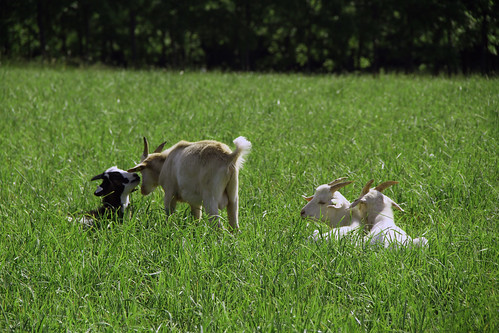 |
| Bucks from the 2012 test |
Now, the goat test era is over (in Maryland). Goat producers will be encouraged and assisted in their move to the next step in performance testing: within and across-herd EBVs. EBV stands for estimated breeding value and is a measure of genetic merit, The data is far more accurate than the data from buck tests.
A sheep research program will be initiated at the Western Maryland Research & Education next spring (2018). The pastures are being re-established and new infrastructure is being put in, as the hoop house that was installed several years ago was completely destroyed this past winter.
Internal parasites (GI worms) will likely continue to be the focus of the research program, as it is a logical follow-up to the goat test and parasites remain a major obstacle to profitable small ruminant production. We also plan to plant different forages for grazing.
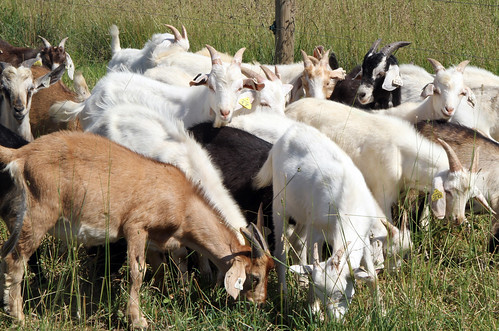 |
| Bucks from the 2014 test |
Dr. Dahlia O’Brien at Virginia State University (previously at Delaware State University) was instrumental to the success of the test, as she performed all the fecal egg analyses.
Thanks to the Maryland Grain Producers Utilization Board for providing funding for the pen vs. pasture studies.
Thanks to everyone who supported the goat test over the years, including all the consigners and buyers of bucks.
Susan Schoenian
Sheep & Goat Specialist
University of Maryland Extension
Tuesday, July 18, 2017
Summer 2017 Wild & Woolly
The Summer 2017 issue of Wild & Woolly has been published to the web. It is available as a PDF file or via ISSUU.
Wild & Woolly is a quarterly newsletter for sheep and goat producers. It is published by the University of Maryland's Western Maryland Research & Education Center.

To receive an email when a new issue of the newsletter has been published, subscribe to the newsletter listserv by sending an email to listserv@listserv.umd.edu. In the body of the message, write subscribe sheepandgoatnews.
PDF: http://docs.wixstatic.com/ugd/aded98_48d3ee266e304746973db9642128399c.pdf
ISSUU: https://issuu.com/mdsheepgoat/docs/summer2017
Wild & Woolly is a quarterly newsletter for sheep and goat producers. It is published by the University of Maryland's Western Maryland Research & Education Center.

To receive an email when a new issue of the newsletter has been published, subscribe to the newsletter listserv by sending an email to listserv@listserv.umd.edu. In the body of the message, write subscribe sheepandgoatnews.
PDF: http://docs.wixstatic.com/ugd/aded98_48d3ee266e304746973db9642128399c.pdf
ISSUU: https://issuu.com/mdsheepgoat/docs/summer2017
Friday, May 19, 2017
Skillathon Winners Announced
About sixty youth competed in the 2017 Junior Sheep & Goat Skillathon, held recently at the Maryland Sheep & Wool Festival. Youth and teams competed according to their ages as of January 1: Junior, 8-10; Intermediate, 11-13; and Senior, 14-19.
The first place junior was Matthew Simpson from West Virginia. Eddyn Molden from Frederick County, Virginia, placed second. Brooke Crandell from Pennsylvania was third. The first place junior team was the team from Frederick County, Virginia. Howard County (Maryland) had the second place junior team. Montgomery County was third.
In the intermediate division, Lizzy Miller from Montgomery County was first. Ana Clemmer from Howard County was second and Jordan Kelly from Frederick County (Virginia) was third. The first place intermediate team was the team from Frederick County (Virginia). Frederick County, Maryland, was second.
In the senior division, Brietta Latham from Howard County placed first. Two Charles County 4-Hers placed second and third, respectively: Hayley Tanner and Taylar Burch. Howard County had the first place senior team, followed by Frederick County, Virginia, and Frederick County Maryland.
The Maryland Sheep Breeders Association provided ribbons and premiums to the top 10 individuals in each age division and Festival t-shirts to the top-3 teams.
Special thanks to Chris Anderson, 4-H Youth Animal Science Specialist with University of Maryland Extension, for running this year's skillathon, while Susan Schoenian, Sheep & Goat Specialist, was on sabbatical.
The skillathon is always held the first weekend of May (Sunday) at the Maryland Sheep & Wool Festival. Competition is open to individuals and teams of youth (age 8-18) from any state or province.
Images by Chris Anderson
http://www.sheepandgoat.com/skillathon
The first place junior was Matthew Simpson from West Virginia. Eddyn Molden from Frederick County, Virginia, placed second. Brooke Crandell from Pennsylvania was third. The first place junior team was the team from Frederick County, Virginia. Howard County (Maryland) had the second place junior team. Montgomery County was third.
 |
| Junior winners |
In the intermediate division, Lizzy Miller from Montgomery County was first. Ana Clemmer from Howard County was second and Jordan Kelly from Frederick County (Virginia) was third. The first place intermediate team was the team from Frederick County (Virginia). Frederick County, Maryland, was second.
 |
| Intermediate winners |
In the senior division, Brietta Latham from Howard County placed first. Two Charles County 4-Hers placed second and third, respectively: Hayley Tanner and Taylar Burch. Howard County had the first place senior team, followed by Frederick County, Virginia, and Frederick County Maryland.
 |
| Senior winners |
The Maryland Sheep Breeders Association provided ribbons and premiums to the top 10 individuals in each age division and Festival t-shirts to the top-3 teams.
Special thanks to Chris Anderson, 4-H Youth Animal Science Specialist with University of Maryland Extension, for running this year's skillathon, while Susan Schoenian, Sheep & Goat Specialist, was on sabbatical.
The skillathon is always held the first weekend of May (Sunday) at the Maryland Sheep & Wool Festival. Competition is open to individuals and teams of youth (age 8-18) from any state or province.
Images by Chris Anderson
http://www.sheepandgoat.com/skillathon
Monday, May 15, 2017
Worms Kill 87,000 goats in 2015
 According to a recent USDA report, "Goat and Kid Predator and Nonpredator Death Loss inthe United States," about 500,000 adult and kid goats were lost to all causes (nonpredator and predator) in the United States (in 2015), which represented 9.8 percent of U.S. adult goat inventory and 19.4 percent of kids born in 2015.
Nonpredator causes accounted for about three-fourths of all adult goat and kid death losses in the United States in 2015. Undetermined causes (found dead or unknown) accounted for the highest number of nonpredator losses in both goats and kids. Of known losses due to nonpredator causes, internal parasites were the primary cause of loss, resulting in almost 87,000 goat and kid deaths in 2015.
Internal parasites accounted for 22.7 percent of all known death losses: 24.8% of goats, 15.6% of pre-weaned kids, 37.7% of post-weaned kids, and 21.5% of all kids. Some of the unknown (found dead) death losses may also have been the result of internal parasites.
Source: Goat and Kid Predator and Nonpredator Death Loss in the United States, 2015
Thursday, March 2, 2017
No Maryland Wool Pool in 2017
After 59 years of operation, there will be no Maryland Wool Pool in 2017. For many years, the wool pool has provided a market outlet for fleeces. The pool has been especially beneficial for small producers.
There have been many managers of the Maryland Wool Pool. Prices always seemed to be higher than other pools, with similar types of wool. The Maryland pool was always innovative in its approaches to marketing wool, instituting classing and baling. In fact, the Maryland Wool Pool hosted many ASI classing schools.

In its next newsletter, the Maryland Sheep Producers Association will offer alternatives for marketing wool. There are still wool pools in neighboring states: Virginia, West Virginia, and Pennsylvania. Some shearers will purchase wool.
Many producers direct market their wool to hand spinners. Others add value to their wool and sell roving, top, yarn, or finished products. You can take wool to landfills. Many producers have switched to hair sheep, so they don't have to worry about shearing and marketing wool.
There have been many managers of the Maryland Wool Pool. Prices always seemed to be higher than other pools, with similar types of wool. The Maryland pool was always innovative in its approaches to marketing wool, instituting classing and baling. In fact, the Maryland Wool Pool hosted many ASI classing schools.
In its next newsletter, the Maryland Sheep Producers Association will offer alternatives for marketing wool. There are still wool pools in neighboring states: Virginia, West Virginia, and Pennsylvania. Some shearers will purchase wool.
Many producers direct market their wool to hand spinners. Others add value to their wool and sell roving, top, yarn, or finished products. You can take wool to landfills. Many producers have switched to hair sheep, so they don't have to worry about shearing and marketing wool.
Monday, July 18, 2016
Summer 2016 Wild & Woolly
The Summer 2016 issue of Wild & Woolly has been published to the
web. Wild & Woolly is a quarterly newsletter for sheep and goat
producers. It is published by University of Maryland Extension.

The newsletter is available as an HTML or PDF file. It is also available on ISSUU, an electronic publishing platform. Mailed copies of the newsletter are available for a cost recovery fee of $10/year, payable to the University of Maryland.
To subscribe to the newsletter listserv, send an email message to listserv@listserv.umd.edu. In the body of the message, write subscribe sheepandgoatnews.
HTML
PDF
ISSUU

The newsletter is available as an HTML or PDF file. It is also available on ISSUU, an electronic publishing platform. Mailed copies of the newsletter are available for a cost recovery fee of $10/year, payable to the University of Maryland.
To subscribe to the newsletter listserv, send an email message to listserv@listserv.umd.edu. In the body of the message, write subscribe sheepandgoatnews.
HTML
ISSUU
Monday, July 11, 2016
Everything Sheep and Goats
A Twilight Tour & Tasting was held July 8 at the Washington County Agricultural Education Center in Boonsboro, Maryland, to celebrate everything sheep and goats. Attendance was capped at 100.
Local chef Todd Morren prepared six dishes made from lamb and chevon (goat meat) and one dish made from cheese (sheep milk). Small ruminant dairies were on hand to give out cheese samples and sell their products. There was a display of small ruminant fibers.
There were wagon tours to the Western Maryland Research & Education Center. Tour stops included the Western Maryland Pasture-Based Meat Goat Performance Test (11th year) and the Goat Performance & Carcass Contest (1st year).
 |
| Handing out samples of lamb and goat |
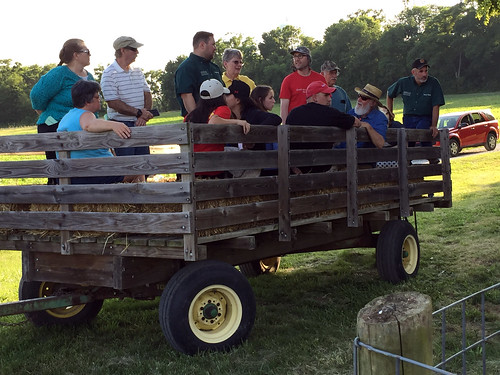 |
| On the wagon tour |
Sunday, June 26, 2016
Looking For the Best Bucks
Ninety-seven (97) mostly Kiko bucks began the 2016 Western Maryland
Pasture-Based Meat Goat Performance Test on June 23-24. There were
originally 142 goats nominated for the test, but nominations had to be
reduced.
The goats were consigned by 34 goat breeders from 17 states. Kentucky is the state with the most goats and consigners. Two Maryland breeders consigned 8 goats to the test.
While on test, the goats will consume a pasture-based diet and be evaluated for growth, parasite resistance, parasite resilience, and carcass muscling. After a 13-day adjustment period, the test will span 84 days. Starting weights will be determined July 7-8. The goats will be handled bi-weekly for data collection.
A Performance & Carcass Contest is being held in conjunction with this year's test. Fifteen goats were entered into the contest. The contest goats will consume a hay-grain diet, with a goal of moderate gain. At the end of the feeding period, they will be harvested to collected carcass data.
To follow the progress of this year's test and contest, visit the blog at http://mdgoattest.blogspot.com.
It is the 11th year of the test and the 1st year of the contest. Both are sponsored by the University of Maryland Extension Small Ruminant Program and held at the University of Maryland's Western Maryland Research & Education Center in Keedysville.
The goats were consigned by 34 goat breeders from 17 states. Kentucky is the state with the most goats and consigners. Two Maryland breeders consigned 8 goats to the test.
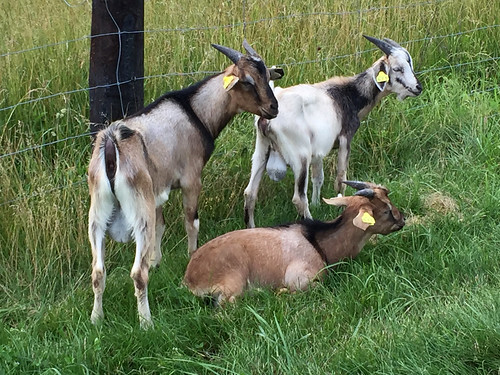 |
| Some of the bucks in the test |
While on test, the goats will consume a pasture-based diet and be evaluated for growth, parasite resistance, parasite resilience, and carcass muscling. After a 13-day adjustment period, the test will span 84 days. Starting weights will be determined July 7-8. The goats will be handled bi-weekly for data collection.
A Performance & Carcass Contest is being held in conjunction with this year's test. Fifteen goats were entered into the contest. The contest goats will consume a hay-grain diet, with a goal of moderate gain. At the end of the feeding period, they will be harvested to collected carcass data.
To follow the progress of this year's test and contest, visit the blog at http://mdgoattest.blogspot.com.
It is the 11th year of the test and the 1st year of the contest. Both are sponsored by the University of Maryland Extension Small Ruminant Program and held at the University of Maryland's Western Maryland Research & Education Center in Keedysville.
Thursday, April 14, 2016
Spring 2016 Issue of Wild & Woolly
The Spring 2016 issue of Wild & Woolly has been published to the web. Wild & Woolly is a quarterly newsletter for sheep and goat producers. It is published by University of Maryland Extension.

The newsletter is available as an HTML or PDF file. It is also available on ISSUU, an electronic publishing platform. Mailed copies of the newsletter are available for a cost recovery fee of $10/year, payable to the University of Maryland.
To subscribe to the newsletter listserv, send an email message to listserv@listserv.umd.edu. In the body of the message, write subscribe sheepandgoatnews.
HTML
PDF
ISSUU

The newsletter is available as an HTML or PDF file. It is also available on ISSUU, an electronic publishing platform. Mailed copies of the newsletter are available for a cost recovery fee of $10/year, payable to the University of Maryland.
To subscribe to the newsletter listserv, send an email message to listserv@listserv.umd.edu. In the body of the message, write subscribe sheepandgoatnews.
HTML
ISSUU
Wednesday, April 13, 2016
Working Dog Liability Insurance
The Working Dog Liability Insurance (WDLI) was unveiled at the American Sheep Industry Convention in January. The insurance is for livestock producers who use guardian and herding dogs to protect their livestock from predators and other risks, and to assist in the management of the flock or herd.
Frequently, producers have no liability protection from incidents related to guardian or herding dogs. Most farm and ranch insurance policies exclude working dogs or dogs which "may show aggressive tendencies." WDLI is managed and serviced by Food and Fiber Risk Managers. They understand the business and know that livestock production is your livelihood. They have your best interest at heart.
Annual premium rates for the first guardian or herding dog can be a low as $100 depending on each producer's situation. Additional dogs can be as low as $25 each.
According to the American Veterinary Medical Association, and the National Canine Research Council, more than $400,000,000 is paid annually in all dog liability claims in the US. Most working dogs owned and used by sheep and livestock producers are excluded from the typical farm and ranch, or home owner’s insurance policies. Having WDLI will protect you from liability.
To learn more, go to http://workingdogliabilityinsurance.com/.
 |
| Livestock guardian dog |
Annual premium rates for the first guardian or herding dog can be a low as $100 depending on each producer's situation. Additional dogs can be as low as $25 each.
According to the American Veterinary Medical Association, and the National Canine Research Council, more than $400,000,000 is paid annually in all dog liability claims in the US. Most working dogs owned and used by sheep and livestock producers are excluded from the typical farm and ranch, or home owner’s insurance policies. Having WDLI will protect you from liability.
To learn more, go to http://workingdogliabilityinsurance.com/.
Tuesday, January 19, 2016
Recap of 2015 Buck Test
2015 was the 10th year of the Western Maryland Pasture-Based Meat Goat Performance Test, which is conducted at the University of Maryland's
Western Maryland Research & Education Center in Keedysville. The
purpose of the test is to evaluate the post-weaning performance of meat
goat bucklings consuming a pasture-based diet, with natural exposure to
internal parasites, primarily the barber pole worm.
Eighty-four (84) mostly Kiko bucks were
consigned to the 2015 test. They were consigned by 25 breeders from 12
states, including Delaware, Illinois, Indiana, Kansas, Kentucky,
Maryland, North Carolina, Pennsylvania, Tennessee, Vermont, and
Virginia. Ten were first-time consignors.
The ten top-performing bucks were selected at the end of the test. The top-performing buck was a commercial Kiko consigned by Randy & Jodie Mazancsik from Kentucky. It was the second year in a row that they had the top-performing buck. David Peters had two bucks in the top 10. He was named top consignor, an award given to the consignor with the three best bucks in the test.
The 2015 Test was dedicated to the memory of long-time consignors Merritt "Sam" Burke from Delaware and Craig Adams from Illinois. Both men passed away in 2015. Each had consigned many top-performing bucks. In fact, Craig had one of the top-performing bucks in the 2015 test.
The progress reports and summary reports from the 2015 year's test can be downloaded from http://www.sheepandgoat.com/#!goattest/cbev. Reports from previous tests are available at the same site.
Read Full Recap of 2015 Test
 |
| Kiko buck grazing clover |
The ten top-performing bucks were selected at the end of the test. The top-performing buck was a commercial Kiko consigned by Randy & Jodie Mazancsik from Kentucky. It was the second year in a row that they had the top-performing buck. David Peters had two bucks in the top 10. He was named top consignor, an award given to the consignor with the three best bucks in the test.
The 2015 Test was dedicated to the memory of long-time consignors Merritt "Sam" Burke from Delaware and Craig Adams from Illinois. Both men passed away in 2015. Each had consigned many top-performing bucks. In fact, Craig had one of the top-performing bucks in the 2015 test.
The progress reports and summary reports from the 2015 year's test can be downloaded from http://www.sheepandgoat.com/#!goattest/cbev. Reports from previous tests are available at the same site.
Read Full Recap of 2015 Test
Wednesday, October 21, 2015
Fall 2015 Wild & Woolly
The Fall 2015 issue of Wild & Woolly is now available on the web. It is available in several formats: HTML and PDF. It is also published on ISSUU. Previous issues of the newsletter may be downloaded from http://www.sheepandgoat.com/#!newsletter/cno0.
Wild & Woolly is a newsletter for sheep and goat producers and anyone else interested in small ruminant production. It is published quarterly by the University of Maryland's Western Maryland Research & Education Center.
You can subscribe to the newsletter listserv, so you'll get an email message whenever a new issue has been posted to the web. To subscribe, send an e-mail to listserv@listserv.umd.edu. In the body of the message, write subscribe sheepandgoat news. To unsubscribe, send an e-mail to the same address, but write unsubscribe instead of subscribe.
HTML
PDF
@ ISSUU
 |
| Valais Blacknose sheep Image credit: Whitehall (UK) |
You can subscribe to the newsletter listserv, so you'll get an email message whenever a new issue has been posted to the web. To subscribe, send an e-mail to listserv@listserv.umd.edu. In the body of the message, write subscribe sheepandgoat news. To unsubscribe, send an e-mail to the same address, but write unsubscribe instead of subscribe.
HTML
@ ISSUU
Monday, August 17, 2015
NSIP Sale Averages $707
The Annual Center of the Nation Sale, featuring National Sheep
Improvement Program (NSIP) sheep, was held recently in Iowa. One hundred and two sheep sold. They averaged $707. Rams averaged $769. Ewes averaged $515. The high-selling ram (Polypay) brought $2400. The top-selling ewe (Suffolk) sold for $1000.
Averages
20 Polypay rams @ $1023
3 Polypay ewes @ $467
24 Suffolk rams @ $614
12 Suffolk ewes @ $600
15 Hampshire rams @ $605
3 Dorset rams @ 433
5 Dorset ewes @ $325
3 Columbia rams @ $717
3 Columbia ewes @ $558
5 Katahdin rams @ $910
2 Katahdin ewes @ $500
3 Targhee rams @ $900
3 SireMax rams @ $550
1 Shropshire ram @ $1200
NSIP calculates Estimated Breeding Values (EBVs) on a variety of traits based on generations of performance data. Midwest producers created the Center of the Nation Sale as a marketplace for sheep with EBVs. The total sheep industry has benefited.
Averages
20 Polypay rams @ $1023
3 Polypay ewes @ $467
24 Suffolk rams @ $614
12 Suffolk ewes @ $600
15 Hampshire rams @ $605
3 Dorset rams @ 433
5 Dorset ewes @ $325
3 Columbia rams @ $717
3 Columbia ewes @ $558
5 Katahdin rams @ $910
2 Katahdin ewes @ $500
3 Targhee rams @ $900
3 SireMax rams @ $550
1 Shropshire ram @ $1200
NSIP calculates Estimated Breeding Values (EBVs) on a variety of traits based on generations of performance data. Midwest producers created the Center of the Nation Sale as a marketplace for sheep with EBVs. The total sheep industry has benefited.
Tuesday, July 21, 2015
Summer 2015 Wild & Woolly
The Summer 2015 issue of Wild & Woolly has been published to the Maryland Small Ruminant Page. It is the first newsletter to be posted to the newly designed web site.
Wild & Woolly is a quarterly newsletter for sheep and goat producers. It is also available via ISSUU and as a PDF file (for download.
HTML version
PDF file
via ISSUU
 |
| Read about the Big 5 of worm control |
HTML version
PDF file
via ISSUU
Friday, June 19, 2015
A Successful Maryland Wool Pool
The Maryland Wool Pool sold 29,643 lbs. of wool, brought to the pool by 58 consignors. The pool shipped 78 bales that weighed an average of 390 lbs. Last year's pool packed 29034 lbs. of wool into 112 bales.
Special thanks is extended to the 30 volunteers who assisted with this year's pool. Volunteers are what makes the pool successful and profitable.
Emily Chamelin is the wool pool manager. Contact her at aeriedairy@yahoo.com. if you have any questions or suggestions for the wool pool. The pool is sponsored by the Maryland Sheep Breeders Association.
| Grade | Pounds | 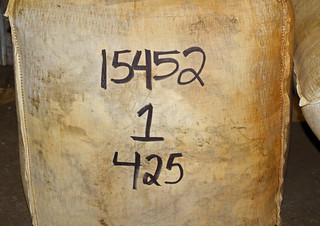 |
| Choice (fine) | 48 | |
| Medium white face | 9793 | |
| Non-white face | 300 | |
| Coarse | 5013 | |
| Short | 14489 | |
| Total | 29643 |
Special thanks is extended to the 30 volunteers who assisted with this year's pool. Volunteers are what makes the pool successful and profitable.
Emily Chamelin is the wool pool manager. Contact her at aeriedairy@yahoo.com. if you have any questions or suggestions for the wool pool. The pool is sponsored by the Maryland Sheep Breeders Association.
Monday, May 4, 2015
Multi-State Skillathon Winners
Youth from several states took home awards from the Junior Sheep & Goat Skillathon held recently at the Maryland Sheep & Wool Festival.
The first place senior was Matt Ferrari from Virginia. Maggie Goodmuth from Howard County was second. Charlie Sasscer from St. Mary's County was 3rd. The first place senior team was the Montgomery-Howard team, composed of Maggie Goodmuth, Lauren Dallas, and Jennifer Brigantae. The second place team was a team from Virginia.
The first place intermediate was Hannah King from North Carolina. Kallam Latham from Frederick County placed second. Madison Shaw from Pennsyvlania was 3rd. The first place intermediate team was the Virginia team composed of Ryleian Travers, Hayley Seabright, Cyle Dehaven, and Chet Boden. Frederick County had the second place intermediate team.
The first place junior was Jessica Martin from Frederick County. Jordan Kelly from Virginia placed 2nd and Marlie Snyder from Washington County placed 3rd. The first place junior team was the Frederick County team, composed of Jessica Martin, Kiandra Strickhouser, and Caroline Clark. Calvert/St. Mary's County had the second place junior team.
Special awards were given to the junior, intermediate, and senior individuals with the top scores in the stations pertaining to fiber. The junior individual with the top fiber score was Jordan Kelly. The intermediate with the top fiber score was Hannah King. Madison Shaw was a close second. The senior individual with the top fiber score was Jennifer Brigantae from Howard County. In close competition were Ian Sanville from Frederick County and Sabrina Dobbins from St. Mary's County.
The Maryland Sheep Breeders Association provided ribbons and premiums to the top 10 individuals in each age group. They provided Festival t-shirts to members of the three top-placing teams in each age division. The University of Maryland Small Ruminant Extension Program provided plaques to the top individuals.
This year's Sheep & Goat Skillathon included the following stations: sheep breed ID, goat breed ID, hay judging, meat ID, feed ID, equipment ID, fleece judging, fiber ID, keep-cull, and a written test.
The Junior Sheep & Goat Skillathon is held every year on the Sunday of the Festival. The Maryland Sheep & Wool Festival is always held the first full weekend of May.
The first place senior was Matt Ferrari from Virginia. Maggie Goodmuth from Howard County was second. Charlie Sasscer from St. Mary's County was 3rd. The first place senior team was the Montgomery-Howard team, composed of Maggie Goodmuth, Lauren Dallas, and Jennifer Brigantae. The second place team was a team from Virginia.
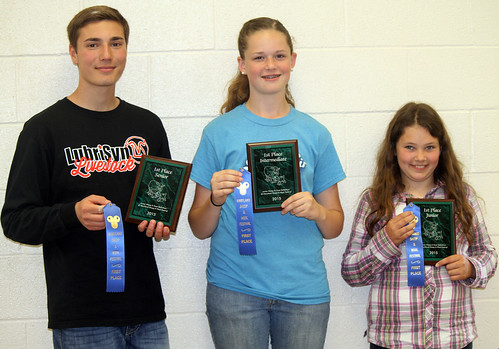 |
| Top individuals (L-R): Matt Ferrari, Hannah King, and Jessica Martin |
The first place junior was Jessica Martin from Frederick County. Jordan Kelly from Virginia placed 2nd and Marlie Snyder from Washington County placed 3rd. The first place junior team was the Frederick County team, composed of Jessica Martin, Kiandra Strickhouser, and Caroline Clark. Calvert/St. Mary's County had the second place junior team.
Special awards were given to the junior, intermediate, and senior individuals with the top scores in the stations pertaining to fiber. The junior individual with the top fiber score was Jordan Kelly. The intermediate with the top fiber score was Hannah King. Madison Shaw was a close second. The senior individual with the top fiber score was Jennifer Brigantae from Howard County. In close competition were Ian Sanville from Frederick County and Sabrina Dobbins from St. Mary's County.
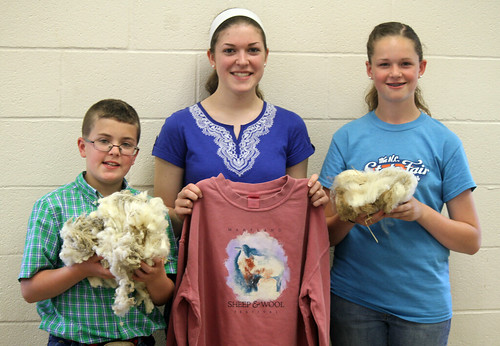 |
| Fiber winners (L-R): Jordan Kelly, Jennifer Brigantae, and Hannah King |
This year's Sheep & Goat Skillathon included the following stations: sheep breed ID, goat breed ID, hay judging, meat ID, feed ID, equipment ID, fleece judging, fiber ID, keep-cull, and a written test.
The Junior Sheep & Goat Skillathon is held every year on the Sunday of the Festival. The Maryland Sheep & Wool Festival is always held the first full weekend of May.
Subscribe to:
Posts (Atom)