Showing posts with label environment. Show all posts

Monday, November 12, 2012

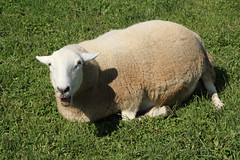
Reducing methane production from sheep

The same digestive system that allows ruminant livestock to convert unusable plant material into nutritious food and fiber also produces methane, a greenhouse gas.

Methane is a by-product of rumination.
Research in Australia has shown that methane production in sheep is heritable, at a level of 0.15 or 15 percent. The Australians plan to develop breeding values for methane production as a way of genetically identifying animals that are better at using energy from feed.

There are two potential benefits to reducing methane production in sheep. Sheep that utilize feed more efficiently will require less feed, which reduces production costs. Animals that use their feed more efficiently are likely to produce less methane per unit of wool or meat, which would help a country achieve its carbon emissions targets.

Another way to reduce methane production in livestock is to add some anti-methanogenic compound (e.g. condensed tannins) to the daily ration, but this may not be practical where livestock are grazed under extensive conditions.

Read article from Stock & Land
Friday, March 2, 2012

International Goat Conference

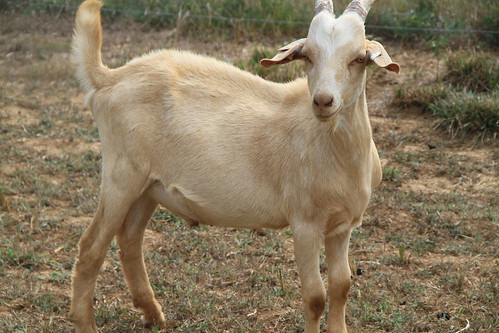
The 2012 International Conference on Goats will be held September 23-27 in the Canary Islands. While part of Spain, the Canary Islands are situated off the North-Coast of mainland Africa (Morocco).

There are 330,000 goats dispersed among the seven islands that comprise the Canary Islands. By way of comparison, there are only 360,000 dairy goats in the United States.

Ninety-nine percent of the goats are dairy goats, of which there are four recognized breeds. The goats are milked once per day. Almost all of the milk is used to make traditional cheese that is consumed mainly in the islands. 

The International Conference on Goats is held every 4 years in a different part of the world. The conference brings together scientists, farmers, and other stakeholders who are involved in goat farming and sustainable development. The International Goat Association is one of the sponsors.

http://www.icg2012.org/

Thursday, December 8, 2011

2012 VA-NC Shepherds' Symposium

The annual Virginia-North Carolina Shepherds' Symposium will be held January 6-7, 2012, at the Alphin-Stuart Livestock Arena on the campus of Virginia Tech in Blacksburg, Virginia.

Program topics include:  Sheep parasite management: past, present, and future; On farm application of FAMACHA for parasite control; Experiences with direct marketing lamb  and wool;  Management and feeding tips for the ewe flock; improving carcass merit in sheep; and Experiences with using CIDRs to induce fall lambing.

Full registration is $25 and includes lunch, breaks, and materials. Youth registration is only $10.  The deadline for pre-registration is January 2.

Download program brochure

Friday, May 27, 2011

Targeted goat grazing demonstration

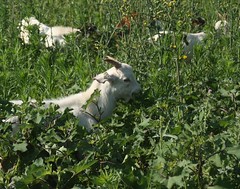
Join  Adkins Arboretum for Goats vs. Weeds: a targeted grazing demonstration Thursday, June 2 from 10 a.m. til noon or Saturday, June 4 from 2 to 4 p.m. to learn how targeted grazing with goats can be a cost-effective and environmentally friendly method of controlling invasive plants.

Participants will see goats in action and learn how to implement this practice on their own land.  Presenters will include Nevin Dawson, Forest Stewardship Educator, University of Maryland Extension; Dr. Sylvan Kaufman, Sylvan Green Earth Consulting; and Brian Knox, Supervising Forester for Eco-Goats.

 The program fee is $15 for members, $20 for the general public per session. Register online at www.adkinsarboretum.org or call 410-634-2847, ext. 0. Light refreshments will be served, including goat cheese.

Through a grant from Shared Earth Foundation, the Arboretum is partnering with University of Maryland Eastern Shore and University of Maryland Agricultural Extension in a three-year program to test the effect of grazing in eradicating aggressive invasive species in targeted areas of the Arboretum’s meadows.

News release

Thursday, October 7, 2010

Bricks made with wool

We’re moving one brick at a time towards a more earth friendly building future, and researchers in Europe have just thrown their latest invention into the equation.

Image link:  Inhabitat
Teams working together at the Schools of Architecture at the University of Seville in Spain and the University of Strathclyde in Glasgow, UK have created a new environmentally-friendly building material that is stronger and uses less energy to make than its conventional counterpart

The new blocks, which are reinforced by wool and seaweed, were developed during a push by the two universities to create more environmentally-kind building materials that would also mechanically improve upon more traditional ones.

"The objective was to produce bricks reinforced with wool and to obtain a composite that was more sustainable, non-toxic, using abundant local materials, and that would mechanically improve the bricks’ strength," Carmen Galán and Carlos Rivera, authors of the study and researchers at the universities said about their invention.

Source:  Inhabitat

Read Science Daily© article

Sunday, October 3, 2010

Targeted grazing webinar

Offering Targeted Grazing Services to Landowners: 
A Primer for Producers

A follow-up to the July 22 webinar:
“Goats and Sheep: A Weapon Against Weeds”

Invasive species cause environmental damages and losses of up to $120 billion per year nationally. Invasive species crowd out native woodland plants and animals, robbing native wildlife species of crucial food and cover sources. Climbing species can also strangle trees and bring down limbs. What can you do to stem the invasion?

Machines often can't get to problem areas, manual removal is very labor intensive, and herbicides can inflict collateral damage water, plant, and animal resources.

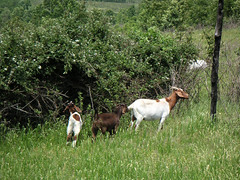
Targeted grazing with goats and sheep can be a cost-effective and environmentally-friendly method of controlling invasive species on your property. Goats and sheep graze in places that mowers can't reach and humans don't want to go, including thickets of both brambles and poison ivy.

Goats eat a wide range of unwanted vegetation, which on the East Cost includes kudzu, Oriental bittersweet, Tree of Heaven, multiflora rose, Japanese honeysuckle, mile-a-minute, and more. Sheep prefer grasses and forbs. Livestock will graze all day, going through very dense material at about a quarter acre per day per 30 animals. They respect electric fences, making this an easy and effective source of mobile containment.

Interest in this control method is building quickly, but there are very few service targeted grazing service providers available to landowners.  This webinar will pick up where the July 22 webinar left off and speak directly to goat and sheep producers who are interested in offering targeted grazing services to landowners.

The webinar is free and will be held on October 7 at noon, eastern time. Contact Carol Taylor to register (carolt@umd.edu or 410-827-8056, ext. 135). Note that registration is limited to the first 100 respondents. A recording will be available at www.naturalresources.umd.edu soon after the live presentation.

Presenters will include Brian Knox, President of Sustainable Resource Management, Inc. and supervising forester for Eco-Goats; and Dr. Nelson Escobar, Small Ruminant Production and Management Specialist with University of Maryland Extension.

Monday, August 23, 2010

Two upcoming events in New York

The 2010 New York State Caprine Outing will be held September 17-19 at the 4-H Camp Owahta in Solon, New York (~12 miles from Cortland). 

The 3-day goat workshop is held every two years.  It includes a variety of presentations and hands-on options.  For more information, visit the Cornell 4-H goat web site and click on Caprine Outing.

The 2010 Cornell Sheep & Goat Symposium will be held Saturday, October 23 at Morrison Hall on the campus of Cornell University in Ithaca, New York.  Simultaneous programs will be held for novice and experienced producers.

There will also be presentations on alternative sheep and goat management and an optional tour of the Cornell sheep farm. For more information, visit the Cornell Sheep web page and click on 2010 Symposium.

Monday, August 9, 2010

Annual Goat Field Day & Sale

The 3rd Annual Western Maryland Goat Field Day and Sale will be held Saturday, October 2, 2010, 9 a .m. to 2 p.m. at the Washington County Agricultural Education Center near Boonsboro, Maryland.

Bucks from the Western Maryland Pasture-Based Meat Goat Performance Test that meet Gold, Silver, and Bronze standards for growth, parasite resistance, and parasite resilience, and minimum standards for reproductive and structural soundness will be offered for sale via public auction. The sale will also include an invitational doe sale.

Top-performing buck (Kiko) as of July 29

All of the goats will be sold via silent auction. The bidding period will be from 10 a.m. to 2 p.m. The field day will be held from 9 a.m. to 12 noon. Dr. Paul Kuber, a research animal scientist from The Ohio State University, will be the featured speaker. Dr. Kuber will demonstrate cuts from a goat carcass, talk about potential grading standards, and prepare products for tasting.

Running concurrent to the field day will be a skillathon for youth ages 8 to 18. In the skillathon, youth will be tested on their knowledge of meat, dairy, and fiber goats. Pre-registration for the skillathon is requested by September 24.

For additional information about the goat sale, field day, or skillathon, contact Susan Schoenian at (301) 432-2767 ext. 343 or sschoen@umd.edu or visit the web site at http://mdgoattest.blogspot.com.

Thursday, August 5, 2010

More targeted grazing webinars

As a follow-up to the targeted grazing webinar held on July 19, a series of sequel webinars is being planned. The first one will be targeted towards sheep and goat producers. It will be held on October 7 at 12 noon.

Image by Brian Knox
The webinar will provide information on starting a targeted grazing enterprise.  More details will be provided as the date approaches. A second webinar will likely focus on landowners who are interested in leasing goats and/or sheep for targeted grazing. 

A recording of the July 19 webinar is available for viewing at http://www.naturalresources.umd.edu/ResourcesWebinars.html. For those who do not have high-speed internet access, a CD-ROM version of the webinar is available for loan.

For more information about the Targeted Grazing Webinars, contact Nevin Dawson, Forest Stewardship Educator at (410) 827-8056 x125 or ndawson@umd.edu.

Thursday, July 15, 2010

Targeted Grazing Webinar

There will be a Targeted Grazing Webinar on Thursday, July 22nd at 12 noon.  To register, contact Carol Taylor at carolt@umd.edu or (410) 827-8056 ext. 135.  A webinar is a seminar that is presented through the world wide web.

If you are unable to attend the webinar, you may view a recording of it at www.naturalresources.umd.edu.  The recording will be posted to the web soon after the live presentation.

Targeted grazing with goats and sheep can be a cost-effective, environmentally-friendly method of controlling invasive weeds on your property.

Instructors for the webinar include Nevin Dawson, Forest Stewardship Educator; Susan Schoenian, Sheep & Goat Extension Specialist; and Brian Knox, Supervising Forester for Eco-Goats.

The American Sheep Industry Association (ASI) has an online educational module on targeted grazing. A handbook on targeted grazing can also be downloaded from ASI's web site.

Sunday, July 1, 2007

Targeted Grazing Handbook

As targeted grazing has gained a foothold in the land management arena, both research and experience have evolved to provide land managers and grazing-service providers with more definitive tools for managing vegetation.

goat grazingThe Targeted Grazing Handbook represents a compilation of the latest research on harnessing livestock to graze targeted vegetation in ways that improve the function and appearance of a wide variety of landscapes.

The handbook is available for $25 and includes the material in both printed form and on a CD. Copies can be ordered by calling the American Sheep Industry Association at (303) 771-3500, ext. 32 or by email at info@sheepusa.org.

Download PDF version
Targeted Grazing Order Form
Targeted Grazing Brochure