Showing posts with label dairy. Show all posts

Tuesday, February 14, 2017

Upcoming Webinar: Dairy Sheep

"Is Sheep Milk Production in Your Future" is the title of an upcoming webinar on March 14, 2017, at 8 p.m. EST. The presenter is Dr. Dave Thomas, Professor of Sheep Management and Genetics from the University of Wisconsin (retired). The host is Jay Parsons from Optimal Ag. The sponsor is ASI's Let's Grow Program.

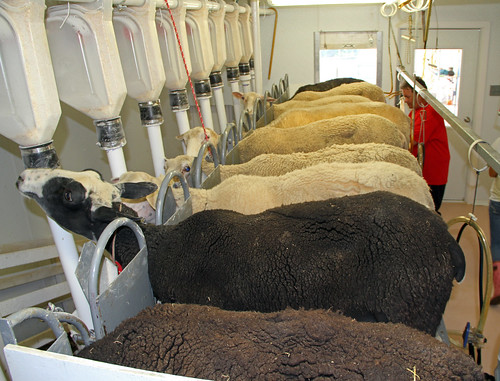
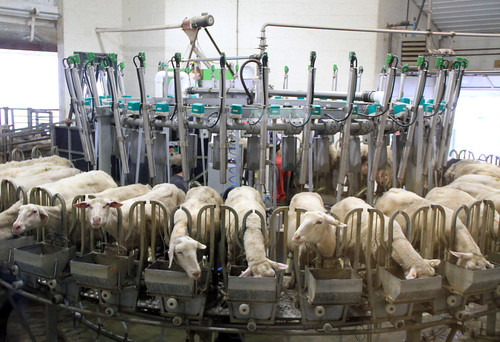
Milking sheep in Maryland
The U.S. is the leading importing of sheep milk cheeses in the world with over half of all world trade in sheep milk cheeses coming to the U.S. Some common imported 100% sheep milk cheeses are Manchego from Spain, Pecorino-Romano from Italy, and Roquefort from France.

Therefore, it would seem that there is ample opportunity for the development of a dairy sheep industry in the U.S. for the production of domestic cheeses to compete with this large influx of imported sheep milk cheeses.

However, nothing is ever as simple as it looks. This webinar will discuss the things that are necessary to produce sheep milk efficiently .

To register for the webinar, go to https://attendee.gotowebinar.com/register/2962937926909717505.

Thursday, November 12, 2015

Dairy Goat Ration Evaluator

The Maryland Dairy Goat Ration Evaluator allows you to evaluate rations for dairy goats. The Excel spreadsheet determines if a dairy goat's requirements for energy (TDN), protein (CP), calcium (Ca), and phosphorus (P) are being met based on the amount and nutritional composition of feeds being fed.


The spreadsheet utilizes the latest nutritional requirements for dairy goats from the National Research Council (NRC, 2007).  Rations for dry, pregnant, and lactating does can be evaluated. There are separate requirements for does being parlor-milked. Rations can also be evaluated for doe, wether, and buck kids and mature bucks. The current spreadsheet utilizes pounds for measurements. A spreadsheet using metric measurements is in the works.

Download spreadsheets from Maryland Small Ruminant Page

Wednesday, September 23, 2015

North American Dairy Sheep Symposium

The 21st Annual Dairy Sheep Association of North America (DSANA) Symposium will be held in Madison, Wisconsin on November 5-7, 2015 with a pre-symposium sheep milk cheese-making course on November 4, 2015. Important deadlines are fast approaching: October 3 for reduced rates on hotel reservations and October 16 for early symposium registration at a reduced rate.

Dairy sheep farm in Maryland
Twelve presentations by 16 animal scientists, dairy sheep producers, veterinarians, and sheep milk cheese makers and marketers will be held on November 5-6 at the Pyle Center on the University of Wisconsin-Madison campus. Tour buses on Saturday, November 7 will take participants to Cedar Grove Cheese in Plain, Wisconsin operated by Master Cheesemaker, Bob Wills, and to Hidden Springs Creamery in Westby, Wisconsin where participants will visit the modern dairy sheep farm and artisan cheese plant operated by Dean and Brenda Jensen.

The pre-symposium sheep milk cheesemaking course will be offered on November 4 at the Center for Dairy Research on the UW-Madison campus for symposium participants and DSANA members for an extra fee.

The complete program and registration and hotel information can be accessed at the DSANA web site (www.dsana.org) or the University of Wisconsin-Madison Sheep and Goat Extension web site (http://fyi.uwex.edu/wisheepandgoat/) or by contacting Bill Halligan, DSANA Treasurer, P.O. Box 96, Bushnell, NE 69128 (308-235-5900, bill.halligan@hotmail.com) or Dave Thomas, UW-Madison, 1675 Observatory Dr., Madison, WI 53706 (608-263-4306, dlthomas@wisc.edu). 

Download program brochure

Tuesday, April 2, 2013

Awassi genetics now available in U.S.

Awassi genetics are now available in the U.S. and for possible export to Canada.  Paolo Losecco, a business man from Illinois, imported Awassi genetics from a breeder in New South Wales, Australia, and partnered with Larry Meisegeier of River Ridge Stock Farm in Bruce, Wisconsin, to produce and make these genetics available.

Awassi lambs
In the fall of 2012, 8 ewes were implanted with Awassi embryos and 52 ewes were artificially inseminated with Awassi semen. Lambs were born in March with more to be born in April. The first offering of F1 Awassi infused ram lambs will be made in June 2013.

The Awassi breed originated in the arid desert regions of the Middle East. It is an extremely hardy breed that is used for milk, meat, and wool production. The improved Awassi is one of the highest milk-producing sheep in the world.

For the North American dairy sheep industry, the Awassi offers some much needed “new blood” in a very small gene pool.  For the U.S. commercial sheep industry, the Awassi offers the fat tail characteristics for those producers wanting to take advantage of certain ethnic markets.

For more information, please contact Larry Meisegeier at rrsf@brucetel.net or (715) 563-2391.

Wednesday, January 30, 2013

Production traits of dairy goats

Researchers analyzed records from six pure breeds of dairy goats to determine genetic parameters and changes over time in various production and reproductive traits. Three kidding periods were examined:  1976-1984, 1985-1994, and 1995-2005.

Saanens  had the highest milk yield.
Saanens had the highest milk (2339-2496 lbs.) and protein yields. Nubians had the highest fat yields and lowest milk yields (1740-1872 lbs). Oberhaslis had the lowest fat and protein yields. Alpines showed the largest increase in milk yield over time (7.4%).

Sannens were the oldest at first kidding (509-589 d). Toggenburgs and LaManchas were usually the youngest (435-545 d). Kidding intervals were usually shorter for Oberhaslis, LaManchas, and Nubians (350-377 d) than for Toggenburgs, Alpines, and Saanens (373-387 d).

Heritability estimates across breeds were determined.


The researchers concluded that genetic selection within breed is feasible for production and reproduction traits of U.S. dairy goats.

Source:  Journal of Dairy Science, 2012.  Read full article.

Thursday, December 13, 2012

Raw Milk: Fact from Fiction

As interest in unpasteurized, or "raw" milk increases, a  new Purdue University Extension publication helps separate fact from fiction over the safety of raw milk consumption.

"Raw Milk FAQs," Extension pubication AS612-W, is available for free download from http://www.extension.purdue.edu/extmedia/AS/AS-612-W.pdf. The seven-page publication was written by Extension Dairy Specialist Mike Schultz and Extension Educator Mike Ferree.

Schultz said the publication is intended to add to the public dialogue as lawmakers consider whether to regulate raw milk, what a regulatory system should look like, and how best to protect both consumer choice and public health.

"This publication provides the scientific facts behind milk pasteurization, its benefits, and issues related to consuming raw milk," Schultz said.

Raw Milk FAQs

Source:  Feedstuffs, 12.03.12

Monday, October 22, 2012

Parasite control in dairy sheep

Presentation at the 18th annual Symposium of the Dairy Sheep Association of North America, held October 18-20, 2012, in Sterling, Virginia.


Sunday, October 21, 2012

Dairy Sheep Association holds annual symposium

The Dairy Sheep Association of North America (DSANA) held its 18th annual symposium recently in Sterling, Virginia. The symposium was attended by people from all over the United States, Canada, and Mexico.

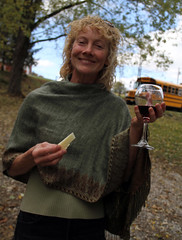
Wine and sheep cheese:
a perfect combination
The symposium included two days of educational presentations and a tour day. Shepherd's Manor Creamery in New Windsor, Maryland, hosted one of the tour groups. The other tour group visited Everona Dairy in Rapidan, Virginia.

The dairy sheep industry in North America is not very large, but there is potential for growth, as most sheep cheeses are imported from Europe. Sheep dairying lends itself well to farmstead cheese production and direct marketing at farmers' markets, wineries, gourmet food stores, and white table cloth restaurants. Ewe's milk is superior, yielding more cheese than either cow or goat's milk. The milk can also be made into soap or other dairy products, such as yogurt.

East Friesian ewe lambs
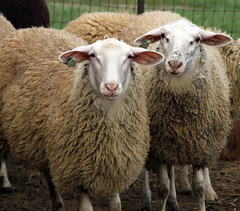
There are two breeds of dairy sheep in the United States:  East Friesian and Lacaune. Most sheep dairies milk ewes of these breeds or crosses. Milking of ewes begins when lambs are removed at one day of age or after being allowed to nurse their dam for 4 weeks. Sheep do not produce as much milk as goats or cows, but the milk is superior and lamb sales contribute more to the income of the dairy enterprise. 

Visit the web site of the DSANA

Monday, October 1, 2012

18th Annual Dairy Sheep Symposium

The 18th Annual Dairy Sheep Association of North America (NADSA) Symposium will be held during the three full days of  Oct. 18-20, 2012 at the Holiday Inn Dulles International Airport! Dulles, Virginia, in the Washington DC area.

The symposium will include presentations by dairy sheep producers, sheep milk processors, University scientists, and industry service personnel on Oct. 18-19, followed by  a bus tour on Saturday, Oct. 20 of dairy sheep farms in Maryland and Virginia, both with farmstead cheese operations.

Program and registration information is available on the Dairy Sheep Association of North America's web site at www.dsana.org. For additional information, contact Laurel Keiffer, NADSA president at (715) 695-3617 or kcf.laurel@tcc.coop.

The symposium will offer an excellent opportunity For established dairy sheep producers And sheep milk producers to gather information to improve operations, while also offering potential new producers and processors the opportunity to network with people active in the industry.

Download program flyer

Tuesday, April 17, 2012

Virginia to host Dairy Sheep Conference

The 18th Annual DSANA Sheep Symposium (formerly called Great Lakes Dairy Sheep Symposium) will be held October 18-20, 2012, at the Holiday Inn Washington Dulles in Dulles, Virginia.

The DSANA Dairy Sheep Symposium is the major annual event of the dairy sheep industry in North America. For 18 years, this event has attracted dairy sheep producers from Canada, Mexico and throughout the United States. As a small but growing industry, the symposium provides critical connections among producers.

The first day includes talks directed towards beginning producers. The second day features presentations by innovative producers and top scientists from North America and Europe to bring the latest information on dairy sheep production and sheep milk processing to our domestic industry. The final day will include a tour to two local dairy sheep producers and processing plants that manufacture sheep milk cheeses.

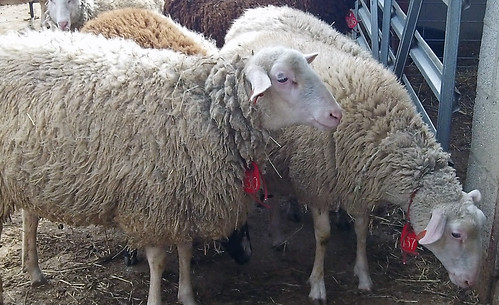
Dairy ewes from Maryland's first sheep dairy
Shepherd's Manor Creamery

The DSANA Dairy Sheep Symposium provides an educational environment and fosters connections among dairy sheep producers, processor and researchers.

DSANA Conference Proceedings

Thursday, September 29, 2011

Linear appraisal workshop

The Maryland Dairy Goat Association is sponsoring a Linear Appraisal workshop. It will be held at the Howard County Fairgrounds in West Friendship, Maryland, on Saturday, November 12.

The American Dairy Goat Association's Linear Appraisal program is a performance program designed to help breeders evaluate their individual animals based on type traits that affect the structural and functional durability of their animals.

Even if breeders have no plans to have a Linear Appraisal performed by the ADGA, a great deal can be learned from this seminar. It will help breeders choose which animals to cull and how to evaluate their own animals.

Sign-in time is 8:30 AM with the workhop taught by Betty Henning beginning at 9 AM. There will be a pot luck lunch.  Please bring a main dish and a salad or dessert.  Kitchen facilities are available.

Registration is $40 per person or $60 for two people from the same family.  Youth ages 14 and under are free if accompanied by a paying adult.  Fees are not refundable. Make checks out to: MDGA and mail them to: Pat Adels, 4878 Paynes Ford Rd., Kearneysville, WV 25430.
 
If you have any questions about the event, please contact Don Marston, workshop coordinator at dbmarstonjr@aol.com.

Saturday, August 13, 2011

Dairy conference cancelled

For a variety of reasons, the Small Ruminant Dairy Conference originally scheduled for Saturday, October 8, 2011, at the Carroll County Ag Center (in Westminster, MD) has been cancelled.  The conference will be re-planned for a date in the future.

If you are interested in small ruminant dairying, please contact Susan Schoenian at (301) 432-2767 x343 or sschoen@umd.edu to suggest topics (or ideas) for a conference.  The original plan was to include topics of interest to people interested in commercially dairying as well as people who raise dairy sheep and/or goats for a hobby or as a 4-H project.

The small ruminant dairy conference was previously announced in this blog and in Wild & Woolly, the Maryland Sheep & Goat Producer quarterly newsletter.

There is a growing interest in raising sheep and goats for dairy purposes.  There are several commercial goat dairies in Maryland.  Maryland also has its first sheep dairy.

Sunday, May 1, 2011

Tour of sheep dairy

Forty-six people boarded a bus in Taneytown, Maryland, on April 27, 2011, en route to Valley Shepherd Creamery in Long Valley, New Jersey. Valley Shepherd milks approximately 600 ewes and has the only carousel (rotating) milking parlor (for sheep) in the United States.

Click to view video at Flickr

Valley Shepherd makes a variety of delicious cheeses and other products from sheep, goat, and cow milk. Their farm is located only 40 miles from New York City, where they market much of their product via farmer's markets and other retail establishments. Product may also be purchased online.

Valley Shepherd Creamery is open to the public for tours. Their Sheep Shoppe merchandises their dairy products and many other unique items pertaining to sheep. The farm hosts an annual Shearing Festival.

Valley Shepherd Creamery

Special thanks is extended to Teresa Ridinger for organizing the tour of Valley Shepherd Creamery.

Thursday, April 7, 2011

Tour of dairy sheep farm

A tour of Valley Shepherd Creamery in Long Valley, New Jersey, is being conducted on Wednesday, April 27, 2011.  Valley Shepherd Creamery is a working creamery with 600 head of dairy sheep. They are the only sheep dairy in the U.S. to utilize a rotary platform for milking.

The tour bus will board at Harney Fire Station in Harney, Maryland, at 9:30 to 9:45 a.m.  The bus will return to Harney at 10:30 to 11 p.m.

The cost of the trip is $55.  Checks should be mailed to Teresa Ridinger at 5107 Piney Creek Road, Taneytown, MD  21787-1237.  Please call Teresa at (410) 756-6198 to convey your interest in the trip.

Download program flyer

Tuesday, December 28, 2010

Goats milk more with festive music

A farmer has discovered that by repeatedly playing Mariah Carey's festive favorite "All I Want For Christmas Is You" to his dairy goat herd, he can increase milk production by 20 per cent.

Angus, 57, who runs St Helen’s Farm in Seaton Ross, near York (UK), said: “We are absolutely dumbfounded by the difference playing this song has made to the goats."

“Our milk maids started listening to the radio when they were milking them. They immediately noticed the animals were more relaxed and started producing more milk as a result."

“When one of the girls brought in a CD of Christmas classics they seemed to perk up when the Mariah Carey song came on. It’s really upbeat and they seem to love it."

“I think the staff here are sick of it now but unfortunately it works for the goats.”

St Helen’s Farm milks 2,000 goats. Each produces about three liters a day -- or three and a half liters if Mariah is playing.

Read full article at Express.co.uk

Thanks to Shannon Uzelac for suggesting this blog entry.

Friday, May 21, 2010

Great Lakes Dairy Sheep Symposium

The 16th Annual Great Lakes Dairy Sheep Symposium will be held during the three full days of November 11-13, 2010, at the Ramada Convention Center in Eau Claire, Wisconsin. 

The symposium will include presentations by dairy sheep producers,  sheep milk processors, university scientists, and industry service personnel.  There will be a bus tour of a sheep dairy farm, a sheep milk farmstead cheese operation, and the Spooner Agricultural Research Station on Saturday, November 13.  The Spooner Station, operated by the University of Wisconsin-Madision, has the only dairy sheep research farm in North America.

The final program and registration information will be available on the Dairy Sheep Association of North America's  web site at http://www.dsana.org/ by the end of July.  For additional information, contact Claire  Mikolayunas at (608) 332-2889 or mikolayunas@wisc.edu.

Tuesday, October 27, 2009

Goat recipes

Getting your goat: the gourmet guideGoats have been a major source of food since time immemorial. Goat meat can be stewed, curried, baked, grilled, barbecued, minced, canned, or made into sausage.

Goat milk and the cheese made from it has remained popular throughout history and still is consumed on a more extensive basis worldwide than cow’s milk.

Getting Your Goat: The Gourmet Guide is the name of a new cook book that contains goat meat and cheese recipes from all over the world. It is written by Patricia Moore and Jill Charlotte Stanford and published by Evertype. The book is available from Amazon.com.

Wednesday, February 11, 2009

Raw milk controversy continues

Controversy over the legality of selling raw (unpasteurized) milk and dairy products and the alleged health benefits of these foods continues.

In a new peer-reviewed scientific publication, Ohio State University food safety expert Jeff LeJeune evaluated the dangers of drinking raw milk and argued that, contrary to claims from advocates, there is no scientific evidence supporting the notion that raw milk cures or prevents disease.

Raw milk advocates claim that pasteurization robs milk of nutrients that can prevent and treat a wide spectrum of diseases, including heart disease, kidney disease, cancer, and lactose intolerence. However, in this article, LeJeune presented scientific data that refute such a claim.

The sale of raw milk is illegal in 22 states.

Source: Feedstuffs. January 26, 2009.

Wednesday, November 12, 2008

Dairy goats in China

There are more dairy goats in Fuping County than any county in the world: 320,000 compared to only 310,000 in the entire United States. Fuping County is in North Central China.

The average dairy goat farmer in China has fewer than 10 does. The government is encouraging larger dairy goat farms, based on several organizational models. Almost all of the dairy goats are Saanen.
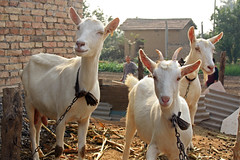
Saanen goats in ChinaSmall farmers keep their goats near the homestead. On large farms, the goats are kept in confinement: brick buildings with concrete or brick floors. The goats are fed in fence line feeders and have an outside loafing area. On the large farms, corn silage or green chop is fed, along with some hay and grain. Small farmers feed mostly the corn plant; grain, if they can afford it.

Most of the goats, regardless of farm size, are milked by hand. The milk is collected into a bucket, strained into another container, then cooled in a vat of cold water. It is transported to the processing plant in containers. Most of the milk is made into powdered milk.

Within five years, most of the goats will probably be machine milked at milking stations, set up in the villages. The authorities believe that machine milking will improve the quality and safety of the milk.

Read full article: "Dairy Goat Production in China"

Thursday, March 20, 2008

Small Ruminant Dairy Project

The University of Vermont Center for Sustainable Agriculture has developed a Small Ruminant Dairy Project. In collaboration with the UVM Department of Animal Sciences, the Center provides assistance to sheep and goat dairy farmers, many of whom are producing farmstead cheeses and premium products for which demand is growing.

Sheep dairy at the University of Wisconsin Spooner Research StationCarol Delaney coordinates the program, including on-farm research projects, farm visits, and consultations, publications, and technical workshops aimed at production, marketing, and financial management. The project publishes a quarterly newsletter which is available online.

For more information about the UVM Small Ruminant Dairy Project, please contact Carol Delaney at (802) 656-0915; UVM Center for Sustainable Agriculture, 63 Carrigan Drive, Burlington, VT 05405; or Carol.Delaney@uvm.edu.

The market for goat and sheep dairy products is expanding, but the small ruminant dairy industry is still in its infancy and its sustainable growth depends on reliable technical assistance in production, processing, and marketing.

Small Ruminant Dairy Project Quarterly Newsletters
Small Ruminant Dairy Project Calendar