Showing posts with label marketing. Show all posts

Thursday, October 20, 2016

Lambulator Cut-Yield Calculator

The LAMBULATOR is a Cut-Yield Calculator for the Lamb Direct Marketer. It has been designed with the small direct marketer in mind. It is easy to understand and use, even if you have no experience with Microsoft Excel. Just plug in your cut weights and prices and let it do the calculating for you.

In an instant, it will calculate carcass yield percentages, individual and average net profit per lamb, and your overall gross and net profit. It will even allow you to try different pricing scenarios should your production or marketing costs increase. The Lambulator was developed by Dave Scott, a livestock specialist with NCAT-ATTRA. It is a free download.

https://attra.ncat.org/attra-pub/summaries/summary.php?pub=548

Wednesday, June 29, 2016

Hair Lambs Sell at Discount to Wool Lambs

Texas A&M University compared the prices of wool lambs, primarily Rambouillet, with the prices of hair lambs, primarily Dorper, sold at Producers Livestock Auction Company in San Angelo Texas, the largest live sheep market in the US. The data set included 286,764 lambs sold in 25,916 lots from 2010 to 2014.

The results indicated an overall discount of $3.42 ± $0.33 per hundredweight (cwt) for hair lambs. The largest discount was in 2011 ($30.74 ± $0.41 per cwt). The discount relative to wool lambs increased as lamb weight increased.

In 2012, the price for hair lambs was $9.62 ± $0.62 per cwt higher for hair lambs. Hair lambs sold for $3.18 ± $0.83 per cwt more than wool lambs in the 40-50 lb. weight class, whereas wool lambs sold for $9.09 ± $0.68 per cwt more than hair lambs in the 90-100 lb. weight class.

Prices increased as lot size increased. Wool lambs sold for a larger premium in the larger lot sizes. Wool lambs sold for $8.59 ± $0.39 per cwt more than hair lambs when there were 35 or more lambs in the lot.The difference in price between hair lambs and wool lambs varied across years, months, weight class, and lot size.

Source:  Sheep & Goat Research Journal.  Read full article.

Friday, June 19, 2015

A Successful Maryland Wool Pool

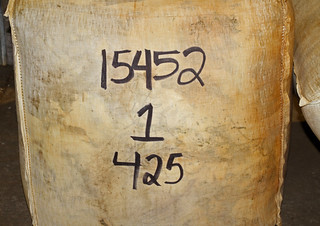
The Maryland Wool Pool sold 29,643 lbs. of wool, brought to the pool by 58 consignors. The pool shipped 78 bales that weighed an average of 390 lbs. Last year's pool packed 29034 lbs. of wool into 112 bales.

Grade Pounds
Choice (fine) 48
Medium white face 9793
Non-white face 300
Coarse 5013
Short 14489
Total 29643

Special thanks is extended to the 30 volunteers who assisted with this year's pool. Volunteers are what  makes the pool successful and profitable.

Emily Chamelin is the wool pool manager. Contact her at aeriedairy@yahoo.com. if you have any questions or suggestions for the wool pool. The pool is sponsored by the Maryland Sheep Breeders Association.

Friday, March 20, 2015

Increased Demand at Easter

The demand for kid (goat) and especially lamb increases prior to the Easter holidays. Easter is a Christian feast commemorating the Resurrection of Jesus after his crucifixion.

Hothouse lamb in NYC
Western Christian churches and Eastern Orthodox Christian churches use different calendars (Gregorian vs. Julian) to determine the date of Easter. Sometimes, the two Easters fall on the same day. Sometimes, they are more than a month apart.  This year, Roman (Western) Easter and Greek (Eastern Orthodox) Easter are only one week apart. Roman Easter is on April 5, while Greek Easter is on April 12.

The demand for kid and lamb is usually stronger for Eastern Orthodox Easter. Eastern Orthodox Christians come from a variety of ethnic backgrounds: Greek, Russian, Egyptian, Romanian, Serbian, Ukrainian, Armenian, Bulgarian, Georgian, Albanian, Ethiopian, Syrian, and American.

The type of lamb or kid preferred for the Easter holiday is usually a "hothouse" lamb or kid.  Hothouse lambs are young, milk-fed lambs weighing between 30 and 50 lbs (live). Certain breeds are more suitable to be sold as hothouse lambs, including Southdown, Dorset, Dorper, Cheviot, etc. Large frame breeds and hair sheep aren't as suitable for the Easter hothouse market, as they don't have as much fleshing at the light weights at which they'd be sold.

Sunday, February 8, 2015

Follow Markets On Your Smart Phone

You can follow the lamb and wool markets on your smart phone. ASI Market News is produced by the American Sheep Industry Association to help sheep producers stay informed on current market conditions.

The app displays 6 national as well as 7 auction barn reports for locations across the United States. The report data is compiled by the USDA Agricultural Marketing Service. From the front page, users can select to search national reports or auction reports

While the number of eastern markets is limited --  only sale barns that have USDA reporting are being used in the app -- the app includes the New Holland (PA) auction report. New Holland is the largest sheep and goat market in the Eastern US.  Lambs sold at New Holland are usually destined for non-traditional markets.

The app was recently updated to include more Eastern reports and a "breakeven calculator." So far, more than 2050 people have downloaded the app. The app allows producers to make more informed marketing decisions.

ASI Market News is available for both Apple and Android operating systems and can be downloaded from their respective stores.

Apple's App Store
Android Store

Wednesday, September 17, 2014

Sell Lambs for Upcoming Muslim Holiday

Muslim holidays have become increasingly important to the lamb (and goat) market. Typically, the demand for lamb (and goat) increases prior to major Muslim holidays.

Eid al-Adha (or the Festival of Sacrifice) is one of the two most important festivals in the Muslim calendar. Eid al-Adha is not to be confused with the other major festival, Eid al-Fitr, or festival of breaking of the fast, which marks the end of the holy month of Ramadan.

Eid al-Adha marks the occasion when God asked Abraham to sacrifice his son, and at the last minute God replaced his son with a lamb. There is a similar story in the Jewish Torah and Old Testament.

To commemorate the story, Muslims usually sacrifice an animal. Usually, it is a sheep, but it can also be a goat, bull, or camel. The sacrificial animal must meet certain age and quality requirements. An intact male is usually required.

The meat from the sacrifice of Eid al-Adha is mostly given away to others. One-third is eaten by immediate family and relatives, one-third is given away to friends, and one-third is donated to the poor.

Eid al-Adha occurs on the same day of the Islamic calendar, but occurs 11 days earlier each year in the Gregorian calendar. This is because the Islamic calendar is lunar based and the Gregorian calendar is solar based. In 2014, Eid Al-Adha will fall on or around October 4.

Monday, August 18, 2014

Value-Added Products is Theme of Field Day

Value-added products is the theme of the 2014 Virginia State University (VSU) Small Ruminant Field Day, to be held Friday, September 19, 7:30 a.m. to 3 p.m., at VSU's Randolph Farm in Petersburg, Virginia.

Dr. Paul Kuber
Speakers will include Dr. Paul Kuber from Ohio State University. Dr. Kuber will speak about small ruminant production and processing. Patricia Knight, owner of Nana's Dream Farm & Apiary will speak about small ruminant dairy production and processing. Theresa Nartea from Virginia Cooperative Extension will explain practical techniques for strategic marketing for small ruminant  products.

Afternoon activities will include small ruminant meat and dairy sample tastings, demonstrations of various  management practices, and the chance to learn about ongoing research projects  by VSU's Small Ruminant faculty.

The pre-registration deadline is September 12. The registration fee is $10 per person.You can register online at http://tinyurl.com/2014srfieldday. For registration information, contact Mollie Klein at mklein@vsu.edu or (804) 524-5906. For field day particulars, contact Dr. Dahlia O’Brien, VSU Small Ruminant Extension Specialist at dobrien@vsu.edu or (804) 524-6963.

The event is also sponsored locally by Heretick Feed & Seed Company and Southern States Cooperative, both of Petersburg, Virginia.

Tuesday, April 8, 2014

Preparing for Ethnic Holidays

According to a 2010 study funded by the American Sheep Industry Association, ethnic markets comprise a significant and growing portion of the US sheep market. For this reason, producers need to consider the dates of various ethnic holidays (or religious observances) when developing their marketing plans.

Traditionally, the demand for lamb increases at Easter. This year, both (Eastern) Orthodox and Roman (Western) Easter will occur on the same day, April 20.  Often, the Easters occur on different Sundays, as different calendars are used to calculate the dates of the holidays. When targeting the Easter markets, be sure to sell the right kind of lambs (usually milk-fed and “fat”) and place lambs in the market place at least 5-10 days before the holiday.  As an option, you might consider spreading your risks and sending some lambs directly after the holiday.  Prices sometimes are high afterwards as supply is decreased due to the holiday.

Muslim holidays have become increasing important to the US lamb market. There are two major Muslim holidays. Eid ul Fitr or the “Festival of Fast Breaking” follows the holy month of Ramadan, in which Muslims fast from sunrise to sunset and have celebratory meals in the evening. In 2014, this three day holiday will occur on July 29-31. The most important Muslim holiday is Eid ul Adha or the “Festival of the Sacrifice.” In 2014, it will occur October 4-7. This holiday commemorates Abraham’s willingness to sacrifice his son in obedience to God. Instead, he sacrificed a lamb (ram).

Muslim holidays cannot be predicted with exact certainty, since they are based on a lunar calendar and the siting of the moon.  For this same reason, Muslim holidays move forward approximately 11 days each year. The type of lamb demanded by Muslim consumers varies, but is usually an older, unblemished lamb or yearling, usually an intact male. As with any market segment, it’s important to learn what potential customers want and will pay a premium for.

To help US sheep producers evaluate and develop potential markets to ethnic consumers, three University Extension systems have partnered with their respective sheep associations to help address this opportunity.  Maine, Maryland and Ohio received funding from ASI’s Let’s Grow campaign in 2013 for this effort.  A series of webinars on marketing lamb to ethnic consumers was presented in November and December of 2013.  These webinars, each 1-hour in length, were recorded and are available for viewing.

In addition, the tri-state ethnic marketing project has created several tools to help producers make better marketing decisions.  Susan Schoenian Sheep & Goat Specialist for University of Maryland Extension has developed several spreadsheet templates to help producers evaluate marketing options.  Richard Brzozowski, Small Ruminant Specialist for the University of Maine has developed a template for producers to use in learning more about specific ethnic consumers as well as a set of questions for possible use in customer surveys.

For these tools on marketing lamb and mutton to ethnic consumers, go to http://umaine.edu/livestock/sheep/ethnic-marketing-of-lamb-and-mutton/.
For links to the webinar series on marketing lamb and mutton to ethnic consumers, go to http://www.sheepandgoat.com/recordings.html#ethnic.

Tuesday, December 10, 2013

Direct Marketing of Lamb (Survey)

from the American Lamb Board

Do you Direct Market your Lamb?  The American Lamb Industry is attempting to take a closer look at the direct marketing of lamb across the United States.  In an effort to better understand the current trends and assess the needs of this type of marketing, we ask those engaged in direct sales of lamb to complete the following survey.  By combining the survey results, interviews and other research; we hope to formulate materials to assist you in your direct marketing pursuits.

Please click here to complete the survey before January 6, 2014.

Please help us spread the word by forwarding this information to fellow shepherds. If you would prefer; we would be happy to send you a hard copy of the survey. Please call (717) 485-0532 to request a hard copy. Also, provide us with your contact information upon completion of the survey and be entered to win one of three prizes!   

Thank you for taking the time to share your experiences and needs for the betterment of the Industry.

https://www.surveymonkey.com/s/GDKJDT6

Monday, October 21, 2013

In-defense of On-Farm Slaughter

In the United States, there are four levels of meat inspection: federal (USDA), state, custom-exempt, and personal exemption (on-farm slaughter).

Custom-exempt slaughter
Federal is the "highest" level of inspection. The meat from animals slaughtered in a federally-inspected plant can be sold without restrictions, so long as the meat is properly labeled. Though state-inspection must be "at least equal to" federal inspection, the meat from animals slaughtered in a state-inspected facility is usually limited to sales within the state of slaughter.

Only 27 states have state meat inspection programs.  Custom-exempt slaughter is exempt from continuous inspection. The carcasses and meat from animals slaughtered in a custom-exempt plant are stamped "not for resale" and returned to the owner. Federal and state regulations provide a personal exemption. The personal exemption allows a farmer to slaughter an animal (of his own raising).

States interpret USDA's "personal exemption" differently. Most states take a very strict interpretation and consider the owner of the animal to only be the person who actually raised it. In New York, the owner of the animal is considered to be the owner when they purchase it. The state of Vermont recently passed a law that will allow the on-farm slaughter of up to 25 sheep or no more than 3,500 lbs. (live weight) of any combination of livestock.

Because meat inspection laws vary by state and sometimes county, it is essential that farmers/producers know the laws in their state and how they are interpreted.

Read full article at http://www.sheepandgoat.com/articles/onfarmslaughter.html.

Wednesday, October 16, 2013

Webinars on Ethnic Marketing

The University of Maryland, the University of Maine, and Ohio State University are cooperating to hold a series of webinars on the ethnic marketing of lamb and mutton. The webinars are being supported by the American Sheep Industry Associations Let’s Grow with TwoPlus program. The series will also be applicable to goat producers, as the marketing of sheep and goats is similar.

The webinars will be held on consecutive Tuesday evenings (7 p.m. EST) on November 19, November 26, December 3, and December 10. Each webinar will last for approximately 1 hour. An additional 30 minutes will be allowed for questions. Interaction will be via a chat box. Participants will be expected to actively participate through practical home assignments and activities.

Date     Topic
I. Nov 19      Ethnic Market Background
II. Nov 26      Understanding ethnic consumers
III. Dec 3      Understanding and evaluating your marketing options
IV. Dec 10      Developing a marketing plan

Anyone with an internet connect may participate. High speed internet access is suggested. The webinars are free, but pre-registration is required. Participation is limited to 100 log-ins.

The webinars will be hosted by the University of Maryland. Pre-registration will be via the University of Maine at http://umaine.edu/livestock/sheep/ethnic-marketing-of-lamb-and-mutton/.

Webinar recordings

Friday, October 11, 2013

Sheep Industry Roadmap Project

The American Lamb Board hired an outside consulting firm with no prior affiliation with the sheep industry to conduct a candid assessment of the U.S. sheep industry and assist industry leaders in making the changes necessary to secure our long-term future. The study was funded by a grant received from the National Sheep Industry Improvement Center.

A summary and detailed version of The American Sheep Industry Roadmap Project is available on the web site of the American Lamb Board. The American Lamb Board will be hosting three conference calls with The Hale Group, the consulting group leading this study, to discuss the draft report and to obtain feedback on Oct. 15, 16 and 17. All calls will begin at 11 a.m. EDT.

In addition, a survey will be distributed to all sectors to garner more input from the thousands of industry players. If you do not receive the e-mail invitation to participate in the survey but would like to, and/or would like to sign up for a conference call with The Hale Group, contact Megan Wortman at Megan@americanlambboard.org or (866) 327-5262, ext. 2.

Summary Report
Detailed Report

Friday, June 21, 2013

Maryland Wool Prices Below Last Year

The 2013 Maryland Wool Pool was held June 19 at the Maryland State Fairgrounds in Timonium. Prices were below last year. Surprisingly, the coarse wool brought the highest bid.


Wool prices remain significantly above the support price ($0.40 for ungraded wool), so producers are not eligible for LDPs (loan deficiency payments) this year.

A wool classing school was held in conjunction with this year's wool pool. The school attracted participants from multiple states. The instructor was Dr. Ron Pope, manager of the Producers Marketing Cooperative and wool consultant with the American Sheep Industry Association.

Tuesday, May 28, 2013

Lamb Checkoff Increases June 13

The Lamb Checkoff will increase on June 13. The current assessment is 0.05 per lb. of live sheep  sold by producers, seedstock producers, feeders, and exporters plus 0.30 per head for sheep and lambs purchased by first handlers, usually packers, but also some producers and feeders and direct marketers. The new assessment will be 0.07 per lb. of live sheep and lamb plus 0.42 per head.

This is the first rate increase in the program's decade-long history. It will raise an additional $700,000 for program activities. Funds collected under the Lamb Checkoff Program are used for promotion, information, research and advertising of American lamb. Program administration accounts for less than 10 percent of total revenues.

For additional information about the Lamb Checkoff, go to www.lambcheckoff.com.

Source:  ASI Weekly News, May 17, 2013

Monday, April 29, 2013

New Processor for Lamb and Goat

Simply Natural is the name of a new company that will begin processing sheep, lambs, goats, and cattle at an abattoir formerly known as Woodlawn Country Meats in Sharpsburg, Maryland. They anticipate a starting date of mid-May (2013).

Simply Natural plans to sell certified-Halal meat products to consumers, restaurants, and retail establishments in the Washington DC Metropolitan area. Customers will be able to order meat online and have it delivered to their homes or businesses. The company will also provide custom slaughter services and facilitate custom slaughter of sheep and goats during various religious observances.

As such, Simply Natural is interested in purchasing naturally-raised sheep, lambs, goats, and cattle from local producers. In the future, the company also hopes to purchase and process locally-raised poultry.

For more information, contact Simply Natural at (202) 656-6328 or visit their web site at www.simplynaturalmeat.com. The web site is currently under construction.

Sunday, March 31, 2013

2013 Maryland Wool Pool

The Maryland Wool Pool will be held Wednesday, June 19, at the Maryland State Fairgrounds in Timonium, Maryland. Wool should be delivered to the pool between 9 a.m. and 2:30 p.m. There will be three lines to accept wool.

Rich Barzcewski, wool pool manager
The pool will not accept wet wool, black or gray wool, or wool from hair sheep or hair x wool crosses.  Wool delivered in polypropylene bags will be refused and wool delivered in burlap bags will be discounted 3 cents per lb. 

Anyone bringing wool to the pool in a nylon square pack weighing 250 lbs. or more will receive a 5 cent per lb. bonus payment for their wool. Smaller lots of wool can be delivered in plastic trash bags (clear preferred) or loose in the vehicle.

Payment will be made within several weeks of the pool.  Wool pool expenses (usually between 5 and 8 cents per pound) will be deducted from checks. Maryland Sheep Breeders Association membership dues will be deducted  on wool sales over $40.

Questions pertaining to the wool pool should be directed to the wool pool manager Rich Barczewski at (302) 857-6410 or rbarczewski@desu.edu.

Thursday, March 28, 2013

ASI Wool Classing School

There will be a three-day wool classing school  on June 18-20, 2013, at the Maryland State Fairgrounds in Timonium, Maryland.  The second day of the school will be held in conjunction with the Maryland Wool Pool.

Class size is limited to 25.
The three day training will help prepare students to meet the Level I requirements of the American Sheep Industry's Association's Certified Wool Classing Program. The school will be taught by Dr. Ron Pope, Raw Wool Services Consultant with ASI.

Anyone interested in learning the fundamentals of wool growth and development, how to identify the different types of wool, how to package and market wool to get the best price is invited to participate in the class.

The cost of the Wool Classing School is $175 per person (payable to ASI).  Contact Linda Shane at lshane@carr.org or 480 Cove Road, Accident, MD  21520 to register for the school. The registration deadline is May 29.  The $175 per person registration fee  includes a large resource notebook, DVD’s on shearing and wool handling and other class materials. 

Sunday, March 10, 2013

Westminster Annual Easter Sale

The Westminster Livestock Auction will hold its Annual Easter Sale on Saturday, March 16, 2013, at 1 p.m.  The auction is located at 1117 Old New Windsor Road, Westminster, Maryland 21157.

Easter is coming!
The Sale will be for goats, lambs, sheep, chickens, ducks, geese, rabbits, pigeons, peafowl, llamas, and alpacas. All young goats and lambs must be weaned from their mother or sold with their mother as a family group.

Poultry must be healthy and cannot be missing feathers. The sale will also accept eggs and homemade baked goods, canned products, handmade blankets and quilts and any other Easter-related items.

Al items except poultry and rabbits may be dropped off on Friday, March 15th from 10 a.m. until 6 p.m. and on Saturday, March 16 between 7 a.m. and 12 p.m. Poultry an rabbits may only be dropped off on Saturday, March 16 between 7 a.m. and 12 p.m.

For more information, contact the office at (410) 848-9820.

See listing at auctionzip.com.

Friday, January 18, 2013

When do you lamb or kid?

Eighty-four people responded to a survey on this blog. The survey question was:  when do you lamb or kid?
This graphic is consistent with the reality that most lambs and kids are born in the first half of year, which results in most being marketed in the second half. This is why prices historically have usually been opposite: highest in the first 6 months; lower in the second half of the year. While other factors can (and do) alter price trends, the fundamentals (supply) still support this historical price cycle. The fact that lambs and kids are sold at different ages and weights, helps to spread out the supply to some extent.