Showing posts with label hair sheep. Show all posts

Wednesday, June 29, 2016

Hair Lambs Sell at Discount to Wool Lambs

Texas A&M University compared the prices of wool lambs, primarily Rambouillet, with the prices of hair lambs, primarily Dorper, sold at Producers Livestock Auction Company in San Angelo Texas, the largest live sheep market in the US. The data set included 286,764 lambs sold in 25,916 lots from 2010 to 2014.

The results indicated an overall discount of $3.42 ± $0.33 per hundredweight (cwt) for hair lambs. The largest discount was in 2011 ($30.74 ± $0.41 per cwt). The discount relative to wool lambs increased as lamb weight increased.

In 2012, the price for hair lambs was $9.62 ± $0.62 per cwt higher for hair lambs. Hair lambs sold for $3.18 ± $0.83 per cwt more than wool lambs in the 40-50 lb. weight class, whereas wool lambs sold for $9.09 ± $0.68 per cwt more than hair lambs in the 90-100 lb. weight class.

Prices increased as lot size increased. Wool lambs sold for a larger premium in the larger lot sizes. Wool lambs sold for $8.59 ± $0.39 per cwt more than hair lambs when there were 35 or more lambs in the lot.The difference in price between hair lambs and wool lambs varied across years, months, weight class, and lot size.

Source:  Sheep & Goat Research JournalRead full article.

Sunday, February 21, 2016

A Guide to Katahdin Hair Sheep

A Guide to Katahdin Hair Sheep has been published by Katahdin Hair Sheep International (KHSI).  The guide is a special issue of the Katahdin Hairald Magazine. It was published January 25, 2016.

This guide was compiled by KHSI's Publications and Promotions committees. It has 40 plus pages of information on raising sheep, common health concerns, registering Katahdins. managing, selecting, and frequently asked questions.

Printed copies are available for $3. Send payment to KHSI Operations, PO Box 778, Fayetteville, AR 72702.  A digital copy of the guide can be downloaded from the KHSI web site at
http://www.katahdins.org/wp-content/uploads/2015/06/A-Guide-to-Katahdin-Hair-Sheep-2016.pdf.

Monday, August 31, 2015

Webinar: Dietary Supplements

The Let's Grow Committee of the American Sheep Industry Association is sponsoring its last webinar of this fiscal year with registration now open for Dietary Supplements: A Necessity or Folly?

The session will be hosted by Dr. Jay Parsons, University of Nebraska-Lincoln, and presented by Dr. Robert Van Saun, Penn State University, on Tuesday, September 22 at 8 p.m. EST. To register, go to https://attendee.gotowebinar.com/register/125169872000771074.

This webinar will look more closely at forages in determining if they can meet essential nutrient requirements of sheep at different productive stages. Fiber content of a forage is a function of plant maturity and can potentially limit intake resulting in inadequate energy or protein intake.

Forage mineral content is a complex interaction between plant, soil conditions and fertilization practices and that may result in inappropriate mineral content predisposing to disease conditions. The true wild card of forages is trace mineral status. Trace minerals are essential nutrients influencing productivity and immune response. Most forages are deficient in a number of critical trace minerals as well as having high concentrations of interfering minerals resulting in deficiency or toxicity conditions.

The goal of the webinar is to provide participants with a better perspective on how their forage may limit or promote their feeding program and the potential role for dietary supplements.

Missed the EBV Webinar?
If you missed the webinar, Using EBVs to Achieve Your Breeding Goals, presented by Dr. Dave Notter, it is now available online at www.growourflock.org by clicking on the Resources tab. 

Friday, September 14, 2012

Hair Sheep Day at VSU

Virginia State University will host a Hair Sheep Field Day on Saturday, October 13, 2012, 8:30 a.m. to 5:00 p.m. at the Randolph Farm at VSU (in Petersburg, Virginia).

The Hair Sheep Day will introduce interested individuals and novice producers to hair sheep production on small farms. It will cover the basic information on breeds, production systems, flock health, and marketing opportunities.

Registration fees ($10) cover breakfast and lunch. To register, contact Celeste Ricks at (804) 524-5894 or cricks@vsu.edu by October 1.

There will also be a FAMACHA workshop that will allow participants to become certified in the use of an integrated parasite management system. Registration ($12) is limited to the first 40.

Katahdin ram lamb sale

There will be a Sheep Field Day and Katahdin Ram Lamb Sale on Saturday, September 22, 2012, at the Virginia Tech Southwest Agricultural Research & Education Center in Glade Spring, Virginia.

The field day will begin at 2:30 p.m. Field day topics will include: Overview of Southwest Forage-Based Ram Test (Dr. Scott Greiner and Lee Wright); Winter Feeding Strategies (Dr. Mark McCann); and Out-of-Season Breeding (Dr. Mark McCann and Dr. Scott Greiner).

Dinner will be provided for all attendees. The Ram Sale will be held at 5:30 p.m. An updated sale catalog will be posted to http://www.apsc.vt.edu/extension/sheep/ early next week.

Updated catalog

Thursday, April 19, 2012

Hair sheep ram test in Virginia

Virginia Tech is initiating a ram performance test (for hair sheep) at the Southwest Ag Research & Extension Center (AREC) in Glade Spring, Virginia. The test is designed to quantify growth and parasite resistance in rams.

While on test, the rams will have continuous access to high-quality fescue pasture and be supplemented daily with a concentrate ration at a rate of 3% of their body weight.

The test is open to breeders from any state. A minimum of 3 rams and a maximum of 10 may be consigned. Registered rams of any hair sheep breed are eligible for the 70-day test. They must have been born between December 15, 2011, and March 15, 2012, and weigh at least 40 lbs. upon delivery to the test site on June 5.  Nominations are due May 10.

For more information, contact Dr. Scott Greiner at (540) 231-9159 or Lee Wright at (276) 944-2200 or visit http://www.apsc.vt.edu/extension/sheep/swarec-ram-program/index.html.

Virginia Tech's Southwest AREC

The Southwest Virginia Agricultural Research and Extension Center has recently become one of the key sites for hair sheep research at Virginia Tech.

Tuesday, February 14, 2012

Shepherd Magazine to continue

Long Draw Publishing is pleased to announce it has acquired the sheep industry’s premier magazine, The Shepherd. Published since 1956, the magazine is making a move from Ohio to Wyoming in early 2012.

All existing subscriptions will be honored. The next new issue will be in the hands of readers in early March.  Check the web site at www.theshepherdmagazine.com for updates. The site is currently under construction.

To start or renew your subscription to The Shepherd, send a check for $25 ($45 for 2 years) to The Shepherd, P.O. Box 168, Farson, WY  82932; editor@theshepherdmagazine.com.

Source:  Long Draw Publishing

In a prior blog entry, it was announced that The Shepherd would no longer be published. Its continuation with a new publisher is fantastic news for the U.S. sheep industry.  Magazines are an important source of information for new and existing sheep producers and others with an interest in sheep production.

The Shepherd Magazine

Monday, August 22, 2011

The genetics of wool shedding

Researchers in the United Kingdom set out to unlock the genetics of wool shedding. They concluded that wool shedding is most likely controlled by a single dominant gene on a non-sex chromosome.  But, the speed and extent of shedding varies by animal and is a polygenic trait, just like commonly recorded traits, such as weaning weights.

Beginning to shed
In a flock of shedding breeds (Dorper, Katahdin, Wiltshire Horn, and Easycare), shedding score (1-5; 1=no shedding, 5=complete shedding) was determined to have a heritability of 0.54 +0.07 in lambs and 0.26 +0.06 in animals of all ages. Shedding score as a lamb had a genetic correlation of 0.94 +0.08 with shedding score as a 2 year old, but at the phenotypic level was only 0.39 +0.05.

According to the researchers, breeding for increased wool shedding ability is possible. First, the dominant gene needs to be introduced into the flock. Then, selection between animals can be done to improve the speed and extent of shedding.

Wool shedding is a valuable trait in situations where the cost of producing and harvesting wool exceeds its value.  In the U.S., Canada, Australia, and Europe, more and more producers are turning to hair or "shedding" sheep to increase their profitability and/or ease of management.

Source: Abstract. J. Animal Science, August 2011

Wednesday, October 1, 2008

Maryland hosts Katahdin Expo

The 2008 Katahdin Hair Sheep International (KHSI) Expo & Sale was held recently at the Washington County Agricultural Education Center near Boonsboro, MD.

Approximately 160 Katahdin enthusiasts from 23 states and Mexico attended the educational program on September 26. Representatives from Virginia Tech, Virginia State University, West Virginia University, and the University of Maryland and Delaware State University briefly discussed their small ruminant programs and how Katahdin sheep were being used.

Todd Morren from the Hagerstown Canteen carves a lamb for dinner Other speakers focused on the pasture production of Katahdin lambs, genetic improvement of Katahdin sheep, including selection for parasite resistance; and marketing Katahdin sheep and lambs. Two speakers addressed the ethnic markets. Representatives from the Scott County Hair Sheep Association shared their experiences marketing Katahdin lamb through a multi-state supermarket chain (Food City).

Lunch was taco salad made from lamb. Two whole lambs were roasted for dinner. The Hagerstown Canteen did an excellent job on the meals. Entertainment was provided by a local country and western band: Don and the Starlighters.

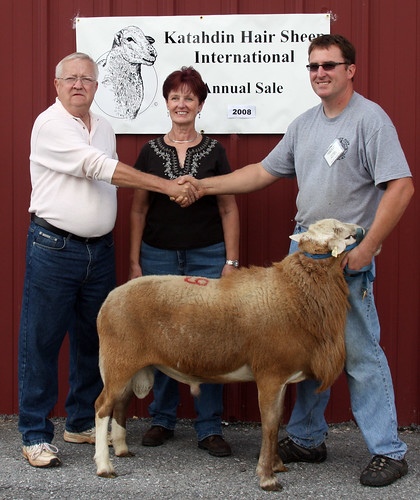
High selling Katahdin:  (L-R) David Maddox (buyer), Marcia and Carl Ginapp (consigners)On the second day of the Expo, participants had the opportunity to tour the nearby Western Maryland Research & Education Center, home of the Western Maryland Pasture-Based Meat Goat Performance Test. The tour also highlighted pumpkins, forages, and vineyards.

Fifty-five registered Katahdin sheep were sold in the National Katahdin Sale on September 27. The high-selling sheep was a yearling ram consigned by Carl Ginapp from Iowa. The ram sold on the strength of his outstanding EPD's and brought $3,100. The buyer was Dave Maddox from Georgia.

Katahdins are an American breed of hair sheep. They are known for their outstanding reproductive qualities and easy-care nature: no shearing or docking and minimal deworming. Katahdins are the sixth most popular breed of registered sheep in the United States.

Tuesday, May 6, 2008

Hair contaminates wool

With the rising number of hair sheep has come rising incidents of hair fiber contamination in U.S. wool clips. A small amount of hair can contaminate a lot of wool.

Like any other contaminant, such as poly or vegetable matter, the presence of hair in a wool clip will devalue it immensely or make the wool worthless. Non-wool fibers such as hair, kemp, and medulated fibers present processing difficulties.

hair x wool lambsProducers who have both hair sheep and wool sheep have to be the first line of defense against hair contamination. Hair sheep and wool sheep should not be run together if the producer intends to sell wool, as shedded fibers will work their way into a wool fleece.

Hair sheep and wool sheep should not be sheared together, if sheared at all, and hair sheep should be sheared after all other wool sheep. Producers need to be very vigilant with wool/hair sheep crosses, especially the first generation. While their fleece may look like wool, it actually is hiding the hair fiber underneath.
Hair x wool crosses should be sheared after wool sheep and their "fleeces" should be discarded.

Source: "Hair contamination still a problem in U.S. wool clip." Sheep Industry News, February 2008

Wednesday, February 20, 2008

Maryland had a little lamb . . .

by Lindsay Callahan, Campus farm manager

The University of Maryland owns and houses a small flock of breeding Katahdin and White Dorper hair sheep at their facility directly on the College Park Campus, the CAMPUS FARM. Our facility is also home to the resident horses, cattle, pigs, and chickens!

students working with a lamb at UMCP (image by Lindsay Callahan)The Animal and Avian Science Department uses the animals at the Campus Farm as a student teaching facility to help enrich the students’ learning experience outside the classroom. By offering such classes as ANSC 235, commonly called “Lamb Watch”, students can gain valuable hands-on experience that can be used in expanding their education in animal care and management.

Should you have any questions about our Department, University, facility, or animals, please feel free to contact: Lindsay Callahan, Campus Farm Manager, at (301) 405-1298, or e-mail at lindsayc@umd.edu.

You can also visit UMCP’s Animal Science Department’s website at: http://www.ansc.umd.edu/.

Tuesday, May 15, 2007

DNA testing to produce meatier lamb

In New Zealand, scientists have isolated genes which result in meatier lamb carcasses. DNA testing can determine if sheep carry these genes.

lamb hindsaddlesRams with a single copy of the MyoMax® gene can be expected to produce progeny with 5 percent more leg and rump muscle, but with 7 percent less fat. The effect will be up to double for a ram carrying two copies of the gene.

The discovery of MyoMAX® builds on a decade of research, but specific isolation and validation of the gene didn't start in earnest until five years ago. MyoMAX® has been identified within Texel and composite breeds containing Texel genetics.

A superior muscling trait, dubbed LoinMAX® was identified in research undertaken by Landcorp and AgResearch. Those animals with the LoinMAX® gene have the genetic potential to produce 10 percent more loin muscle. The LoinMAX® effect is only inherited from the sire. The gene is silent in the dam. LoinMAX® has been identified within Poll Dorsets and composite breeds containing Poll Dorset genetics.

Catapult Genetics, a global leader in sheep and cattle DNA testing technologies, offers DNA marker tests for both genes.

Source: www.catapultsystems.co.nz

Tuesday, August 1, 2006

Proceedings from Hair Sheep Workshop

In June 2005, Virginia State University hosted a Hair Sheep Workshop. The workshop was co-sponsored by the National Sheep Industry Improvement Center and the NCERA-190 Regional Research Project (Increasing efficiency of sheep production). The purpose of the workshop was to provide timely, research-based information on the production potential of hair sheep and their role in the U.S. Sheep Industry.

A web site was created to summarize the invited presentations. The web site is being hosted by the American Sheep Industry Association at www.sheepusa.org. To view the proceedings of the Hair Sheep Workshop, click on the RESEARCH JOURNAL icon, then 2005 Hair Sheep Workshop.

2005 Hair Sheep Workshop

Tuesday, April 25, 2006

"Hair Sheep Capital" of the Nation

Virginia Tech has announced plans to establish a flock of 200 hair sheep ewes at its Southwest Agricultural Research and Extension Center in Glade Spring, Virginia.

Hair sheep have appealing characteristics such as high resistance to parasites, adaptability to hot or cold climates, and a high demand for the meat in the growing U.S. ethnic marketplace, according to data provided by the Scott County Hair Sheep Association.

"I am confident that with the help of Virginia Tech and the excellent work of the Scott County Hair Sheep Association, Southwest Virginia will soon become known as the "'hair sheep capital' of the nation," said U.S. Rep. Rick Boucher (D-VA).

Read article in Kingsport-Times News