Showing posts with label tail docking. Show all posts

Tuesday, October 28, 2014

Dock Length Has No Effect on Rectal Prolapse

At Texas Tech, researchers investigated the effects of sex, breed, docked tail length, and the expression of the callipyge phenotype on the incidence of rectal prolapse in lambs.

To test whether these factors influence rectal prolapse in a controlled feedlot environment, lambs (n = 382) representing both sexes and four breed types were assigned randomly to one of three docking treatments. In short-docked lambs, the tail was removed as close to the body as possible. In medium-docked lambs, the tail was removed midway between the attachment of the tail to the body and the caudal folds to the tail. Long-docked lambs had their tails removed at the attachment of the caudal folds to the tail.

Incorporating the callipyge phenotype into the study design assessed the effect of enhanced muscle development on rectal prolapse. The overall incidence of rectal prolapse in the study was 2.1 percent. Ewe lambs were no more likely to experience prolapses than male lambs. Seven of the eight (87 percent) lambs that prolapsed were hair sheep. No lambs expressing the callipyge phenotype prolapsed. There was no difference in rectal prolapse occurrence among the three docking treatments.

In the study, sex, tail dock length, and muscling did not appear to contribute to rectal prolapse in lambs. However, there may be an over-looked genetic component that influences the occurrence of prolapses in response to the practice of docking.

Source: Sheep & Goat Research Journal, March 2014

Monday, December 8, 2008

2009 Maryland 4-H Tail Docking Policy

The 2009 Maryland 4-H Tail Docking Policy remains unchanged from 2008. 4-H lambs should be docked no shorter than the distal end of the caudal tail fold. Lambs docked in this manner will have a minimum tail length of 0.7 inches at the time of show, as determined by the approved measuring device.

Purchased lambs should have a minimum tail length of 1.4 inches at the time of "weaning." This gives a high probability that the lamb's tail will measure at least 0.7 inches at the time of show. 4-Hers should use the DeTail device to select lambs that have been properly docked.

Compliance with the Maryland 4-H Tail Docking Policy is voluntary. Lamb tails (docks) will not be officially measured at any Maryland 4-H activity. No lambs will be disqualified from showing due to tail length, unless the short dock has resulted in a rectal prolapse.

Any sheep or lamb that exhibits a rectal prolapse at a 4-H activity will be ineligible for the activity and sent home by the Extension Educator, Sheep Superintendent, or other appropriately deemed individual. Lambs with purse-string sutures will also be ineligible for exhibition in 4-H activities.

Exhibitors and breeders who complied with 2008 Maryland 4-H Tail Docking Policy are to be commended for maintaining high ethical standards.

Friday, December 21, 2007

2008 Maryland 4-H Tail Docking Policy

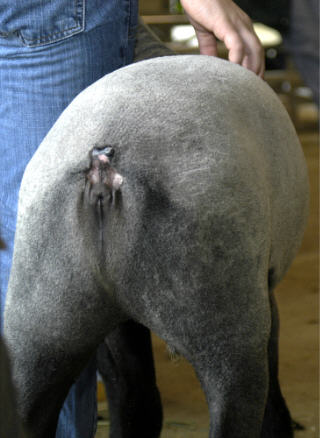
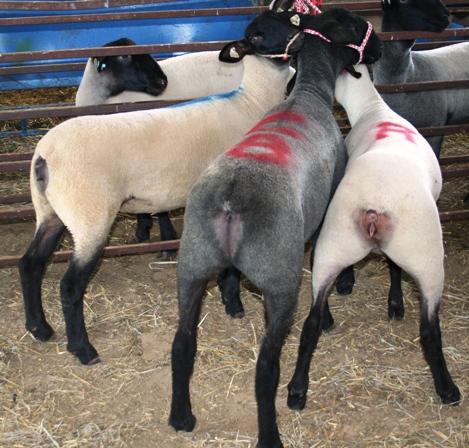
December 12, 2007 -- The 2008 Maryland 4-H Tail Docking Policy remains virtually unchanged from 2007. 4-H lambs should be docked no shorter than the distal end (farthest from the body) of the caudal tail fold. The caudal fold is a flap of skin attached to the underside of the tail near the rectum and is clearly visible when the tail is lifted.

Lambs meeting the 0.7 inch requirementLambs docked in this manner will have a minimum tail length of 0.7 inches at the time of show. Purchased lambs (market and breeding) should have a minimum tail length of 1.4 inches at the time of "weaning." This gives a high probability that the lamb's tail will measure at least 0.7 inches at the time of show. 4-Hers should continue to use the DeTail device to select lambs that have been properly docked.

Voluntary compliance
In 2008, compliance with the Maryland 4-H Tail Docking Policy will be VOLUNTARY. Lamb tails (docks) will not be officially measured at Maryland 4-H activities. No lambs will be disqualified from showing due to tail length, unless the short dock results in a rectal prolapse.

The policy will be re-evaluated at the end of 2008.

Rectal prolapses
Any sheep or lamb that exhibits a rectal prolapse at a 4-H activity will be ineligible for the activity and sent home by the Extension Educator, Sheep Superintendent, or other appropriately deemed individual. The following will be used as a guideline to determine occurrence of a rectal prolapse:
    “A rectal prolapse is defined as an inversion of the rectum that protrudes 4 cm (1.6 in.) or more outside the body and remains exterior to the body while the animal is standing."
If a lamb is observed with a rectal prolapse (by one of the above people) and in the future is not observed with a rectal prolapse, it is still classified as having a rectal prolapse. This was the criteria used in the 2003 multi-year study published by the Journal of Animal Science that established a link between tail length and the incidence of rectal prolapses in lambs fed concentrate diets.

Questions about Maryland's 2008 4-H Tail Docking Policy should be directed to Susan Schoenian at (301) 432-2767 x343 or sschoen@umd.edu.

Wednesday, May 16, 2007

A national policy on tail docking warranted

According to a recent article in the Delmarva Farmer, "A national policy, which is uniform, easily understood — and above all, enforceable — is the only way to settle the lamb tail-docking debate that is roiling and confusing 4-H leaders and 4-H youngsters across the country."

Grand Champion Market Lamb at 2006 Maryland State FairMaryland has had a 4-H tail docking policy since 2003. Maryland's current policy requires that a lamb entered in the market show must have a tail no shorter than 0.7 inches as determined by the approved measuring device. Most other states do not have a policy and allow tails to be docked as short as the breeder or owner desires.

According to the article, those in favor of the Maryland policy say a longer docked tail reduces the incidence of rectal prolapse, which can lead to death if left untreated. Those who oppose the policy say prolapses are more the result of other factors, mainly genetics and diet.

A 2003 multi-state study established a link between short-tail docks and rectal prolapses, when lambs were fed feed lot diets, as is common with most 4-H lambs.

Read Delmarva Farmer article

Saturday, December 2, 2006

Revised Maryland 4-H Tail Docking Policy

Following the past year's show season, the Maryland 4-H Youth Development Program, with leadership from the 4-H Animal Sciences Curriculum Committee, has reviewed the tail docking policy. The Curriculum Committee has conferred with numerous staff and faculty, volunteers and youth, Extension faculty in others states, and with the Maryland Sheep Breeders Association. A state-wide listening session was held in Timonium in early November with over 70 participants.

The current policy will continue with several amendments. Breeding sheep will be treated separately from the current policy, and there will be an appeal process for market lambs.

2007 Market Lamb Policy
"Market Lambs exhibited after January 1 of the current calendar year will be accepted for 4-H participation only if tails are not docked shorter than the level of the distal end of the caudal tail fold. Market Lambs that are properly docked will have a minimum tail length of 0.7 inches at 4-H Activities, 4-H weigh-ins and taggings, and 4-H Shows, measured by the approved measurement device, which will be placed against the base of the tail and pin bones."

Appeal Process
If a market lamb fails by the committee’s ruling, the youth and one adult (family member, legal guardian, 4-H leader or FFA advisor) will have five (5) minutes to use the approved measuring devise and attempt to prove to the committee that the animal meets the 0.7 inch standard. If this is not accomplished, the market lamb is disqualified. If the youth can prove to the committee within the 5 minute limit that the market lamb does pass the 0.7 inch standard, the animal will be permitted to exhibit at that particular 4-H show, activity, etc. At this point, there is NO further appeal process. The decision of the committee is FINAL.

Breeding sheep
Breeding sheep will be treated separately from the current policy:

"Breeding sheep shall have NO evidence of surgical docking, prolapses, purse strings, sutures, etc. If any of these are evident in breeding sheep, the breeding sheep in question will be sent home immediately by the Extension Educator, Sheep Superintendent, or the appropriately deemed individual. There is NO appeal process for breeding sheep. "

The 4-H Youth Development Program in Maryland will strive diligently to apply the policy and rules fairly and consistently in all venues and with all youth.

Questions regarding Maryland's 4-H tail docking policy should be directed to J. Willard Lemaster, 4-H Animal Specialist, by e-mail at Lemaster@umd.edu or telephone at (301) 314-7187.

Source: Dr. Richard Bryne, 4-H Program Leader, Maryland Cooperative Extension, December 1, 2006.

Thursday, October 26, 2006

The Effect of Dock Length on Rectal Prolapses

A study was conducted at Texas Tech University in 2004 and 2005 to evaluate the possible causes for rectal prolapse in lambs. One particular factor of interest is tail-docking length, so this factor was varied as an experimental treatment. Docking treatments were balanced across breeds, sex, type of birth, and callipyge genotype. The same person docked all of the lambs in the study (n=382).

A short-docked lamb was a lamb for which the elastrator band was placed as close as possible to the lamb's body. A medium-docked lamb was achieved by placing the elastrator band on the tail at a location midway between the attachment of the tail to the body and the attachment of the caudal folds to the tail. To create a long-docked lamb, the elastrator band was placed at the attachment of the caudal folds to the tail. According to the American Sheep Industry Association, American Association of Small Ruminant Practitioners, and various other organizations, the latter is the proper location for docking lambs.

The lambs were creep fed, then fed a high concentrate diet in a feed lot environment until they reached a target weight of 125 lbs. The breeds included in the study were hair sheep (St. Croix and Barbado), Rambouillet, Suffolk x Hampshire, and various crossbreds. 125 lambs either carried or expressed the callipyge gene.

The overall incidence of rectal prolapse was 2.1 percent: 8 out of the 382 lambs. Female lambs (n=6) had a greater incidence of rectal prolapses than wether lambs (n=2). Hair sheep (n=7) accounted for the majority of the prolapses. Five of the lambs that prolapsed had the same sire. Only one callipyge lamb prolapsed.

Results of this study showed NO statistically differences among the three tail docking treatments. These results differ with a recent multi-state study which implicated short tail docks as a cause of rectal prolapses in lambs finished on high concentrate diets. This researcher states "the results of this study do not eliminate dock length as a contributing factor to rectal prolapse, but rather offer other factors that are equally or more significant."

Texas Tech Study [M.S. Thesis]
Multi-state Study [Journal article]
Where to dock lambs

Wednesday, August 2, 2006

24 Lambs Disqualified at County Fair

According to the Carroll County Times, 24 lambs were disqualified at this week's Carroll County Fair in Westminster, Maryland. Their tails were too short.

The Maryland 4-H Program requires that lamb tails be at least 0.7 inches long at the time of show. The 0.7 inch rule was developed based on research that showed that short-docked lambs are more likely to develop rectal prolapses.

A committee of three judges used a state-approved measuring device to determine tail length at the fair. This is the 4th year of a 4-H tail docking policy in Maryland.

Tail Length and Incidence of Rectal Prolapse in Lambs
A Candid Discussion on the Tail Docking Controversy
Where to Dock Lambs' Tails

Wednesday, April 26, 2006

Tail Docking Brochure

Maryland is one of several states that has a tail docking policy for 4-H sheep and lambs. To learn about Wyoming's policy, read this brochure (PDF). The brochure has a diagram showing the location of the coccygeal vertebra. To show sheep in Wyoming, 4-Hers must have a signed certificate from a veterinarian that says their lamb has a minimum of three full coccygeal vertabrae in place.

Sunday, April 2, 2006

Tail Docking Guidelines in Wyoming

The Wyoming State Fair has implemented new tail docking guidelines. Every sheep born after Dec. 1, 2005, and exhibited at the 2006 Wyoming State Fair must be accompanied by certification that its tail has been inspected by a veterinarian for three coccygeal vertebrae. The tail length of a lamb can be contested for $50 collateral, which is forfeited if an x-ray shows that the lamb’s tail is the proper length.

A resolution passed by the American Veterinary Medical Association reads, “Cosmetic, excessively short tail docking can lead to an increased incidence of rectal prolapses and is unacceptable for the welfare of the lamb.”

Wyoming State Fair Implements Tail Docking Rules

Wednesday, February 22, 2006

Bill Challenges Tail Docking Policy

A bill challenging Maryland's 4-H Sheep Tail Docking Policy was introduced into the Maryland General Assembly. If the bill passes, it would prohibit Maryland Cooperative Extension from adopting a rule, regulation, or policy regarding the tail docking of livestock for exposition at Maryland open or 4-H livestock shows. The bill was introduced by Delegate Barry Glassman, a Republican who represents District 35A (Harford County). It has 12 co-sponsors. A public hearing has been scheduled for Wednesday, March 1 at 1 p.m. in Annapolis.

House Bill 1097

Maryland's 4-H Tail Docking Policy states, "Lambs born after January 1, 2005 will be accepted for exhibition only if tails are not docked shorter than the level of the distal end of the caudal tail fold. Lambs that are properly docked will have a minimum tail length of 0.7 inches at show, measured by the approved measuement device, which will be placed against the base of the tail and pin bones." The policy is based on research that strongly implicated short tail docks as a cause of rectal prolapses in lambs finished on high concentrate rations.

A candid discussion on the tail docking controversy