Showing posts with label sheep. Show all posts

Tuesday, October 3, 2017

"Worm Tested" Rams Average $1226

On September 22, 2017, thirty-nine rams from the Southwest AREC Ram Test in Virginia were auctioned off to eager bidders. One hundred and ten rams originating from twenty-six flocks in nine states were delivered to the test site on May 30. Thirty-nine top-performers were selected for the auction. They represented the top 60 percent in performance.

The thirty-nine rams grossed $47,800. Prices ranged from $400 to $3400. The average price was $1226. The mean was $1000. The top-indexing ram sold for $2200. The high-selling ram brought $3400.  Fourteen of the rams sold, including the top-performing ram, also had EBVs (estimated breeding values) for worm egg counts. These rams ranged in price from $600 to $2200. They sold for an average price of $1278. The median price was $1350.

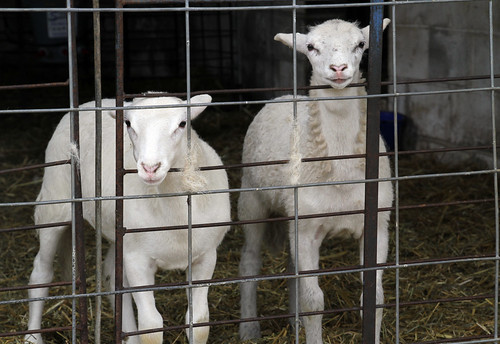
One of the rams being auctioned off
Following a three week adjustment period, the rams were evaluated for growth and parasite resistance over a 70-day period. They grazed fescue paddocks and received supplemental feed (76% TDN, 18% CP) at a rate of approximately 3 percent of their body weight. At the start of the test, the rams received an oral dose of 5000 3rd stage Haemonchus contortus. Body weights and FAMACHA© scores were determined biweekly. Fecal samples were collected every 14 days. The rams were scanned at the end of the test to determine backfat and eye muscle depth. An index, based on a combination of traits, was used to identify top performers and determine the sale order.

The Southwest AREC Ram Test is conducted annually at Virginia Tech's Southwest Ag Research & Extension Center in Glade Spring, Virginia. The first test was conducted in 2012. For more information about the test, contact Lee Wright at (276) 944-2200 or Dr. Scott Greiner at (540) 231-9159.

The Southeast AREC Ram Test is the only ram performance test that evaluates rams for parasite resistance . For 11 years, the Western Maryland Pasture-Based Meat Goat Performance Test evaluated meat goat bucks for parasite resistance (natural infection). Eastern Oklahoma State College conducts an annual buck test in which fecal egg counts are used to determine performance. The Katahdin breed is the only breed of sheep or goat (in the US) in which EBVs are calculated for parasite resistance (fecal egg counts).

Thursday, September 21, 2017

Next ASI Let's Grow Webinar

The next ASI Let's Grow Webinar is Tuesday, October 3, 2017, at 8 p.m. The title of the webinar is Selection of Replacement Ewes and Culling Underperforming Ewes. The presenter is Susan Schoenian, University of Maryland Sheep & Goat Specialist.

Sound, productive ewes are the foundation of a successful sheep farm. Selection and culling decisions will go a long way towards ensuring profitability.


This webinar is made possible with funding support from the Let’s Grow Committee of the American Sheep Industry Association.

http://www.optimalag.net/sheepagriculture/webinars/replacement-ewe-selection-and-culling-of-underperforming-ewes/

Friday, August 18, 2017

Upcoming Programs in Virginia

The 42nd  Annual Virginia Performance Tested Ram Sale, Ewe Lamb Sale, and Sheep Field Day will be held Saturday, August 26 at the Shenandoah Valley Agricultural Research & Education Center near Raphine, Virginia. The educational program starts at 10:30 am, with the ram and ewe lamb sale starting at 1 pm. Information is available on the Virginia Sheep Producers Association web site at www.vasheepproducers.com.


The Virginia Tech Sheep Center will be hosting its 18th annual Production Sale on Saturday, September 2 at the Alphin-Stuart Livestock Arena on the campus of Virginia Tech. Approximately 50 head of Suffolk and Dorset ram lambs and ewe lambs will be offered. Additional information is available at http://www.apsc.vt.edu/extension/sheep/.

On Friday, September 22, a Sheep Field Day and Katahdin Ram Sale will be held at the Southwest Agricultural Research & Education Center in Glade Spring, Virginia. This is the fifth year for this hair sheep ram performance test which includes evaluation of parasite resistance. The educational program will center around this activity, and the top end of the rams will be sold. The Field Day will begin at noon with sale to follow. Details and information will be forthcoming on the Southwest AREC web site at https://www.arec.vaes.vt.edu/arec/southwest-virginia.html.

Wednesday, August 16, 2017

A New Era in Western Maryland

The Western Maryland Pasture-Based Meat Goat Performance Test was initiated at the University of Maryland’s Western Maryland Research & Education in Keedysville (Washington County) in 2006.

The purpose of the test was to evaluate the post-weaning performance of meat goat bucklings consuming a pasture-based diet, with natural exposure to internal parasites. Identifying bucks that were resistant and resilient to internal parasites was the trademark of the test.

The test was conducted for eleven years. Almost 800 bucks were evaluated. While the test was open to any breed or cross of goat, it gradually evolved into a “Kiko test.”  Over the span of the test, more than 100 producers from 20 states consigned bucks. Top-performing bucks were sold (as far away as California) or returned to farms for breeding.

Bucks from the 2012 test
Over the years, many programs and activities were held in conjunction with the test, including field days, tours, sales, skillathons, and carcass evaluation. In 2014, the BluegrassPerformance Invitational in Frankfort, Kentucky, was established as a place to sell performance tested goats, including the top-performing bucks from the Maryland test. This year's sale is September 1-2, 2017.

Now, the goat test era is over (in  Maryland). Goat producers will be encouraged and assisted in their move to the next step in performance testing: within and across-herd EBVs. EBV stands for estimated breeding value and is a measure of genetic merit, The data is far more accurate than the data from buck tests.

A sheep research program will be initiated at the Western Maryland Research & Education next spring (2018). The pastures are being re-established and new infrastructure is being put in, as the hoop house that was installed several years ago was completely destroyed this past winter.

Internal parasites (GI worms) will likely continue to be the focus of the research program, as it is a logical follow-up to the goat test and parasites remain a major obstacle to profitable small ruminant production. We also plan to plant different forages for grazing.

Bucks from the 2014 test
I’d like to express appreciation to my “Goat Team”: Jeff Semler, David Gordon, Pam Thomas, and Mary Beth Bennett. Others who played key roles include E. Nelson Escobar, Niki Whitley, Willie Lantz, Chris Anderson, Jeanne Deitz-Band, Lexie Simmons, and Amy Garza.

Dr. Dahlia O’Brien at Virginia State University (previously at Delaware State University) was instrumental to the success of the test, as she performed all the fecal egg analyses.

Thanks to the Maryland Grain Producers Utilization Board for providing funding for the pen vs. pasture studies.

Thanks to everyone who supported the goat test over the years, including all the consigners and buyers of bucks.

Susan Schoenian
Sheep & Goat Specialist
University of Maryland Extension

Wednesday, August 2, 2017

Webinar: Selection for Parasite Resistance

Dr. Joan Burke
Image from USDA ARS
The next ASI Let's Grow Webinar will be held Tuesday, August 22, 2017, at 8 p.m. The topic is Selection for Parasite Resistance. The speaker is Dr. Joan Burke. The host is Dr. Jay Parsons. Dr. Burke is a USDA-ARS Research Animal Scientist at the Dale Bumper's Small Farm Research Center in Booneville, Arkansas. Dr. Parsons is from the University of Nebraska.

To register, to: https://attendee.gotowebinar.com/regist…/1611123568671444227. After registering, you will receive a confirmation email containing information about joining the webinar.

The webinar is made possible with funding support from the Let's Grow Committee of the American Sheep Industry Association. The Let's Grow mission is to support and ensure the future of U.S. wool and lamb production.

Link to previous Let's Grow webinars

Monday, April 3, 2017

DUP has no effect during periparturient period

Ewes experience a temporary decline in resistance to gastrointestinal nematodes (GIN) during the periparturient period, characterized by a rise in fecal egg count (FEC) that represents a major source of pasture contamination for naïve progeny. The aim of an Irish study was to assess the effect of level of supplementation with digestible undegraded protein (DUP) during the last 6 weeks of pregnancy on periparturient FEC and the performance of ewes with a naturally acquired parasite infection.

Periparturient ewes
Eighty-five Belclare and Belclare x Scottish Blackface twin/triplet-bearing ewes were allocated to 1 of 4 dietary groups representing the combination of 2 concentrates (DUP concentration 29 and 94 g/kg dry matter) with 2 levels of concentrate during the final 6 weeks of gestation. All ewes were housed during the pre-partum feeding period and offered grass silage ad libitum.  After lambing, ewes and lambs grazed on permanent sheep pasture, without concentrate supplementation, until weaning (14 weeks post lambing).

The effect of week (relative to lambing date) on FEC was highly significant. However, diet did not influence FEC at any stage either pre- or post-partum.  The changes in BW and BCS from 6 weeks before lambing to weaning were not affected by the concentration of DUP in the supplement, but ewes on treatments involving the higher level of supplementation lost less BW and BCS.

The results of this study indicate that the level of DUP supplementation during the last 6 weeks of pregnancy does not affect FEC, BW or BCS of housed ewes with a naturally acquired GIN infection.

Read abstract from Veterinary Parasitology (February 2017).

Thursday, March 2, 2017

No Maryland Wool Pool in 2017

After 59 years of operation, there will be no Maryland Wool Pool in 2017.  For many years, the wool pool has provided a market outlet for fleeces. The pool has been especially beneficial for small producers.

There have been many managers of the Maryland Wool Pool. Prices always seemed to be higher than other pools, with similar types of wool. The Maryland pool was always innovative in its approaches to marketing wool, instituting classing and baling. In fact, the Maryland Wool Pool hosted many ASI classing schools.


In its next newsletter, the Maryland Sheep Producers Association will offer alternatives for marketing wool. There are still wool pools in neighboring states:  Virginia, West Virginia, and Pennsylvania. Some shearers will purchase wool.

Many producers direct market their wool to hand spinners. Others add value to their wool and sell roving, top, yarn, or finished products. You can take wool to landfills. Many producers have switched to hair sheep, so they don't have to worry about shearing and marketing wool.

Tuesday, February 14, 2017

Upcoming Webinar: Dairy Sheep

"Is Sheep Milk Production in Your Future" is the title of an upcoming webinar on March 14, 2017, at 8 p.m. EST. The presenter is Dr. Dave Thomas, Professor of Sheep Management and Genetics from the University of Wisconsin (retired). The host is Jay Parsons from Optimal Ag. The sponsor is ASI's Let's Grow Program.

Milking sheep in Maryland
The U.S. is the leading importing of sheep milk cheeses in the world with over half of all world trade in sheep milk cheeses coming to the U.S. Some common imported 100% sheep milk cheeses are Manchego from Spain, Pecorino-Romano from Italy, and Roquefort from France.

Therefore, it would seem that there is ample opportunity for the development of a dairy sheep industry in the U.S. for the production of domestic cheeses to compete with this large influx of imported sheep milk cheeses.

However, nothing is ever as simple as it looks. This webinar will discuss the things that are necessary to produce sheep milk efficiently .

To register for the webinar, go to https://attendee.gotowebinar.com/register/2962937926909717505.

Wednesday, February 8, 2017

2017 Maryland Sheep Shearing School

The 2017 Maryland Sheep Breeders Association (MSBA) Sheep Shearing School will be held Friday and Saturday, April 14-15 (Friday and Saturday), 9:30 a.m. to 3:30 p.m. at Ridgely Thompson's farm at 1942 Uniontown Road, Westminster, MD 21157.

The school is open to anyone in Maryland, Delaware and surrounding states who wants to learn to shear sheep. Ownership of sheep or a desire to become a commercial shearer is preferred. Participation is limited to 15 people. The minimum age is 16.

The New Zealand method of shearing will be taught. Shearing machines will be provided. Blade shearing will not be taught. Instructors are Aaron Geiman and Emily Chamelin-Hickman. Aaron is an Agriscience teacher at North Carroll High School. Emily is a professional shearer.

The registration fee is $100 per person and includes a copy of ASI's Sheep Shearing Notebook, instructional DVD, and wall chart. Pre-registration is required. No registrations will be accepted after April 1.  Checks should be made payable to the Maryland Sheep Breeders Association, Inc. and mailed to Aaron Geiman at 429 Hook Road, Westminster,  Maryland  21157.

Download registration form

Thursday, January 26, 2017

2017 Maryland Shearing School

The 2017 Maryland Shearing School will be held Saturday and Sunday, April 14-15 at Ridgely Thompson's farm in Westminster, Maryland.

The shearing school is open to anyone who wants to learn to shear sheep. The minimum age is 16. The $100 fee includes instruction, ASI sheep shearing manual, DVD, and wall chart. The registration deadline is April 1. Registration should be mailed to Aaron Geiman, 429 Hook Road, Westminster, MD  21157. Checks should be made payable to the Maryland Sheep Breeders Association.

The New Zealand method of sheep shearing will be taught. Instructors will be Aaron Geiman and Emily Chamelin-Hickman.

Download information and registration form.

Thursday, January 12, 2017

Best Management Practices to Increase Lamb Crop

The American Sheep Industry Association (ASI) has published a set of 12 Best Management Practices fact sheets. The fact sheet series is aimed at helping producers increase their lamb crop. They are written and reviewed by Sheep Specialists throughout the United States.

The fact sheets have been professionally edited and are now available for downloading from the United States Lamb Resource Center.

  1. Accelerated Lambing Cycles
  2. Breeding Ewe Lambs at 7-9 Months
  3. Cull Underperforming Ewes
  4. Disease Prevention and Treatment
  5. Manage for Seasonal Changes in Reproduction
  6. Match Reproduction to Management
  7. Optimal Nutrition
  8. Reduce Lamb Loss
  9. Select for Prolific Genetics
  10. Test for Pregnancy Status
  11. Testing Rams for Breeding Soundness
  12. Use Crossbreeding
Because production methods vary across the U.S. and among producers within the same production system, not all of these “best practices” are applicable to a particular sheep operation. However, most sheep producers should be able to identify at least three of the 12 Lamb Crop Best Practices that will help them gain efficiency and improve profitability. Most of the practices are equally applicable to goats.

Thursday, November 3, 2016

No Advantage to Hydroponic Fodder

Barley sprouts
Hydroponic fodder is being promoted as a means to reduce feed costs and improve productivity.  Alan Sulser, an Agricultural Extension Agent with Utah State University, conducted an experiment to evaluate the economic potential of hydroponic fodder and its effect(s) on the performance of sheep. Over a two year period, Sulser fed hydroponic fodder to replacement ewes and rams.

 After a 2-week adaptation period, sheep were randomly allocated to two treatment groups. The control group was fed alfalfa hay and mixed grain (corn + barley). The treatment group was fed the same feed ingredients (in different amounts), along with hydroponic fodder. Sulser sprouted his own grains from barley (6 day growth period). The rations were balanced for energy (TDN) on a dry matter basis using Montana State University's Sheep Ration Balancer. The sheep were fed their respective diets for 100 days. They were fed twice daily and weighed every 10 days.

Group
Cost per day
ADG
Cost per gain
Fodder-fed
$0.96
$1.01
0.59
$1.71
$1.87
Control
$0.54
0.64
$0.89

Averaged over both years and sexes, body weight gain was not significantly between groups. Control sheep gained an average of 0.64 lbs. per day, while the fodder-fed sheep averaged 0.59 lbs. per day. Compared to the control group, the fodder-fed animals consumed more dry matter on a daily basis. Feed cost per day was higher for the fodder-fed animals:  $0.96 vs. $0.54 per day.  If all costs are included, feed cost per day for the fodder-fed animals increases to $1.08, and cost per pound of gain increases to $1.87.  Other costs include labor, water, electricity, and equipment ($10,000 for a commercial fodder system prorated over 10 years).

The experiments showed no advantage to feeding hydroponic fodder in replacement of hay and grain to replacement sheep. The experiments were not scientific.

 Source:  Journal of the NACAA, December 2015

Thursday, October 20, 2016

Lambulator Cut-Yield Calculator

The LAMBULATOR is a Cut-Yield Calculator for the Lamb Direct Marketer. It has been designed with the small direct marketer in mind. It is easy to understand and use, even if you have no experience with Microsoft Excel. Just plug in your cut weights and prices and let it do the calculating for you.

In an instant, it will calculate carcass yield percentages, individual and average net profit per lamb, and your overall gross and net profit. It will even allow you to try different pricing scenarios should your production or marketing costs increase. The Lambulator was developed by Dave Scott, a livestock specialist with NCAT-ATTRA. It is a free download.

https://attra.ncat.org/attra-pub/summaries/summary.php?pub=548

Friday, September 2, 2016

No Benefit to Removing Tapeworms

In 2012 and 2013, an experiment was conducted on a commercial sheep farm in the Northern Tablelands of New South Wales, Australia, to test the hypothesis that the growth rates of meat-type lambs would not be affected by the removal of tapeworms (Monieza spp.).

In 2012 and 2013, 93 and 85 lambs respectively were randomly allocated to two treatment groups. One group (Prazi) was treated with praziquantel, levamisole and abamectin to remove tapeworm and gastrointestinal nematode infection (GIN) while the second group (Control) was treated with levamisole and abamectin to remove only GIN.

Tapeworm prevalence and egg counts of Control lambs ranged from 25 to 77% and 7 to 730 eggs per gram (epg) respectively and were significantly reduced in Prazi lambs, following treatment, at all time-points in both years. Pre-treatment GIN worm egg counts ranged between 1684 and 3368 epg with Haemonchus contortus being the dominant species. Post-treatment GIN worm egg counts were similar between Prazi and Control groups, expect on one occasion (Day 65, 2013) when GIN worm egg counts were expectantly higher in Control lambs.

Group
2012
2013
CONTROL
81 g/d
0.18 lb/d
134 g/d
0.30 lb/d
PRAZI
95 g/d
0.21 lb/d
132 g/d
0.29 lb/d

No significant difference in growth rates were observed between treatment groups in either year with overall group mean daily body weight gains being 95 and 81 g/day  (0.18 and 0.21 lb/d)  in 2012 and 132 and 134 g/day (0.30 and 0.29 lb/d) in 2013 for the Prazi and Control groups respectively. This experiment confirmed that removal of tapeworm burdens did not increase growth rates in meat-breed lambs.

Source:  Veterinary Parasitology, March 2015

Thursday, August 25, 2016

Southwest Virginia Ram Sale & Field Day

The 2016 Southwest AREC Sheep Field Day and Ram Test Sale will be held Saturday, September 23 at Virginia Tech's Southwest Agricultural Research & Extension Center in Glade Spring, Virginia. Katahdin rams participating in the ram test will be offered for sale.

Katahdin rams from 2014 sale
The purpose of the test is to quantify the growth and parasite resistance of rams. For more information, please contact Lee Wright at (276) 944-2200 or Dr. Scott Greiner at (540) 231-9159.

Wednesday, August 10, 2016

Field Day, Ram & Ewe Sale in Virginia

The 41st Annual Virginia Performance Tested Ram Lamb Sale & Replacement Ewe Lamb Sale will be held Saturday, August 27, 2016, at the Virginia Sheep Evaluation Station in Steele's Tavern, Virginia.  It will include a Field Day and Educational Program. The educational program will begin at 10:30 a.m. The sale will begin at 1 p.m.

Field Day topics include forage management and winter feeding, selecting for parasite resistance, lamb marketing, and sheep health. Eighty rams were delivered to the test site on May 3, 2016 (13 fall Dorset, 7 winter Dorset,  8 winter Hampshire, 3 fall Suffolk, 36 winter Suffolk, 6 winter North Country Cheviot, 3 fall White Dorper, 5 winter White Dorper, 1 fall Katahdin, and 10 Winter Katahdin). Unsound and unsuitable rams will not be sold.

More information, including videos of the sale rams, is available at www.vtsheep.apsc.vt.edu. Or visit the ram test on Facebook at www.facebook.com/VARamTest.

Tuesday, July 5, 2016

Comparison of Weaning Methods

Researchers in Arkansas compared weaning methods to determine effects on performance and behavior of lambs. 168 crossbred Katahdin lambs were utilized in two experiments. Traditional weaning was characterized by complete separation of lambs from their dams, whereas fenceline weaning maintained fenceline contact. In contrast with calves, lamb performance and behavior did not differ among weaning methods.

There is no benefit to fenceline contact.

In two additional experiments, involving 190 Katahdin lambs, the time of day was added as a variable. The four treatment groups were 1) traditional-am; 2) traditional-pm; 3) fenceline-am; and 4) fenceline-pm. In these experiments, there were no beneficial effects of alternative weaning strategies. No performance differences were detected among treatment groups. The percentage of lambs vocalizing was greater among those with fenceline contact with their dams.

Source:  Sheep & Goat Research Journal

Wednesday, June 29, 2016

Hair Lambs Sell at Discount to Wool Lambs

Texas A&M University compared the prices of wool lambs, primarily Rambouillet, with the prices of hair lambs, primarily Dorper, sold at Producers Livestock Auction Company in San Angelo Texas, the largest live sheep market in the US. The data set included 286,764 lambs sold in 25,916 lots from 2010 to 2014.

The results indicated an overall discount of $3.42 ± $0.33 per hundredweight (cwt) for hair lambs. The largest discount was in 2011 ($30.74 ± $0.41 per cwt). The discount relative to wool lambs increased as lamb weight increased.

In 2012, the price for hair lambs was $9.62 ± $0.62 per cwt higher for hair lambs. Hair lambs sold for $3.18 ± $0.83 per cwt more than wool lambs in the 40-50 lb. weight class, whereas wool lambs sold for $9.09 ± $0.68 per cwt more than hair lambs in the 90-100 lb. weight class.

Prices increased as lot size increased. Wool lambs sold for a larger premium in the larger lot sizes. Wool lambs sold for $8.59 ± $0.39 per cwt more than hair lambs when there were 35 or more lambs in the lot.The difference in price between hair lambs and wool lambs varied across years, months, weight class, and lot size.

Source:  Sheep & Goat Research JournalRead full article.