Showing posts with label performance. Show all posts

Tuesday, October 3, 2017

"Worm Tested" Rams Average $1226

On September 22, 2017, thirty-nine rams from the Southwest AREC Ram Test in Virginia were auctioned off to eager bidders. One hundred and ten rams originating from twenty-six flocks in nine states were delivered to the test site on May 30. Thirty-nine top-performers were selected for the auction. They represented the top 60 percent in performance.

The thirty-nine rams grossed $47,800. Prices ranged from $400 to $3400. The average price was $1226. The mean was $1000. The top-indexing ram sold for $2200. The high-selling ram brought $3400.  Fourteen of the rams sold, including the top-performing ram, also had EBVs (estimated breeding values) for worm egg counts. These rams ranged in price from $600 to $2200. They sold for an average price of $1278. The median price was $1350.

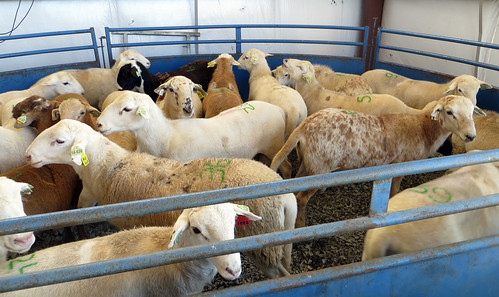
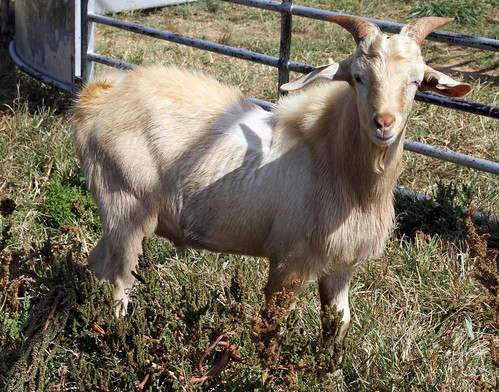
One of the rams being auctioned off
Following a three week adjustment period, the rams were evaluated for growth and parasite resistance over a 70-day period. They grazed fescue paddocks and received supplemental feed (76% TDN, 18% CP) at a rate of approximately 3 percent of their body weight. At the start of the test, the rams received an oral dose of 5000 3rd stage Haemonchus contortus. Body weights and FAMACHA© scores were determined biweekly. Fecal samples were collected every 14 days. The rams were scanned at the end of the test to determine backfat and eye muscle depth. An index, based on a combination of traits, was used to identify top performers and determine the sale order.

The Southwest AREC Ram Test is conducted annually at Virginia Tech's Southwest Ag Research & Extension Center in Glade Spring, Virginia. The first test was conducted in 2012. For more information about the test, contact Lee Wright at (276) 944-2200 or Dr. Scott Greiner at (540) 231-9159.

The Southeast AREC Ram Test is the only ram performance test that evaluates rams for parasite resistance . For 11 years, the Western Maryland Pasture-Based Meat Goat Performance Test evaluated meat goat bucks for parasite resistance (natural infection). Eastern Oklahoma State College conducts an annual buck test in which fecal egg counts are used to determine performance. The Katahdin breed is the only breed of sheep or goat (in the US) in which EBVs are calculated for parasite resistance (fecal egg counts).

Friday, August 18, 2017

Upcoming Programs in Virginia

The 42nd  Annual Virginia Performance Tested Ram Sale, Ewe Lamb Sale, and Sheep Field Day will be held Saturday, August 26 at the Shenandoah Valley Agricultural Research & Education Center near Raphine, Virginia. The educational program starts at 10:30 am, with the ram and ewe lamb sale starting at 1 pm. Information is available on the Virginia Sheep Producers Association web site at www.vasheepproducers.com.


The Virginia Tech Sheep Center will be hosting its 18th annual Production Sale on Saturday, September 2 at the Alphin-Stuart Livestock Arena on the campus of Virginia Tech. Approximately 50 head of Suffolk and Dorset ram lambs and ewe lambs will be offered. Additional information is available at http://www.apsc.vt.edu/extension/sheep/.

On Friday, September 22, a Sheep Field Day and Katahdin Ram Sale will be held at the Southwest Agricultural Research & Education Center in Glade Spring, Virginia. This is the fifth year for this hair sheep ram performance test which includes evaluation of parasite resistance. The educational program will center around this activity, and the top end of the rams will be sold. The Field Day will begin at noon with sale to follow. Details and information will be forthcoming on the Southwest AREC web site at https://www.arec.vaes.vt.edu/arec/southwest-virginia.html.

Wednesday, August 16, 2017

A New Era in Western Maryland

The Western Maryland Pasture-Based Meat Goat Performance Test was initiated at the University of Maryland’s Western Maryland Research & Education in Keedysville (Washington County) in 2006.

The purpose of the test was to evaluate the post-weaning performance of meat goat bucklings consuming a pasture-based diet, with natural exposure to internal parasites. Identifying bucks that were resistant and resilient to internal parasites was the trademark of the test.

The test was conducted for eleven years. Almost 800 bucks were evaluated. While the test was open to any breed or cross of goat, it gradually evolved into a “Kiko test.”  Over the span of the test, more than 100 producers from 20 states consigned bucks. Top-performing bucks were sold (as far away as California) or returned to farms for breeding.

Bucks from the 2012 test
Over the years, many programs and activities were held in conjunction with the test, including field days, tours, sales, skillathons, and carcass evaluation. In 2014, the BluegrassPerformance Invitational in Frankfort, Kentucky, was established as a place to sell performance tested goats, including the top-performing bucks from the Maryland test. This year's sale is September 1-2, 2017.

Now, the goat test era is over (in  Maryland). Goat producers will be encouraged and assisted in their move to the next step in performance testing: within and across-herd EBVs. EBV stands for estimated breeding value and is a measure of genetic merit, The data is far more accurate than the data from buck tests.

A sheep research program will be initiated at the Western Maryland Research & Education next spring (2018). The pastures are being re-established and new infrastructure is being put in, as the hoop house that was installed several years ago was completely destroyed this past winter.

Internal parasites (GI worms) will likely continue to be the focus of the research program, as it is a logical follow-up to the goat test and parasites remain a major obstacle to profitable small ruminant production. We also plan to plant different forages for grazing.

Bucks from the 2014 test
I’d like to express appreciation to my “Goat Team”: Jeff Semler, David Gordon, Pam Thomas, and Mary Beth Bennett. Others who played key roles include E. Nelson Escobar, Niki Whitley, Willie Lantz, Chris Anderson, Jeanne Deitz-Band, Lexie Simmons, and Amy Garza.

Dr. Dahlia O’Brien at Virginia State University (previously at Delaware State University) was instrumental to the success of the test, as she performed all the fecal egg analyses.

Thanks to the Maryland Grain Producers Utilization Board for providing funding for the pen vs. pasture studies.

Thanks to everyone who supported the goat test over the years, including all the consigners and buyers of bucks.

Susan Schoenian
Sheep & Goat Specialist
University of Maryland Extension

Monday, February 6, 2017

Regional NSIP Workshops

There will be a series of National Sheep Improvement Program (NSIP) workshops, "Getting Your Genetics Right: Converting Performance Records into Relevant Decision-Making Tools."  The workshops will be held March 1-11 in New York, Pennsylvania, Virginia, and West Virginia. The target audience is meat sheep and meat goat producers.

NSIP is a quantitative genetic evaluation program for sheep and goats. It calculates EBVs or estimated breeding values. The workshops are being conducted as part of a Northeast SARE project, "New Approaches for Improving Integrated Parasite Control Strategies for Small Ruminants in the Northeast."


Tuesday, January 24, 2017

Lambing Record Workbooks

Mississippi State University has created Excel spreadsheets for keeping lambing records. There is a general spreadsheet for all sheep and one specifically for hair sheep. There is a different spreadsheet for hair sheep because they have different adjustment factors. In order to properly compare lambs, weaning weights need to be adjusted for sex, type of birth and rearing, and age of dam.

Some other breeds also have different adjustment factors that have been gleaned from National Sheep Improvement Program data. Goats also have different adjustment factors. Without records (and adjustment factors), you may be selecting against reproductive efficiency, if you select the biggest ewe and ram lambs.

The worksheets are Excel spreadsheets, so you'll need Excel to properly run them. Instructions are included in the Excel files.

Download lamb records worksheet
Download hair sheep worksheet

Wednesday, October 19, 2016

Performance & Carcass Contest

A Performance & Carcass Contest was held in conjunction with the 2016 Western Maryland Pasture-Based Meat Goat Performance Test. Consigners who consigned bucks to the test were eligible to enter a goat in the contest. Fifteen goats were entered from ten states. All of the bucks were Kiko. There were 14 bucks and 1 wether.

Grand Champion Goat

After a 13-day adjustment period, the goats were fed for 87 days. They consumed a hay and grain diet. Hay was fed ad libitum. Grain was limit fed, about 1 pound per head per day. The goats were not fed for maximum gain. They were kept in a 16 ft. x 16 ft pen, with limited grazing. Shelter was provided via a 3-sided shed. Environmental enrichment was provided.

Eleven of the original goats were harvested to collect carcass data. The carcasses were deboned into portions of lean, fat, and bone.  Lean gain per day was the statistic used to rank the goats. It was determined by multiplying yield (lbs. lean ÷ live weight) by ADG (lbs. gain per day).

The Grand Champion goat was a Kiko buck entered by Angie Loos from Illinois. It easily won the competition, excelling in every performance and carcass category. The Reserve Champion was entered by Richard Gamby from Ohio. William Winingear & Brittany White from Missouri had the 3rd place goat. The 4th and 5th place goats were entered by John Smith (Virginia) and Patricia Larr (Indiana), respectively. The wether was the fattest goat in the competition. It did not place in the top 5.

Read full article about contest

Thursday, August 25, 2016

Southwest Virginia Ram Sale & Field Day

The 2016 Southwest AREC Sheep Field Day and Ram Test Sale will be held Saturday, September 23 at Virginia Tech's Southwest Agricultural Research & Extension Center in Glade Spring, Virginia. Katahdin rams participating in the ram test will be offered for sale.

Katahdin rams from 2014 sale
The purpose of the test is to quantify the growth and parasite resistance of rams. For more information, please contact Lee Wright at (276) 944-2200 or Dr. Scott Greiner at (540) 231-9159.

Wednesday, August 10, 2016

Field Day, Ram & Ewe Sale in Virginia

The 41st Annual Virginia Performance Tested Ram Lamb Sale & Replacement Ewe Lamb Sale will be held Saturday, August 27, 2016, at the Virginia Sheep Evaluation Station in Steele's Tavern, Virginia.  It will include a Field Day and Educational Program. The educational program will begin at 10:30 a.m. The sale will begin at 1 p.m.

Field Day topics include forage management and winter feeding, selecting for parasite resistance, lamb marketing, and sheep health. Eighty rams were delivered to the test site on May 3, 2016 (13 fall Dorset, 7 winter Dorset,  8 winter Hampshire, 3 fall Suffolk, 36 winter Suffolk, 6 winter North Country Cheviot, 3 fall White Dorper, 5 winter White Dorper, 1 fall Katahdin, and 10 Winter Katahdin). Unsound and unsuitable rams will not be sold.

More information, including videos of the sale rams, is available at www.vtsheep.apsc.vt.edu. Or visit the ram test on Facebook at www.facebook.com/VARamTest.

Sunday, June 26, 2016

Looking For the Best Bucks

Ninety-seven (97) mostly Kiko bucks began the 2016 Western Maryland Pasture-Based Meat Goat Performance Test on June 23-24.  There were originally 142 goats nominated for the test, but nominations had to be reduced.

The goats were consigned by 34 goat breeders from 17 states.  Kentucky is the state with the most goats and consigners. Two Maryland breeders consigned 8 goats to the test.

Some of the bucks in the test

While on test, the goats will consume a pasture-based diet and be evaluated for growth, parasite resistance, parasite resilience, and carcass muscling. After a 13-day adjustment period, the test will span 84 days. Starting weights will be determined July 7-8. The goats will be handled bi-weekly for data collection.

A Performance & Carcass Contest is being held in conjunction with this year's test. Fifteen goats were entered into the contest. The contest goats will consume a hay-grain diet, with a goal of moderate gain. At the end of the feeding period, they will be harvested to collected carcass data.

To follow the progress of this year's test and contest, visit the blog at http://mdgoattest.blogspot.com.

It is the 11th year of the test and the 1st year of the contest. Both are sponsored by the University of Maryland Extension Small Ruminant Program and held at the University of Maryland's Western Maryland Research & Education Center in Keedysville.

Wednesday, March 23, 2016

Nominate Goats to Maryland Test

Nomination packets for the 2016 Western Maryland Pasture-Based Meat Goat Performance Test will be mailed in early April. Packets will be mailed to 2014 and 2015 consignors. Packets can be mailed to anyone else, upon request. To request a nomination packet, contact Pam Thomas at pthomas@umd.edu or (301) 432-2767 x315.

The test is open to goat breeders from any state. A producer may consign up to five male goats to the test. Goats may be of any breed or breed cross, with or without registration papers or eligibility. They must have been born between January 1 and March 15 of this year, and weigh between 40 and 70 lbs. upon delivery to the test site on June 24. After a 13-day adjustment period, the test will span 84 days, from July 7 to September 29.While on test, the goats will be evaluated for growth, parasite resistance, and parasite resilience. At the conclusion of the test, the top 10 bucks will be recognized.

This year's test will also include a performance and carcass contest. Anyone who consigns at least one goat is eligible to enter a goat in the carcass contest. Those who consign five goats to the test and have a goat in the carcass contest will receive a discount of $20 per test goat. There is no cost to enter the carcass contest. The age, weight, and health requirements for the contest goats is the same as the test goats.

http://mdgoattest.blogspot.com

Monday, March 21, 2016

2016 WV Small Ruminant Evaluation

West Virginia University conducts an annual performance test for rams and bucks. Due to changes in funding, the test has been moved from Wardensville to Morgantown.

Rams/bucks should be delivered to WVU Animal Science Farm on Saturday, May 14. Nomination forms need to be post-marked by April 29 and include a check for $20 per ram/buck. The estimated cost of testing is $100, due at the time the rams/bucks are delivered to the test site.

A maximum of 30 rams and 30 bucks will be accepted for the test. Rams/bucks of any meat breed will be accepted to the test. Rams/bucks will be sold August 20.

Pertinent documents can be downloaded from the West Virginia Small Ruminant Evaluation web site at http://sheepandgoats.wvu.edu/

Friday, February 26, 2016

Workshop: Increasing Sheep Productivity

West Virginia University will be hosting a workshop on Increasing Productivity through the use of Genetically Evaluated Breeding Stock.

The workshop will cover the following areas: 1)Approaches to selection of breeding animals; 2) Benefits of knowing the genetic value of animals using genetic evaluation in selection of animals; 3)  Traits and indices evaluated in flocks/animals enrolled in NSIP/Lambplan; and 4) The NSIP/Lamplan System.

Please let us know if you are interested and what time suits you best for the workshop by completing a survey at http://goo.gl/forms/KupC2PnVN4.  For more information, you can contact Dr. Marlon Knights at marlon.knights@mail.wvu.edu or (304) 293-1946.

Thursday, February 4, 2016

2016 Goat Performance & Carcass Contest

The 2016 Western Maryland Pasture-Based Meat Goat Performance Test will feature a Goat Performance & Carcass Contest. The purpose of the contest is to collect performance and carcass data from meat goats fed a moderate energy diet and to recognize producers whose goats excel in performance and carcass merit.

Jeff Semler
The contest is open to all consignors. Consignors must have a least one goat in the test in order to enter a goat in the contest. Contest goats must have a litter mate or half-sib in the test. There is no cost to enter. The test will cover the cost of feed, health care, slaughter, and data collection. A minimum of 10 goats and a maximum of 15 is needed to hold the contest.

The criteria for contest goats is the same as test goats. The contest goats will be housed in a zero-grazing pen with ample room for exercise and social interaction. They will be fed hay and grain: approximately 2 lbs. per head per day of a mixed alfalfa-grass hay and 1 lb. per head per day day of whole barley. They will be harvested to collect carcass data.

Goat Performance & Carcass Contest Procedures

Tuesday, February 2, 2016

Ram Buying Guide

The National Sheep Improvement Program (NSIP) has published a Ram Buying Guide. The guide takes producers though the process of evaluating their current production levels, establishing goals for productivity, and selecting rams using EBVs to help achieve those goals.  EBVs are a much strong selection tool than raw data and centralized testing.

Selecting breeding rams is arguably the most important decision a sheep producer needs to make. After 4 generations, over 90% of the flock’s genetics are contributed by the ram. Therefore, careful consideration needs to go into each breeding decision.

The Ram Buying Guide can be downloaded from the NSIP web site at http://nsip.org/wp-content/uploads/2015/01/NSIP-Ram-Buying-Guide-FINAL-12-21-15.pdf.

Tuesday, January 19, 2016

Recap of 2015 Buck Test

2015 was the 10th year of the Western Maryland Pasture-Based Meat Goat Performance Test, which is conducted at the University of Maryland's Western Maryland Research & Education Center in Keedysville. The purpose of the test is to evaluate the post-weaning performance of meat goat bucklings consuming a pasture-based diet, with natural exposure to internal parasites, primarily the barber pole worm.

Kiko buck grazing clover
Eighty-four (84) mostly Kiko bucks were consigned to the 2015 test. They were consigned by 25 breeders from 12 states, including Delaware, Illinois, Indiana, Kansas, Kentucky, Maryland, North Carolina, Pennsylvania, Tennessee, Vermont, and Virginia.  Ten were first-time consignors.

The ten top-performing bucks were selected at the end of the test. The top-performing buck was a commercial Kiko consigned by Randy & Jodie Mazancsik from Kentucky. It was the second year in a row that they had the top-performing buck.  David Peters had two bucks in the top 10. He was named top consignor, an award given to the consignor with the three best bucks in the test. 

The 2015 Test was dedicated to the memory of long-time consignors Merritt "Sam" Burke from Delaware and Craig Adams from Illinois. Both men passed away in 2015. Each had consigned many top-performing bucks. In fact, Craig had one of the top-performing bucks in the 2015 test.

The progress reports and summary reports from the 2015 year's test can be downloaded from http://www.sheepandgoat.com/#!goattest/cbev. Reports from previous tests are available at the same site. 

Read Full Recap of 2015 Test 

Friday, September 25, 2015

Buy a Performance Tested Buck

Most of the bucks in this year's Western Maryland Pasture-Based Meat Goat Performance Test are for sale via private treaty. Some of the top-performers will be sold next year (as yearlings) at the Bluegrass Performance Invitational in Frankfort, Kentucky.

Top-performing buck as of day 70
After a 12-day adjustment period, the test began on June 26. The last data will be collected on October 2. While on test, the bucks are evaluated for growth (average daily gain), parasite resistance (fecal egg counts), and parasite resilience (FAMACHA© scores and need for deworming). Carcass muscling (rib eye area) is determined by ultrasound. The bucks are also evaluated for reproductive soundness (teats and testicles) and structural correctness (feet, legs, hooves, and teeth). The top-ten bucks will be identified after all of the data is received and analyzed.

Visit the Goat Test blog (or web page) to find a buck that meets your breeding goals. A list of consignors (with contact info) can be downloaded from the blog (right hand column) or web page.

http://mdgoattest.blogspot.com
http://www.sheepandgoat.com/#!goattest/cbev

Tuesday, September 22, 2015

Sheep Field Day & Ram Lamb Sale

The 2015 Virginia Tech Southwest Sheep Field Day and Ram Lamb Sale will be held Saturday, September 26 at the Virginia Tech Southwest Agricultural Research & Extension Center, Glade Spring, Virginia. Katahdin rams participating in the ram test at the AREC will be offered for sale.  Some of the rams sold will also have EBVs for parasite resistance.

Katahdin rams from 2014 Sale
The purpose of the Southwest Virginia AREC Ram Test is to provide a standardized post-weaning performance evaluation of growth and parasite resistance that will furnish records which will be useful to the consignor's breeding program. The test also serves as an educational tool for the sheep industry.

Download Sale Catalog 

Editor's note:  This is one of the few opportunities to buy a ram that has proven parasite-resistance.

Wednesday, August 19, 2015

Upcoming Events in Virginia

August 29
Sheep Field Day & 40th Annual Virginia Performance Tested Ram Lamb and Replacement Ewe Lamb Sale, Steele's Tavern, Virginia

The field day will start at 10:30 a.m. Field day topics will include selection for parasite resistance, fall lamb management, lamb marketing, and sheep health.  The sale will start at 1 p .m. Eighty rams of various breeds were evaluated in the 2015 test.

September 5
16th Annual Virginia Tech Sheep Center Production Sale
Virginia Tech Alphin-Stuart Livestock Arena, Blacksburg, Virginia

Rams and ewes from Virginia Tech's registered Suffolk and Dorset flocks will sell. The Suffolk flock has been selected for growth and carcass composition. The Dorset flock is maintained primarily as a fall-lambing flock, with emphasis on maternal ability, growth, and moderate size. The sale will begin at 10 a.m. For the first time, sale-day internet bidding will be available at www.cowbuyer.com

September 26
2015 Virginia Tech Southwest AREC Ram Test Annual Field Day & Ram Sale
Southwest AREC, Glade Spring, Virginia

The field day begins at 10:30 a.m. Field day topics will include flock health and management, parasite management, and test data summary.  The sale starts at 1 p..m  One hundred and nine rams are being evaluated in this year's test. Approximately 30 rams from the top end will be sold. A portion of the rams will be from NSIP flocks and have EBVs. 

November 6-7
Sheep Management Basics Workshop
Virginia Tech Jack Copenhaver Sheep Center, Blacksburg, Virginia

This workshop is designed for individuals with a limited amount of experience in the care and management of sheep. Special emphasis will be placed on the management practices required during and around the time of lambing. Participants will get hands-on experience with a group of ewes that will be lambing during the two-day workshop. This workshop is limited to a maximum of 25 participants.

For more information about any of these events, visit the Virginia Tech Sheep Extension web site at http://www.apsc.vt.edu/extension/sheep/index.html.

Monday, August 17, 2015

NSIP Sale Averages $707

The Annual Center of the Nation Sale, featuring National Sheep Improvement Program (NSIP) sheep, was held recently in Iowa.  One hundred and two sheep sold. They averaged $707. Rams averaged $769. Ewes averaged $515. The high-selling ram (Polypay) brought $2400. The top-selling ewe (Suffolk) sold for $1000.

Averages
20 Polypay rams @ $1023
3 Polypay ewes @ $467
24 Suffolk rams @ $614
12 Suffolk ewes @ $600
15 Hampshire rams @ $605
3 Dorset rams @ 433
5 Dorset ewes @ $325
3 Columbia rams @ $717
3 Columbia ewes @ $558
5 Katahdin rams @ $910
2 Katahdin ewes @ $500
3 Targhee rams @ $900
3 SireMax rams @ $550
1 Shropshire ram @ $1200

NSIP calculates Estimated Breeding Values (EBVs) on a variety of traits based on generations of performance data. Midwest producers created the Center of the Nation Sale as a marketplace for sheep with EBVs.  The total sheep industry has benefited.