Wednesday, January 30, 2008

Two shakes of a lamb's tail

While Americans debate the proper length of a lamb's tail, in other countries they eat docked tails. Apparently, they eat them in New Zealand, or at least they used to.

Fat-tailed sheep in Afghanistan (image by Fardeen OmidwarIf this interests or intrigues you, check out this blog entry. The author equates eating lamb tails with eating ribs. There's also a Kiwi recipe for lamb tail curry soup and fried mountain oysters (lamb testicles).

In the Middle East, it's far more traditional to eat or cook with sheep-tail fat. Fat-tailed sheep, which comprise 25 percent of the world's sheep population, concentrate their fat in their tail and rump region. The only fat-tailed sheep in the U.S. is the Karakul.

Sheep-tail fat is called allyah (in Arabic). Though other fats and oils have largely replaced sheep-tail fat, it is still used in modern Arabic cookery, especially in rural, mountaineous areas. You'll find lots of recipes on the Internet that call for sheep-tail fat.

Historical religious text (Hadith) claims that sheep-tail fat was a "cure" for sciatica (lower back and leg pain caused by irriation of the sciatic nerve).

Monday, January 28, 2008

Prevalence of scrapie in goats

While there have been only 19 cases of scrapie in goats reported since 1990, the extent to which the disease affects goats is not known. USDA is in the process of determining the prevalence of scrapie in the U.S. goat population.

goat with scrapie (FAO image)The study started in May of 2007 and is expected to be completed in 2008. The primary sampling sites are those most likely to slaughter goats that have been comingled with sheep and slaughter facilities which have found scrapie-infected sheep.

The goal of the study is to determine the prevalence of scrapie in goats. If no scrapie is found, there will be a 95 percent confidence that the prevalence is below 0.1 percent (1 in 1,000 goats).

USDA is currently conducting research to determine which codons affect scrapie susceptibility in goats. Currently, all goats test QQ, though it is not known if resistance /susceptibility is determined solely by codon 171.

Source: Sheep & Goat Health Report, Fall/Winter 2007

Tuesday, January 22, 2008

Delmarva Goat Association

The Delmarva1 Goat Association was organized in April 2007. It currently has about 40 members, comprised of adult as well as youth producers and exhibitors of meat goat, dairy goat, and Pygmy goats.

goats at Delaware State UniversityThe Delmarva Goat Association's mission statement is to promote the education, breeding, showing, and marketing of all breeds of goats within the Delmarva region, through networking, professional seminars, clinics, breeding and marketing services, and sanctioned shows.

Goat Field Day on April 5
The association's first large event will be a Goat Field Day on Saturday, April 5, 2008, in Camden-Wyoming, Delaware. The field day will feature seminars conducted by professional educators and nationally-recognized breeders. In addition, there will be a small auction, raffle, and private treaty sales.

The goal of the field day is to provide a well-rounded experience to our youth, as well as adults, who are interested in goats for pleasure or business. For more information about the Delmarva Goat Association and field day, contact Kim Vincent at kimv.1@netzero.net.

Download program flyer for field day (PDF)

Information provided by Kim Vincent and Ed Moore.

1Delmarva is an acronym for Delaware/Maryland/Virginia.

Friday, January 18, 2008

Ultrasound services available

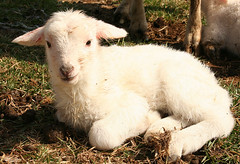
day old lamb
SonoVision, Inc. in Reisterstown, Maryland, provides state-of-the-art animal ultrasound services performed by a registered diagnostic medical sonographer.

Information from an ultrasound exam may help sheep and goat producers better manage their pregnant animals. Pregnancy in sheep may be detected as early as 30 days. Fetal number and gestational age may be determined accurately between 50-80 days.

For more information, contact Gretchen Dimling, RDMS, at SonoVision@verizon.net.

Thursday, January 17, 2008

Performance-tested bucks preferred

According to the results of a survey, 82 percent of visitors to the Western Maryland Pasture-Based Meat Goat Performance Test Blog (http://mdgoattest.blotspot.com/) would prefer to use a performance-tested buck. Four (4) percent favored "show" bucks, while 12 percent did not have a preference. Forty-seven (47) people responded to the online survey.

buck from the 2007 testThe purpose of the Western Maryland Pasture-Based Meat Goat Performance Test is to evaluate male goats for growth performance, carcass merit, and parasite resistance and to facilitate the marketing and use of top performing bucks.

The 2008 test is open to male goats of any breed or breed cross, approximately 3 to 5 months of age, and weighing a minimum of 35 lbs. (as of 6/7/08). A (slaughter) carcass component is being added to this year's test, which is conducted at the University of Maryland's Western Maryland Research & Education Center (approximately 9 miles south of Hagerstown, MD).

The top 20 bucks in this year's test, based on performance ratios and minimum standards for reproductive soundness and structural correctness, will be sold at the 1st Annual Western Maryland Pasture-Based Performance Tested Buck and Invitational Doe Sale on Saturday, October 4, 2008. Consigners to the test will also be eligible to nominate does for the sale.

For information about the test, visit the blog at http://mdgoattest.blogspot.com/. Guidelines, protocol, and nomination forms for the 2008 test will soon be posted to the blog. Send an e-mail to Susan Schoenian at sschoen@umd.edu if you'd like to subscribe to the blog, so you'll receive blog entries vial e-mail.

Friday, January 11, 2008

No beneficial effect of treament

Opinions on the importance of tapeworms (Moniezia sp.) to sheep (and goat) health and growth are controversial. Researchers in Germany used two flocks of sheep and several breeds of sheep to determine the effect of treatment (with praziquantel) for tapeworms.
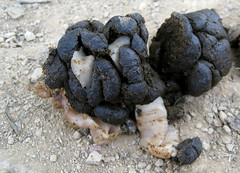
tapeworm segments in sheep fecesIndividual fecal flotations were performed (using a combination of zinc chloride and sodium chloride). Lambs were assigned to treatment (n=117) or control (n=117) groups. The treated animals received a commerical 2.5% solution of praziquantel at 3.75 mg/kg orally, repeated every six weeks for up to 4 treatments. All lambs, treated and control, received oral moxidectin on the same schedule, at the labeled dosage, to remove possible effects of nematodes on lamb health.

At the beginning of the trial, in June-July, 28 to 45% of lambs were positive for tapeworm eggs. The percentage dropped off markedly in both the treated and untreated lambs, such that 0 to 7% of treated animals and 0 to 9% of control lambs had detectable eggs at the last sampling before slaughter, up to 140 days after the beginning of the trial. There was no significant differences in body weight between the groups. In fact, the animals that remained infected with tapeworms were often heavier than the average of the uninfected lambs.
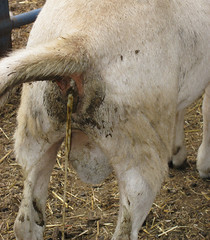
lamb passing a tapewormReinfection presumably occurred on pasture as 11 of 22 lambs last treated 30-36 days before slaughter had juvenile tapeworms in the intestine as did 5 of 45 necropsied up to 29 days after the final treatment. 29 of the 67 control lambs contained juvenile tapeworms.

In this study, the researchers found no clear evidence for pathogenicity. A beneficial effect of treatment for tapeworms could not be demonstrated in this trial.

Source: Wool & Wattles, AASRP Newsletter, October-December 2007.

About praziquantel
Praziquantel is considered to be more effective at removing tapeworms than albendazole (Valbazen®), which is more effective than fenbendazole (SafeGuard®). Praziquantel is marketed in the U.S. primarily for cats and dogs as Droncit®. Some horse dewormers contain praziquantel: Zimecterin® Gold Paste, Equimax™ Paste, and Quest® Plus Gel.

Read article on tapeworms.

Thursday, January 10, 2008

Please fill out and return survey

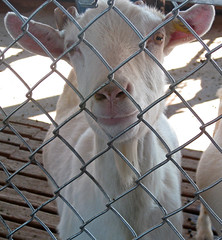
Saanen goat
Shannon Uzelac, a graduate student at the University of Maryland Eastern Shore (UMES), has put together a survey to determine goat producers' interest in a (written) Basic Guide to Goat Production.

It will only take a few minutes to fill out the survey. The completed survey can be faxed to Shannon at (401) 651-8498 or returned via the mail to Dr. Niki Whitley at University of Maryland Eastern Shore, Department of Agriculture, Trigg Hall, Princess Anne, MD 21853.

Download survey (PDF format).
E-mail Shannon at
snuzelac@umes.edu.

Your participation is appreciated. Please return the survey by March 1, 2008.

Friday, January 4, 2008

New Wild & Woolly Newsletter

The latest issue (Winter 2007) of Wild & Woolly has been posted to the web. Wild & Woolly is a quarterly sheep and goat newsletter published by University of Maryland Cooperative Extension.

Access to the newsletter via the web is FREE. From the web, the newsletter may be downloaded as a PDF file and printed in its original graphics format. You can be added to a list to receive an e-mail message when a new newsletter has been posted to the web. Contact Susan Schoenian or Cindy Mason at sschoen@umd.edu or cmason@umd.edu if you would like to be added to the newsletter or Shepherd's Blog e-mail lists.

Mailed copies of the newsletter are available for a cost recovery fee of $10 per year, payable to the University of Maryland and sent to the Western Maryland Research & Education Center, 18330 Keedysville Road, Keedysville, MD 21756, tel. (301) 432-2767 x301 or 343.

Winter 2007 issue

Past issues of the newsletter

Wednesday, January 2, 2008

Counting sheep and goats

America's farmers and ranchers will have the opportunity to make their voices heard and help shape the future of agriculture for years to come.

That opportunity will come in mailboxes in the form of the 2007 Census of Agriculture. Conducted every five years by the U.S. Department of Agriculture's National Agricultural Statistics Service (NASS), the census is a complete count of the nation's farms and ranches and the people who operate them.

Policy makers factor census data into decisions concerning agricultural and rural programs. The American Sheep Industry Association (ASI) utilizes this data as it prepares briefs and comments about the industry. All sheep and goat operations, regardless of size, are encouraged to respond.

NASS mailed out census forms Dec. 28, 2007, to collect data for the 2007 calendar year. Completed forms are due back by Feb. 4, 2008. Producers can return their forms by mail or fill the census out online via a secure Web site at www.agcensus.usda.gov.

Source: ASI Weekly for December 28, 2007