As part of efforts to eradicate scrapie, US sheep and goat producers are required to follow federal and state regulations for officially identifying their sheep and goats. Prior to October 1, 2017, the National Scrapie Eradication Program provided free plastic ear tags and applicators. As of October 1, the program will only provide free metal tags.
Producers who already have premise IDs can call 1-888- USDA-TAG to get metal tags free of charge. Producers who don't have a premise ID need to request one from their area APHIS office before ordering tags. Producers who don't want to use the metal tags will need to purchase their own identification tags/devices from approved companies.
According to federal regulations, sheep under 18 months of age that move directly into slaughter channels do not need to be identified. Wethers under 18 months of age do not need to be identified. Low risk commercial goats, slaughter goats, and castrated goats do not need to be identified, according to the federal regulations. State regulations may be stricter than federal requirements and require additional animals to be identified.
Scrapie is a fatal, degenerative disease affecting the central nervous system of sheep and goats. There is no cure or treatment for scrapie. While the incidence of scrapie has been significantly reduced, the goal remains: to have the US eventually declared scrapie-free by international animal health organizations.
Read latest fact sheet regarding scrapie identification and record keeping
Showing posts with label scrapie. Show all posts
Thursday, October 19, 2017
Thursday, March 26, 2015
Scrapie Update
Since the beginning of FY 2015, 29 sheep have tested positive for scrapie; 26 of these positives were from the same source flock. Two goats have tested for positive --both from the same herd. The most recent positive case was confirmed on February 18, 2015.
Since the beginning of FY 2015,12,683 sheep and 3,325 goats have been tested for scrapie. In November 2014, the first positive goat found through slaughter surveillance was identified. Based on the goats sampled at slaughter to date, the prevalence of scrapie in U.S. cull goats is 0.004 percent.
To report a sheep or goat with clinical signs of scrapie, please contact your local VS office. To learn more about scrapie, the disease, and the national scrapie eradication program visit the APHIS VS Scrapie Website and www.eradicatescrapie.org.
View February monthly scrapie report via PowerPoint
Since the beginning of FY 2015,12,683 sheep and 3,325 goats have been tested for scrapie. In November 2014, the first positive goat found through slaughter surveillance was identified. Based on the goats sampled at slaughter to date, the prevalence of scrapie in U.S. cull goats is 0.004 percent.
To report a sheep or goat with clinical signs of scrapie, please contact your local VS office. To learn more about scrapie, the disease, and the national scrapie eradication program visit the APHIS VS Scrapie Website and www.eradicatescrapie.org.
View February monthly scrapie report via PowerPoint
Monday, March 24, 2014
Scrapie Update
The February 2014 report for the National Scrapie Eradication Program has been posted to www.aphis.usda.gov/animal_health/animal_diseases/scrapie/downloads/monthly_report.pdf. Published by the U.S. Department of Agriculture's Animal and Plant Health Inspection Service (APHIS), the report reviews the current progress of scrapie eradication in the United States.
Since the start of Regulatory Scrapie Slaughter Surveillance (RSSS) in fiscal year (FY) 2003, there has been a 90-percent decrease in the number of positive sheep found in samples at slaughter, adjusted for face color. As of Dec. 31, 2013, the percent of cull sheep found positive at slaughter and adjusted for face color was 0.015 percent.
Eight source flocks (including two goat herds) and three infected flocks were designated in FY 2013. One source flock and three infected flocks have been designed in FY 2014.
Before the United States may be declared "scrapie free," remaining cases must be found. Sheep and goats that are slaughtered outside the commercial slaughter facilities are being missed in the routine scrapie slaughter surveillance. Submission of samples from sheep/goats over 18 months of age found dead or euthanized on farms is critically important.
Without these submissions, scrapie-infected animals will go undetected, costing the sheep and goat industries anywhere from $10 million to $20 million annually. To learn more about submitting samples, visit www.aphis.usda.gov/animal_health/animal_diseases/scrapie/gen_submission.shtml.
| Sheep with scrapie (image from Colorado State University) |
Eight source flocks (including two goat herds) and three infected flocks were designated in FY 2013. One source flock and three infected flocks have been designed in FY 2014.
Before the United States may be declared "scrapie free," remaining cases must be found. Sheep and goats that are slaughtered outside the commercial slaughter facilities are being missed in the routine scrapie slaughter surveillance. Submission of samples from sheep/goats over 18 months of age found dead or euthanized on farms is critically important.
Without these submissions, scrapie-infected animals will go undetected, costing the sheep and goat industries anywhere from $10 million to $20 million annually. To learn more about submitting samples, visit www.aphis.usda.gov/animal_health/animal_diseases/scrapie/gen_submission.shtml.
Friday, May 10, 2013
We Are Eliminating Scrapie
In its March 2013 report, USDA-APHIS reported that the percent of cull sheep (adjusted for face color) found positive for scrapie (at slaughter) was only 0.006 percent (at the end of FY2012). This is a decrease of 96 percent since slaughter surveillance began in 2003.
The goal of the National Scrapie Eradication Program is to eliminate scrapie by 2017 and document the absence of scrapie for the following 7 years, thereby giving the United States recognition as a scrapie-free country.
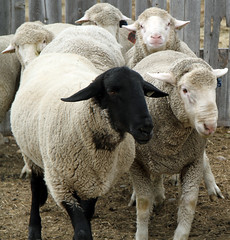
Scrapie has been diagnosed predominately in sheep and predominantly in blackface sheep. While few goats have been diagnosed with scrapie (only 32 since FY2002), a meat-type goat (in Maryland) submitted as a clinical suspect tested positive in FY2013.
Scrapie is a fatal, neurological disease that affects sheep and goats. It is in the same family of diseases (transmissible spongiform encephalopathies or TSE's) as mad cow disease, chronic wasting disease, and Creutzfeldt-Jakob disease. There is no human health risk associated with scrapie.
Source: National Scrapie Eradication Program, March 2013 Monthly Report, Fiscal Year 2013.
The goal of the National Scrapie Eradication Program is to eliminate scrapie by 2017 and document the absence of scrapie for the following 7 years, thereby giving the United States recognition as a scrapie-free country.
Scrapie has been diagnosed predominately in sheep and predominantly in blackface sheep. While few goats have been diagnosed with scrapie (only 32 since FY2002), a meat-type goat (in Maryland) submitted as a clinical suspect tested positive in FY2013.
Scrapie is a fatal, neurological disease that affects sheep and goats. It is in the same family of diseases (transmissible spongiform encephalopathies or TSE's) as mad cow disease, chronic wasting disease, and Creutzfeldt-Jakob disease. There is no human health risk associated with scrapie.
Source: National Scrapie Eradication Program, March 2013 Monthly Report, Fiscal Year 2013.
Thursday, May 9, 2013
Revisions to Scrapie Flock Certification Program
Effective June 3, 2013, USDA-APHIS is eliminating the Complete Monitored and Certified categories of the Voluntary Scrapie Flock Certification Program (SFCP). Approximately 94 percent of current program participants are in the Complete Monitored category. Forty-four percent of enrolled flocks are certified scrapie-free.
Producers who are currently enrolled in the Complete Monitored or Certified categories will have the option of converting to the (revised) Select or Export categories of the SFCP or withdrawing from the program. Both the Select and Export categories have more stringent sampling requirements than the Complete Monitored and Certified categories. Flock owners who wish to convert must notify their area APHIS office by October 31, 2013, in writing, if they wish to do so.
The Select category does not require an annual inspection, but a specified number of animals must be submitted for scrapie testing. The Select category does not provide a pathway to certification. There is no status date for a flock. In the Export category, an annual inspection is required and all clinical suspects and found dead animals must be submitted for testing. Certification is possible after 7 years of participation.
The Complete Monitored and Certified categories are being eliminated due to dwindling budgets. In the Federal Register, the following reasons were given as justification for eliminating the Complete Monitored and Certified categories of the SFCP: 1) Participating flocks represent only about 1 percent of sheep in the U.S.; 2) Participation in the SFCP has declined by about 25 percent since 2007; 3) The Complete Monitored category does not efficiently detect scrapie cases; and 4) More sheep producers are using genotyping to reduce their risk of scrapie.
According to USDA-APHIS, it makes more sense to spend limited resources on the components of the scrapie program which have had the most impact, which is slaughter surveillance.The goal of the National Scrapie Eradication Program is to eliminate scrapie by 2017 and document the absence of scrapie for the following 7 years, enabling the United States to eventually gain recognition as a scrapie-free country.
Source: SFCP 2013, An Overview of the Revised Program, USDA, APHIS. May 3, 2013.
Producers who are currently enrolled in the Complete Monitored or Certified categories will have the option of converting to the (revised) Select or Export categories of the SFCP or withdrawing from the program. Both the Select and Export categories have more stringent sampling requirements than the Complete Monitored and Certified categories. Flock owners who wish to convert must notify their area APHIS office by October 31, 2013, in writing, if they wish to do so.
| Only 1% of U.S. sheep are enrolled in the SFCP. |
The Select category does not require an annual inspection, but a specified number of animals must be submitted for scrapie testing. The Select category does not provide a pathway to certification. There is no status date for a flock. In the Export category, an annual inspection is required and all clinical suspects and found dead animals must be submitted for testing. Certification is possible after 7 years of participation.
The Complete Monitored and Certified categories are being eliminated due to dwindling budgets. In the Federal Register, the following reasons were given as justification for eliminating the Complete Monitored and Certified categories of the SFCP: 1) Participating flocks represent only about 1 percent of sheep in the U.S.; 2) Participation in the SFCP has declined by about 25 percent since 2007; 3) The Complete Monitored category does not efficiently detect scrapie cases; and 4) More sheep producers are using genotyping to reduce their risk of scrapie.
According to USDA-APHIS, it makes more sense to spend limited resources on the components of the scrapie program which have had the most impact, which is slaughter surveillance.The goal of the National Scrapie Eradication Program is to eliminate scrapie by 2017 and document the absence of scrapie for the following 7 years, enabling the United States to eventually gain recognition as a scrapie-free country.
Source: SFCP 2013, An Overview of the Revised Program, USDA, APHIS. May 3, 2013.
Tuesday, March 12, 2013
USDA APHIS Offices Merge
The USDA APHIS VS Maryland, Delaware, and Washington DC Area Office has closed and merged with the Virginia Area Office.
Inquiries regarding the mandatory and voluntary scrapie programs should be directed to the Virginia Area Office at (804) 343-2560. To request a premise ID and/or scrapie ear tags, call (804) 343-2569.
The USDA-APHIS-Veterinary Services Area Office at Richmond, Virginia is responsible for the following states: Maryland, Delaware, District of Columbia, and Virginia.
Area Veterinarian-in-Charge
USDA, APHIS, VS
400 North 8th Street Suite 726
Richmond, VA 23219-4824
Phone: (804) 343-2560
Fax: (804) 343-2599
Maryland/Delaware/DC Area Office
If you are not a resident of Maryland, Delaware, Virginia or DC, you can call 1-866-USDA-TAG (1-866-873-2824) to be connected with your local USDA APHIS Veterinary Services Area Office.
Inquiries regarding the mandatory and voluntary scrapie programs should be directed to the Virginia Area Office at (804) 343-2560. To request a premise ID and/or scrapie ear tags, call (804) 343-2569.
The USDA-APHIS-Veterinary Services Area Office at Richmond, Virginia is responsible for the following states: Maryland, Delaware, District of Columbia, and Virginia.
Area Veterinarian-in-Charge
USDA, APHIS, VS
400 North 8th Street Suite 726
Richmond, VA 23219-4824
Phone: (804) 343-2560
Fax: (804) 343-2599
Maryland/Delaware/DC Area Office
If you are not a resident of Maryland, Delaware, Virginia or DC, you can call 1-866-USDA-TAG (1-866-873-2824) to be connected with your local USDA APHIS Veterinary Services Area Office.
Thursday, August 2, 2012
Help eradicate scrapie
USDA needs help from producers to get surveillance samples to test from flocks and herds that sell cull animals only through nontraditional markets. USDA is asking for owners of these types of flocks or herds to submit the heads of animals found dead between 30 and 52 months of age to the state diagnostic laboratory for scrapie testing.
This is especially true if the sheep are of a black-face meat breed or if they have been commingled with ewes of a black-face meat breed even if the commingling occurred several years ago. In the recent goat cases, there was a history of Suffolk sheep having been commingled with the goats years before the positive goat cases were found.
Likewise it is critical that all producers notify their state veterinarian’s office or their area USDA Veterinary Services office (866/873-2824) if they have a sheep or goat over 18 months of age with neurological signs such as incoordination, behavioral changes or severe frequent rubbing with wool loss and thickened or abraded skin.
Producers can prevent scrapie by maintaining a flock/herd closed to female additions, increasing genetic resistance and/or only purchasing ewes that are genetically resistant or from certified scrapie-free flocks/herds.
Importance of record keeping
It is important for producers to keep good records of sales and purchases. Last year, two positive sheep could not be traced due to poor records. Since the incubation period for scrapie is typically three to five years, it is critical that producers keep purchase and sales records for at least five years.
Source: Quarterly Scrapie Newsletter. June 12, 2012
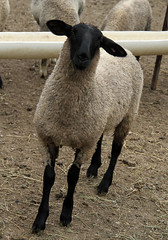
| Suffolk ewe lamb |
Likewise it is critical that all producers notify their state veterinarian’s office or their area USDA Veterinary Services office (866/873-2824) if they have a sheep or goat over 18 months of age with neurological signs such as incoordination, behavioral changes or severe frequent rubbing with wool loss and thickened or abraded skin.
Producers can prevent scrapie by maintaining a flock/herd closed to female additions, increasing genetic resistance and/or only purchasing ewes that are genetically resistant or from certified scrapie-free flocks/herds.
Importance of record keeping
It is important for producers to keep good records of sales and purchases. Last year, two positive sheep could not be traced due to poor records. Since the incubation period for scrapie is typically three to five years, it is critical that producers keep purchase and sales records for at least five years.
Source: Quarterly Scrapie Newsletter. June 12, 2012
Tuesday, July 31, 2012
Scrapie surveillance in goats
A potential stumbling block to scrapie eradication has been identified that needs to be addressed. Last fiscal year, for the first time, there were more scrapie field cases in goats than in sheep.
In FY 2008 and 2011, two significant scrapie outbreaks occurred in goats involving a total of 18 positive goats. The initial case in each outbreak was discovered through owner submission of a suspect animal. In one outbreak, while sheep had resided on the farm years earlier, none of the positive goats had come in contact with sheep.
In the other outbreak, the positive goats no longer resided with sheep. This indicates that to eradicate scrapie from the United States it will be necessary to conduct slaughter surveillance in goats similar to what is being done for sheep.
The current goat identification rules are inadequate to allow for effective slaughter surveillance in goats. To address this situation USDA is planning to publish a proposed rule that will consider making the identification requirements for goats similar to those currently in place for sheep.
Source: Quarterly Scrapie Newsletter. June 12, 2012.
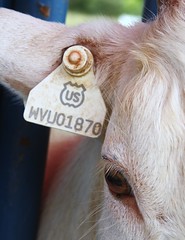
| Scrapie ear tag |
In the other outbreak, the positive goats no longer resided with sheep. This indicates that to eradicate scrapie from the United States it will be necessary to conduct slaughter surveillance in goats similar to what is being done for sheep.
The current goat identification rules are inadequate to allow for effective slaughter surveillance in goats. To address this situation USDA is planning to publish a proposed rule that will consider making the identification requirements for goats similar to those currently in place for sheep.
Source: Quarterly Scrapie Newsletter. June 12, 2012.
Tuesday, November 9, 2010
A new test to detect scrapie
Scientists at Iowa State University have discovered a way to detect scrapie in sheep using fluorescence spectroscopy. The eyes of sheep infected with scrapie return an intense, almost-white glow when they're illuminated with blue excitation light, says Jacob Petrich.
The accidental discovery occurred while Petrich and his collaborators were developing a fluorescence spectroscopy device used in slaughterhouses to test livestock carcasses for possible E. coli contamination.
The findings suggest technologies and techniques can be developed to quickly and non-invasively test for transmissible spongiform encephalopathies. Petrich, in fact, is working to develop a testing device.
Petrich and a team of researchers began studying the feasibility of a fluorescence test. The researchers collected 140 eyeballs from 73 sheep. Thirty five of those sheep were infected with scrapie; 38 were not. The researchers took fluorescence readings from various parts of the eyes of all the sheep.
"The bottom line is the scrapie-positive retinas fluoresced like crazy," Petrich said. "And the scrapie-negative ones did not."
Read full article at OptoIQ
Editor's note: According to Dr. Petrich, the test should work on both live, sedated sheep and intact carcasses. It should work the same in goats.
The accidental discovery occurred while Petrich and his collaborators were developing a fluorescence spectroscopy device used in slaughterhouses to test livestock carcasses for possible E. coli contamination.
The findings suggest technologies and techniques can be developed to quickly and non-invasively test for transmissible spongiform encephalopathies. Petrich, in fact, is working to develop a testing device.
Petrich and a team of researchers began studying the feasibility of a fluorescence test. The researchers collected 140 eyeballs from 73 sheep. Thirty five of those sheep were infected with scrapie; 38 were not. The researchers took fluorescence readings from various parts of the eyes of all the sheep.
"The bottom line is the scrapie-positive retinas fluoresced like crazy," Petrich said. "And the scrapie-negative ones did not."
Read full article at OptoIQ
Editor's note: According to Dr. Petrich, the test should work on both live, sedated sheep and intact carcasses. It should work the same in goats.
Tuesday, October 12, 2010
Scrapie eradication is in sight . . .
Scrapie eradication is in sight, and producers are the key to finding the last cases. There are three ways that sheep and goat producers can lead in the fight against scrapie:
| Scrapie tag in sheep's left ear |
- Correctly identify sheep and goats.
The Scrapie Eradication Program is a mandatory program which requires sheep and goat producers, dealers, markets, and slaughter plants to officially identify certain sheep and goats. Most sheep and goats must be officially identified prior to selling them or transporting them from their place of birth. To get free official ear tags (and an applicator), call 866-USDA-TAG.
- Protect your flock or herd.
There are several precautions that producers can take to minimize the risk of getting scrapie in their flock or herd: 1) Close the herd to female additions; 2) Use RR rams; 3) Remove placentas and bedding soiled by birth fluids from birthing areas right away and thoroughly clean birthing areas; 4) Buy sheep and goats from flocks that have reached the certified level of the National Scrapie Flock Certification Program; and 5) Quarantine all new animals to observe for any signs of scrapie.
- Report suspect sheep and goats.
If any signs of scrapie are noticed in a sheep or goat over 18 months of age that continue for several weeks or if a mature sheep or goat dies after showing some signs, report it to your veterinarian, state veterinarian, or USDA's Veterinary Services at (866) 873-2824.
Thursday, July 1, 2010
Free carcass disposal
Until funds run out, any sheep or goat over 14 months of age that has died in a Maryland flock (or herd) can be disposed of at the Frederick Animal Health Laboratory at no charge to the owner.
The USDA will cover the disposal cost as part of the Scrapie Eradication Program. These animals will be tested for scrapie.
For more information, contact Dr. Kent Holm at Kent.B.Holm@aphis.usda.gov.
The USDA will cover the disposal cost as part of the Scrapie Eradication Program. These animals will be tested for scrapie.
For more information, contact Dr. Kent Holm at Kent.B.Holm@aphis.usda.gov.
Saturday, January 10, 2009
Sheep & Goat Health Report
The National Institute of Animal Agriculture (NIAA) has published a special issue of the Sheep & Goat Health Report. To read this latest issue, go to http://www.animalagriculture.org/publications/sheepintropage.asp.
The issue contains articles on scrapie eradication, Nor98-like scrapie, OPP (ovine progressive pneumonia), spontaneous abortions caused by toxoplasmosis, wormer resistance, and biosecurity.
Thursday, October 23, 2008
Quarterly Scrapie Newsletter
The goal of the American Sheep Industry Association (ASI) and the U.S. sheep and goat industry is to eradicate scrapie from our borders and to have the World Organization for Animal Health declare the United States free from scrapie in 2017.
ASI publishes a quarterly newsletter that provides current information from all 50 states, as well as from the U.S. Department of Agriculture and other organizations. The newsletter provides up-to-date information on scrapie eradication efforts in the U.S.
The September 2008 issue of the newsletter includes a brochure for youth involvement. If you have information that you would like to have included in the newsletter, contact ASI at becky@sheepusa.org.
Download September 2008 Scrapie newsletter
ASI publishes a quarterly newsletter that provides current information from all 50 states, as well as from the U.S. Department of Agriculture and other organizations. The newsletter provides up-to-date information on scrapie eradication efforts in the U.S.
The September 2008 issue of the newsletter includes a brochure for youth involvement. If you have information that you would like to have included in the newsletter, contact ASI at becky@sheepusa.org.
Download September 2008 Scrapie newsletter
Friday, August 29, 2008
Scrapie resistance and production
The current USDA APHIS scrapie eradication program utilizes genotyping for alleles that confer resistance to scrapie.
Genotyping has been utilized in the University of Wyoming Performance Test since 2002. Performance test records from 2002 to 2006 (n=518) were analyzed to determine if any production loss or benefit was associated with scrapie resistance in Rambouillet rams.
Performance of rams with scrapie-resistant genotypes was equal to or better than scrapie-susceptible rams. Based on test performance as an acceptable indicator of sire superiority, selection for rams with scrapie-resistant genotypes should not negatively impact flock performance.
Source: Research in Veterinary Science, October 2008
Performance of rams with scrapie-resistant genotypes was equal to or better than scrapie-susceptible rams. Based on test performance as an acceptable indicator of sire superiority, selection for rams with scrapie-resistant genotypes should not negatively impact flock performance.
Source: Research in Veterinary Science, October 2008
Saturday, May 3, 2008
Blood test for scrapie
Amorfix Life Sciences Ltd. announced this week the detection of endogenous prions in the blood plasma of asymptomatic scrapie-infected sheep.
"Identification of scrapie sheep prior to symptoms is critical for an effective program to eradicate the disease," said George Adams, Ph.D., chief executive officer for Amorfix. "For the first time, we have been able to sort scrapie infected and unaffected sheep using a simple blood test."
Scrapie-infected lambs as early as 17 months of age were detected by the Amorfix EP-TSE™ test. Sheep normally show symptoms of scrapie at three years to five years of age. Detection of infected sheep two to three years prior to symptoms will allow effective removal of infected animals before they have the ability to infect other sheep in the flock.
Amorfix is in discussions with potential partners to complete product development, regulatory approvals and commercialize the EP-TSE™ test.
ASI Weekly, May 2, 2008
Amorfix Life Sciences Ltd. is a theranostics company developing therapeutic products and diagnostic devices targeting brain-wasting diseases including ALS, Alzheimer’s Disease, Parkinson’s Disease and variant Creutzfeldt-Jakob Disease (vCJD).
Scrapie-infected lambs as early as 17 months of age were detected by the Amorfix EP-TSE™ test. Sheep normally show symptoms of scrapie at three years to five years of age. Detection of infected sheep two to three years prior to symptoms will allow effective removal of infected animals before they have the ability to infect other sheep in the flock.
Amorfix is in discussions with potential partners to complete product development, regulatory approvals and commercialize the EP-TSE™ test.
ASI Weekly, May 2, 2008
Amorfix Life Sciences Ltd. is a theranostics company developing therapeutic products and diagnostic devices targeting brain-wasting diseases including ALS, Alzheimer’s Disease, Parkinson’s Disease and variant Creutzfeldt-Jakob Disease (vCJD).
Tuesday, April 22, 2008
Five goats diagnosed with scrapie
Five goats from a farm in Michigan have been diagnosed with the fatal brain disease scrapie. Scrapie was first detected in a 3-year old 4-H Nubian goat in December 2007. Since then, scrapie was diagnosed in four other Nubian and Alpine goats. All goats in the herd have been destroyed to prevent spread of the disease.
How the first goat contacted the disease is unknown. The animal was born in 2004 and transferred to another farm in 2007. Sheep had previously been raised on the second farm, but the goat did not have direct contact with any sheep. Officials wonder if there may have been a carryover of infective material in the soil or vegetation.
While Michigan goats no longer meet federal criteria for "low-risk," the diagnosis of scrapie in five goats does not portend a disease outbreak. It underscores the importance of animal and premise identification. Scrapie is not known to pose a human health threat.
Goats with contagious brain disease destroyed
Eradicate Scrapie! - National Institute for Animal Health
While Michigan goats no longer meet federal criteria for "low-risk," the diagnosis of scrapie in five goats does not portend a disease outbreak. It underscores the importance of animal and premise identification. Scrapie is not known to pose a human health threat.
Goats with contagious brain disease destroyed
Eradicate Scrapie! - National Institute for Animal Health
Monday, April 14, 2008
Scrapie transmitted to lambs through milk
Scrapie can be transmitted to lambs through milk, according to new research. The study provides important information on the transmission of this prion-associated disease and the control of scrapie in affected flocks. Scrapie is a fatal neurodegenerative disease of sheep and goats.
Timm Konold and colleagues from the Veterinary Laboratories Agency in Weybridge, United Kingdom, investigated the transmission of scrapie by feeding milk from scrapie-affected ewes to lambs that are genetically susceptible to contracting scrapie. The researchers were looking for the presence of the prion protein, PrPd, which is associated with the disease.
Eighteen lambs were fed milk from scrapie-affected ewes. Three of these lambs were culled and two were found to have PrPd in intestinal tissues. The prion protein was also detected in lymphoid tissue of the gut of the surviving lambs and in some control lambs, mixed with the scrapie milk recipients after weaning.
According to Katherine O'Rourke, Ph.D., of the U.S. Department of Agriculture's Agricultural Research Service, "These results help confirm earlier research demonstrating that abnormal prions can be found in the udders of some scrapie-infected sheep with mastitis."
There are no known human health implications from scrapie.
Source: ASI Weekly, April 11, 2008.
Adapted from a news story by Sciencedaily.com
Eighteen lambs were fed milk from scrapie-affected ewes. Three of these lambs were culled and two were found to have PrPd in intestinal tissues. The prion protein was also detected in lymphoid tissue of the gut of the surviving lambs and in some control lambs, mixed with the scrapie milk recipients after weaning.
According to Katherine O'Rourke, Ph.D., of the U.S. Department of Agriculture's Agricultural Research Service, "These results help confirm earlier research demonstrating that abnormal prions can be found in the udders of some scrapie-infected sheep with mastitis."
There are no known human health implications from scrapie.
Source: ASI Weekly, April 11, 2008.
Adapted from a news story by Sciencedaily.com
Friday, April 11, 2008
Nor98-like scrapie found in U.S.
Nor98 is an atypical scrapie first found in Norway in 1998. It has since been found in sheep and goats in many European countries. Last year, the first case of Nor98 was found in the United States. Since then four more cases have been discovered; none in goats.
Nor98 affects sheep and goats of all common genotypes, including those that are resistant to classical scrapie. Nor98 is more difficult to detect than classical scrapie because the distribution of prions is different, and live animal tests involving the lymph tissue do not work.
Unlike classical scrapie, most cases of Nor98 occur in normal-appearing sheep that are over five years of age. Twenty-five pecent of the cases occur in sheep over 10. Seldom does the disease occur in more than one sheep in a flock (unless flock size exceeds 500). There is speculation that Nor98 may be a sporadic disease of sheep, occurring primarily, but not exclusively in older sheep.
The international community is still deciding how to deal with Nor98 scrapie. Research is currently underway in Europe and the United States. At this point, it is not known if and how Nor98 is transmitted. Age and genetics are considered primary risk factors.
To prevent the introduction of all types of scrapie, sheep and goat producers should maintain closed flocks. Breeding stock should only be purchased from farms with a known scrapie status. The genetics of purchased animals should be known.
The goal of the American Sheep Industry Association (ASI) and U.S. sheep and goat industry is to eradicate scrapie by 2010 and to have the World Organization for Animal Health declare the United States scrapie-free by 2017.
Read about Nor98 in the March 2008 issue of Scrapie: Eradicate it
Unlike classical scrapie, most cases of Nor98 occur in normal-appearing sheep that are over five years of age. Twenty-five pecent of the cases occur in sheep over 10. Seldom does the disease occur in more than one sheep in a flock (unless flock size exceeds 500). There is speculation that Nor98 may be a sporadic disease of sheep, occurring primarily, but not exclusively in older sheep.
The international community is still deciding how to deal with Nor98 scrapie. Research is currently underway in Europe and the United States. At this point, it is not known if and how Nor98 is transmitted. Age and genetics are considered primary risk factors.
To prevent the introduction of all types of scrapie, sheep and goat producers should maintain closed flocks. Breeding stock should only be purchased from farms with a known scrapie status. The genetics of purchased animals should be known.
The goal of the American Sheep Industry Association (ASI) and U.S. sheep and goat industry is to eradicate scrapie by 2010 and to have the World Organization for Animal Health declare the United States scrapie-free by 2017.
Read about Nor98 in the March 2008 issue of Scrapie: Eradicate it
Friday, March 21, 2008
New live animal test for scrapie
USDA-APHIS has approved a new live animal test to detect scrapie in sheep and goats. The rectal biopsy was approved in January. Scrapie is a fatal, degenerative disease that affects the nervous systems of sheep and goats. It is one of several transmissible spongiform encephalopathies (TSEs).
In recent research, it was discovered that disease-associated prion protein accumulates in the lymphoid tissue of the rectal mucosa in a high percentage of scrapie-infected sheep. Rectal biopsies have the advantages of providing high numbers of lymphoid follicles for testing and are considered to be relatively easy to perform.
The intent is that the rectal biopsy will be used for all of the same purposes as the third eyelid test. With a sensitivity level reaching into the 87th percentile for detecting scrapie-positive sheep, the rectal biopsy is proving to be as effective as the third eyelid test. It is also anticipated that there will be a lower risk of receiving a 'no-test' result.
"This newly approved test is as good or better for diagnosing scrapie in live sheep and goats than the third eyelid test for a number of reasons," stated Diane Sutton, DVM, coordinator for the National Scrapie Eradication Program. "It is less invasive and less stressful for the animal so producers should like it better, and it is a faster and easier test to perform for the veterinarian."
The rectal biopsy is currently only being used by USDA and state personnel for scrapie testing but is expected to be available to accredited veterinarians in the future after training and guidance have been provided.
Source: ASI Weekly, March 21, 2008
In recent research, it was discovered that disease-associated prion protein accumulates in the lymphoid tissue of the rectal mucosa in a high percentage of scrapie-infected sheep. Rectal biopsies have the advantages of providing high numbers of lymphoid follicles for testing and are considered to be relatively easy to perform.
"This newly approved test is as good or better for diagnosing scrapie in live sheep and goats than the third eyelid test for a number of reasons," stated Diane Sutton, DVM, coordinator for the National Scrapie Eradication Program. "It is less invasive and less stressful for the animal so producers should like it better, and it is a faster and easier test to perform for the veterinarian."
The rectal biopsy is currently only being used by USDA and state personnel for scrapie testing but is expected to be available to accredited veterinarians in the future after training and guidance have been provided.
Source: ASI Weekly, March 21, 2008
Monday, January 28, 2008
Prevalence of scrapie in goats
While there have been only 19 cases of scrapie in goats reported since 1990, the extent to which the disease affects goats is not known. USDA is in the process of determining the prevalence of scrapie in the U.S. goat population.
The study started in May of 2007 and is expected to be completed in 2008. The primary sampling sites are those most likely to slaughter goats that have been comingled with sheep and slaughter facilities which have found scrapie-infected sheep.
The goal of the study is to determine the prevalence of scrapie in goats. If no scrapie is found, there will be a 95 percent confidence that the prevalence is below 0.1 percent (1 in 1,000 goats).
USDA is currently conducting research to determine which codons affect scrapie susceptibility in goats. Currently, all goats test QQ, though it is not known if resistance /susceptibility is determined solely by codon 171.
Source: Sheep & Goat Health Report, Fall/Winter 2007
The goal of the study is to determine the prevalence of scrapie in goats. If no scrapie is found, there will be a 95 percent confidence that the prevalence is below 0.1 percent (1 in 1,000 goats).
USDA is currently conducting research to determine which codons affect scrapie susceptibility in goats. Currently, all goats test QQ, though it is not known if resistance /susceptibility is determined solely by codon 171.
Source: Sheep & Goat Health Report, Fall/Winter 2007
Subscribe to:
Posts (Atom)