

Showing posts with label reproduction. Show all posts
Showing posts with label reproduction. Show all posts
Monday, July 31, 2017


Thursday, January 12, 2017
Best Management Practices to Increase Lamb Crop
The American Sheep Industry Association (ASI) has published a set of 12 Best Management Practices fact sheets. The fact sheet series is aimed at helping producers increase their lamb crop. They are written and reviewed by Sheep Specialists throughout the United States.
The fact sheets have been professionally edited and are now available for downloading from the United States Lamb Resource Center.
The fact sheets have been professionally edited and are now available for downloading from the United States Lamb Resource Center.
- Accelerated Lambing Cycles
- Breeding Ewe Lambs at 7-9 Months
- Cull Underperforming Ewes
- Disease Prevention and Treatment
- Manage for Seasonal Changes in Reproduction
- Match Reproduction to Management
- Optimal Nutrition
- Reduce Lamb Loss
- Select for Prolific Genetics
- Test for Pregnancy Status
- Testing Rams for Breeding Soundness
- Use Crossbreeding
Sunday, March 8, 2015
Goat AI Short Course in North Carolina
North Carolina State University will be holding a Goat Artificial Insemination (AI) Short Course on August 10-12, 2015, at the Small Ruminant Educational Unit on the North Campus of North Carolina State University in Raleigh, North Carolina.
 The 3-day short course is designed to provide participants with both theoretical background and significant opportunity for hands-on practice needed to facilitate the adoption of artificial insemination into their goat breeding programs. With the use of improved transcervical AI breeding techniques for goats, pregnancy rates comparable to those routinely achieved for AI in cattle are now possible.
The short course will consist of an initial series of lectures on Monday morning coupled with four hands-on practice sessions (Monday pm, Tuesday am & pm, and Wednesday am). Lecture topics will include anatomy & physiology of the female reproductive tract, estrous & ovulation synchronization, AI breeding techniques (standard and improved), and the use of frozen semen for AI.
For more information and to register online, go to:
http://www.cals.ncsu.edu/ncsugoatAI/.
Thursday, May 8, 2014
Goat AI Course in North Carolina
A three-day short course on goat artificial insemination is scheduled for Aug. 11-13 at North Carolina State University in Raleigh, North Carolina.
 The course will feature presentations by faculty members from North Carolina State University and North Carolina A&T State University. It is designed to provide participants with the background and hands-on practice needed to include artificial insemination in goat breeding programs.
Morning lectures will be followed by afternoon hands-on practice sessions. Topics to be covered include anatomy and physiology of the female reproductive tract, estrous synchronization, ovulation synchronization, AI breeding techniques (standard and improved), use of fresh, chilled and frozen semen and management considerations including record keeping systems, facilities requirements and pre- and post-breeding management.
The registration cost is $400 until July 21 and $450 after that date. Registration fee includes refreshment breaks, daily lunch, course manual and CD, transportation to/from host hotel and all course venues or parking passes for personal vehicles. The course coordinator is Dr. Charlotte Farin, professor of animal science at North Carolina State University.
Course information, including course and hotel reservation information, is available online at http://www.cals.ncsu.edu/ncsugoatAI/ or
https://www.facebook.com/events/730296180322180/.
The course will feature presentations by faculty members from North Carolina State University and North Carolina A&T State University. It is designed to provide participants with the background and hands-on practice needed to include artificial insemination in goat breeding programs.Morning lectures will be followed by afternoon hands-on practice sessions. Topics to be covered include anatomy and physiology of the female reproductive tract, estrous synchronization, ovulation synchronization, AI breeding techniques (standard and improved), use of fresh, chilled and frozen semen and management considerations including record keeping systems, facilities requirements and pre- and post-breeding management.
The registration cost is $400 until July 21 and $450 after that date. Registration fee includes refreshment breaks, daily lunch, course manual and CD, transportation to/from host hotel and all course venues or parking passes for personal vehicles. The course coordinator is Dr. Charlotte Farin, professor of animal science at North Carolina State University.
Course information, including course and hotel reservation information, is available online at http://www.cals.ncsu.edu/ncsugoatAI/ or
https://www.facebook.com/events/730296180322180/.
Friday, April 18, 2014
Goat Artificial Insemination Clinic
There will be a Goat Artificial Insemination (AI) Clinic on May 16-17 at the University of Maryland Eastern Shore (UMES) in Princess Anne.
Ms. Teresa Wade from BIO-Genics, LTD will be the instructor for the two-day event. The workshop will run from 9 a.m. to 5 p.m. on both days. On the first day, students will spend the day in the classroom. On the second day, students will practice AI with does at the UMES small ruminant farm.
Class size is limited to 14. The registration fee is $175 per student. After the clinic, ten AI kits used during the clinic will be available for purchase for $80. The kits will include everything a goat producer needs to successfully perform AI.
For more information, contact Dr. Nelson Escobar at (410) 651-7930 or enescobar@umes.edu.
Online registration will be available at https://www.umes.edu/1890-MCE/.
Thursday, November 21, 2013
Effect of DDGS on Ram Reproduction
Dried distiller's grains with solubles (DDSG) have become a popular feedstuff, due to the expansion of the ethanol industry and the increase in the price of cereal grains. However, it is recommended that growing bulls and rams not be fed DDSG, due to the fear of a negative effect on reproduction. Researchers at North Dakota State University conducted a study to
determine the effect of DDGS on the performance, carcass characteristics, and
reproductive traits of growing rams.
One hundred and twenty crossbred (Suffolk x western white face) ram lambs received one of three ground diets: 1) 85% corn and 15% market lamb pellet; 2) 15% DDGS substituted for corn; or 3) 30% DDGs substituted for corn. Rams were weighed on consecutive days at the beginning and end of the trial and every 28 days. Scrotal circumference was measured on all rams at d 84, 96, and 117. Semen and blood samples were collected on a subset of the rams (n=48).
Dry matter intake (DMI) and average daily gain (ADG) increased linearly with the addition of DDGS in the diet (similar to other research). Carcass traits were not affected by dietary treatment. Change in scrotal circumference, serum testosterone concentrations, and sperm motility were not affected by dietary treatment. However, spermatozoa concentrations decreased linearly as DDGS increased in the diet.
More research is needed to determine the impact of DDGS on ram development.
References
North Dakota State University 2013 Research Report
Journal of Animal Science (December 2013) Abstract
 |
| DDGS |
Dry matter intake (DMI) and average daily gain (ADG) increased linearly with the addition of DDGS in the diet (similar to other research). Carcass traits were not affected by dietary treatment. Change in scrotal circumference, serum testosterone concentrations, and sperm motility were not affected by dietary treatment. However, spermatozoa concentrations decreased linearly as DDGS increased in the diet.
More research is needed to determine the impact of DDGS on ram development.
References
North Dakota State University 2013 Research Report
Journal of Animal Science (December 2013) Abstract
Wednesday, October 2, 2013
Understanding Embryo Survival
New Zealand researchers evaluated the effect of age, weight, and sire on embryo and fetal survival in sheep. Data consisted of 11,369 records on ovulation rate and litter size.
Ovulation rate was lowest at age 2 and increased from age 2 to 6. In ewes that survived to year 6, the mean litter size was 1.87, 2.05, 2.01, 2.07, and 1.91 in ewes of age 2, 3, 4, 5, and 6, respectively. Litter size was less in ewes of age 2 and 6 compared to ewes of age 3, 4, and 5.
Two-year-old ewes had lower embryo survival than 3-yr-old ewes and the probability of embryo survival decreased after age 3. Thus, embryo survival contributes significantly to lower fertility in 2-year-old ewes. In ewes with high ovulation rates, more balanced ovulations tended to be associated with increased embryo survival.

There was a quadratic effect of ewe weight on embryo survival, with decreased embryo survival for low and high ewe weights. There was a positive linear relationship between pre-breeding ewe weight and ovulation rate. The optimal ewe weight for embryo survival increased with ovulation rate, which is consistent with the requirement of greater body reserves for maintaining a larger number of fetuses during gestation.
A quadratic relationship between ewe weight and the probability that a ewe is able to maintain a pregnancy was also observed, Pregnancy loss is due to failure of the embryo or fetus or failure of the dam to maintain the pregnancy. The sire of the embryo only influences the embryo, whereas the maternal grand sire influences both the ewe and the embryo.
Genetically, the dam’s ability to maintain a pregnancy has 5.5 times the effect on pregnancy loss than the embryo’s ability to survive. Therefore, selection among dams based on the mean embryonic survival of their embryos will provide an effective way to improve embryonic survival.
Source: Abstract, Journal of Animal Science. October 2013.
Wednesday, May 8, 2013
Goat AI Course in North Carolina
A three-day short course on goat artificial insemination is scheduled for August 12-14, 2013, at North Carolina State University in Raleigh, North Carolina.
 The course will feature presentations by faculty members from North Carolina State University and North Carolina A&T State University. It is designed to provide participants with the background and hands-on practice needed to include artificial insemination in goat breeding programs.
Morning lectures from N.C. State and N.C. A&T State faculty members will be followed by afternoon hands-on practice sessions. Topics to be covered include anatomy and physiology of the female reproductive tract, estrous synchronization, ovulation synchronization, AI breeding techniques (standard and improved), use of fresh, chilled and frozen semen and management considerations including record keeping systems, facilities requirements and pre- and post-breeding management.
The registration cost is $400 until July 20 and $450 after that date. The course coordinator is Dr. Charlotte Farin, Professor of Animal Science at N.C. State University.
Course information, including course and hotel reservation information, is available online at http://www.cals.ncsu.edu/ncsugoatAI/.
Saturday, May 4, 2013
A Blood Test to Determine Pregnancy
In their recently published 2013 Sheep Research Report, North Dakota State University reported on a study whereby they evaluated the effectiveness of the BioPRYN blood test to detect early pregnancy and pregnancy rates in sheep.
The BioPRYN test can be used to determine pregnancy status in cattle, bison, goats, sheep, deer, elk, and other ruminants. It measures the presence of Pregnancy-Specific Protein B (PSPB), a protein only produced by the placenta of a growing fetus, in the blood circulation of the female.
In the North Dakota study, pregnancy was detected as early as 20 days in one ewe; however, 72 percent of the ewes were falsely determined to be open when the test was conducted before 25 days of pregnancy. Testing between 25 and 30 days accurately determined pregnancy in 83 percent of pregnancies. Testing after 30 days of pregnancy accurately identified 98 percent of pregnant ewes.
Breed and age of pregnancy were strongly correlated with PSPB concentrations. Concentrations of PSPB were not correlated with litter size in the Katahdin and Hampshire breeds. Thus, the test could not be used to determine pregnancy rates in ewes of these breeds.
 Concentrations of PSPB were strongly correlated with litter size in the Columbia and Dorset breeds. Thus, PSPB concentrations could be used to sort Columbia and Dorset ewes into pregnancy groups. However, the exact date of breeding would need to be known.
The BioPRYN (PRYN stands for "Pregnant Ruminant Yes No) test is commercially available from BioTracking, LLC. The test costs approximately $6.50, plus the cost of the sample tube and needle
The alternative to blood testing for pregnancy is ultrasound scanning, which requires expensive equipment and a highly trained technician. In some states, only licensed veterinarians may provide the service.
Source: Efficacy of pregnancy specific protein B assay to predict pregnancy and pregnancy rate in sheep, 2013 Sheep Research Report. North Dakota State University.
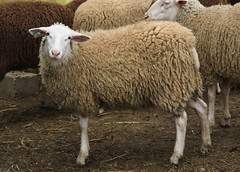 |
| Is she or isn't she? |
In the North Dakota study, pregnancy was detected as early as 20 days in one ewe; however, 72 percent of the ewes were falsely determined to be open when the test was conducted before 25 days of pregnancy. Testing between 25 and 30 days accurately determined pregnancy in 83 percent of pregnancies. Testing after 30 days of pregnancy accurately identified 98 percent of pregnant ewes.
Breed and age of pregnancy were strongly correlated with PSPB concentrations. Concentrations of PSPB were not correlated with litter size in the Katahdin and Hampshire breeds. Thus, the test could not be used to determine pregnancy rates in ewes of these breeds.
 Concentrations of PSPB were strongly correlated with litter size in the Columbia and Dorset breeds. Thus, PSPB concentrations could be used to sort Columbia and Dorset ewes into pregnancy groups. However, the exact date of breeding would need to be known.
The BioPRYN (PRYN stands for "Pregnant Ruminant Yes No) test is commercially available from BioTracking, LLC. The test costs approximately $6.50, plus the cost of the sample tube and needle
The alternative to blood testing for pregnancy is ultrasound scanning, which requires expensive equipment and a highly trained technician. In some states, only licensed veterinarians may provide the service.
Source: Efficacy of pregnancy specific protein B assay to predict pregnancy and pregnancy rate in sheep, 2013 Sheep Research Report. North Dakota State University.
Thursday, April 11, 2013
Skewing the male: female ratio
 Diets high in omega-6 (n-6) fatty acids in mice have been associated with a higher proportion of female offspring. So, Australian researchers designed a study to determine whether feeding ewes a diet differing in n-6 for 6 weeks before and 3 weeks after conception would increase the proportion of females born.
Merino x Border Leicester ewes (n=296) received either a diet high in n-6 (70% oat grain, 8% cottonseed meal) or a control diet low in n-6 (88% legume silage) for 42 or 53 days before and 17 days after conception. After mating, all ewes grazed improved pastures until lambing.
Plasma n-6 concentrations were greater, the time to parturition was shorter, and the proportion of female offspring was higher (58.2 vs. 43.5%) for the ewes fed the high n-6 diet compared to the low n-6 diet.
Further research is needed to find out if the observed differences in the sex ratio were due to the alterations in the n-6 fatty acids or other differences in the diet (e.g. energy density).
Source: Animal Production Science. April 2013.
Monday, December 17, 2012
Flushing range ewes
A study was conducted (in Wyoming) to determine the effect of flushing on the reproductive performance of range ewes. Flushing or supplementing ewes just prior to, and during the breeding season has been shown to improve the ovulation rate of ewes.
From a range flock of 6,500 ewes plus replacements, 1,600 ewes were selected for flushing. The ewes were fed a pelleted supplement for 35 days. The initial amount fed was 0.4 lbs. per head per day. It was gradually increased to 1.3 lbs. per head per day by the end of the breeding season.
Lambing rate is difficult to determine on range land so the number of lambs per flock was determined when lambs were gathered for castration, docking and vaccination the following spring. On average, flushing increased lamb survival rate from 78% (without supplement) to 90% (with supplement) on the range.
 A small-scale pen study was also conducted with two groups of 25 ewes. The supplemented group was fed 1.11 lbs. per
head per day or 39 lbs. of supplement. Lambing rate increased 37% for
ewes receiving supplement compared to those not receiving supplement.
 The profitability of flushing will obviously depend on both lamb and grain prices. Producers may be able to cut costs by shortening the supplementation period or feeding less processed feeds. Ewes already in good body condition may not benefit from flushing.
Source: Journal of the National Association of County Agricultural Agents.Vol. 5. Issue 2.
Read full journal article
From a range flock of 6,500 ewes plus replacements, 1,600 ewes were selected for flushing. The ewes were fed a pelleted supplement for 35 days. The initial amount fed was 0.4 lbs. per head per day. It was gradually increased to 1.3 lbs. per head per day by the end of the breeding season.
Lambing rate is difficult to determine on range land so the number of lambs per flock was determined when lambs were gathered for castration, docking and vaccination the following spring. On average, flushing increased lamb survival rate from 78% (without supplement) to 90% (with supplement) on the range.


Source: Journal of the National Association of County Agricultural Agents.Vol. 5. Issue 2.
Read full journal article
Monday, November 19, 2012
What if you overfeed adolescent ewes...
Researchers at Colorado State University conducted two experiments to determine the effect of overfeeding on naturally-mated, adolescent ewes. Single-bearing ewes were fed diets meeting their gestational NRC requirements (MN; n=10 in Exp. 1, and n=7 in Exp. 2) or the same diets ad libitum (15% refusal rate) throughout gestation (HN; n=7 in Exp. 1, n=6 in Exp. 2).
Ewe body weight was greater for HN than MN ewes beginning on d-75 and d-52 of gestation for Experiment 1 and 2, respectively. Final body condition score was greater for the HN than MN ewes in both experiments, 3.5 vs. 3.0, respectively for Experiment 1, and 4.8 vs. 2.9, respectively for Experiment 2.
Gestation length did not differ by treatment in Experiment 1, but in Experiment 2, HN ewes had shorter gestation lengths (144 vs. 149 days) and increased dystocia scores. There were no differences in lamb birth weight and fetal measurements. In Experiment 2, there were no differences in hot carcass weight, dressing percentage, loin muscle, fat thickness, or KPH between treatments.
The researchers concluded that excess nutrition during gestation in adolescent ewes did not affect birth weight or post-natal performance of lambs.
Source: Journal of Animal Science, November 2012.
Editor's comment: I have two concerns about the ewes fed ad libitum: the increased dystocia scores in Experiment 2; and the final body condition score of the HN ewes in Experiment 2 (4.8/5.0!). There is also a direct financial cost to overfeeding: more feed + more feed wastage.
Ewe body weight was greater for HN than MN ewes beginning on d-75 and d-52 of gestation for Experiment 1 and 2, respectively. Final body condition score was greater for the HN than MN ewes in both experiments, 3.5 vs. 3.0, respectively for Experiment 1, and 4.8 vs. 2.9, respectively for Experiment 2.
 |
| Pregnant adolescent ewes |
The researchers concluded that excess nutrition during gestation in adolescent ewes did not affect birth weight or post-natal performance of lambs.
Source: Journal of Animal Science, November 2012.
Editor's comment: I have two concerns about the ewes fed ad libitum: the increased dystocia scores in Experiment 2; and the final body condition score of the HN ewes in Experiment 2 (4.8/5.0!). There is also a direct financial cost to overfeeding: more feed + more feed wastage.
Tuesday, October 16, 2012
Variable reproductive performance of rams
Researchers in Wyoming and Utah evaluated the reproductive performance of rams in three producer range flocks. Rams were classified as either low or high performers, based on the number of offspring sired. The number of lambs expected to be sired by each ram was determined and
based on the expectation that each ram would sire the same number of
offspring.
 Prior to being joined with ewes, rams underwent a breeding soundness exam. DNA was extracted from blood samples collected from each ram and from approximately one-third of the lambs and their dams. Microsatelllite makers were used to determine parentage of lambs. Paternity was established for over 80 percent of the lambs sampled.
Rams which had higher than expected numbers of lambs made up 23–29% of the ram population but sired from 39.4% to 70% of the lamb crop. Low performing rams (23–43% of the ram population) sired from 3.2% to 16.2% of the lamb crop.
Poor mating behavior increases ram costs and extends the lambing season while decreasing genetic progress.
Source: Abstract. Small Ruminant Research, October 2012.
Wednesday, June 27, 2012
Immunity vs. fertility
According to a Princeton University study, strong immunity is key to a long life, but it may be at the expense of fertility.
For 11 years, scientists studied a wild population of sheep (Soay), located on a remote island off the coast of Scotland. They tested the animals for levels of antibodies (e.g. to influenza and parasitic worms).
The sheep whose blood contained the most antibodies lived the longest. They were more likely to survive a harsh winter. However, they failed to produce as many offspring as other sheep.
Sheep with lower levels of antibodies tended to die earlier, but they gave birth to more lambs each year. Overall, there was a balance between immunity and fertility, as the differing groups of sheep produced the same number of progeny over their life times.
The results may explain why vaccines work better in some than others and why some get sicker than others when exposed to the same infection.
Source: News-Medical.net
For 11 years, scientists studied a wild population of sheep (Soay), located on a remote island off the coast of Scotland. They tested the animals for levels of antibodies (e.g. to influenza and parasitic worms).
 |
Sheep with lower levels of antibodies tended to die earlier, but they gave birth to more lambs each year. Overall, there was a balance between immunity and fertility, as the differing groups of sheep produced the same number of progeny over their life times.
The results may explain why vaccines work better in some than others and why some get sicker than others when exposed to the same infection.
Source: News-Medical.net
Tuesday, June 19, 2012
Sperm production

Aim to have rams and bucks in a body condition of 3.5/5.0. Overly fat males are less sexually active and more prone to heat stress. Shear rams so that they have 3 to 4 months of wool at joining.
Testical size is a good indication of sperm-producing ability and more emphasis should be placed on it when selecting males.
Read article about sperm production in rams
View YouTube video of ram sperm
Friday, April 27, 2012
Sire and dam: who determines what?
Many sheep and goat producers are quick to credit their ram or buck when they have a significant number of multiple births (twins and triplets) born. But, they are giving credit to the wrong animal.
The dam determines the maximum number of offspring that can be born via her ovulation rate. If she only ovulates one egg, there's not much the male can do to turn that single ovulation into twins, although sometimes a fertilized embryo will split, resulting in the birth of identical twins.
One way the male may contribute to the incidence of multiple births is through the viability of the conceptus (embryo). Research has identified differences in embryo survival among different sire lines. Thus, females bred to a male with high embryo survival will give birth to more offspring than females bred to a male with low embryo survival (all other factors being equal).
What the male does determine is the sex of the offspring. Females have two of the same kind of sex chromosomes (XX), whereas males have two distinct sex chromosomes (XY). Whichever sex chromosome the male contributes will determine the genetic sex of the offspring: XX (female) or XY (male).
At the same time, there are various maternal factors that can affect the sex ratio of offspring. The "default" sex is female. Theories suggest that females in better body condition will produce more male offspring and that wild animals can adapt the sex ratio to enhance survival of their species.
While reproduction is complicated, for the most part, the female determines the number of offspring and the male determines the sex of the offspring.
The dam determines the maximum number of offspring that can be born via her ovulation rate. If she only ovulates one egg, there's not much the male can do to turn that single ovulation into twins, although sometimes a fertilized embryo will split, resulting in the birth of identical twins.
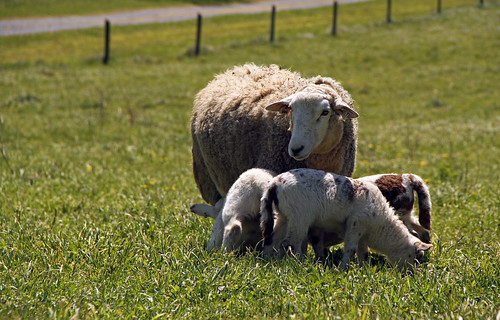 |
| The female (dam) determines the number of offspring. |
One way the male may contribute to the incidence of multiple births is through the viability of the conceptus (embryo). Research has identified differences in embryo survival among different sire lines. Thus, females bred to a male with high embryo survival will give birth to more offspring than females bred to a male with low embryo survival (all other factors being equal).
What the male does determine is the sex of the offspring. Females have two of the same kind of sex chromosomes (XX), whereas males have two distinct sex chromosomes (XY). Whichever sex chromosome the male contributes will determine the genetic sex of the offspring: XX (female) or XY (male).
 |
| The male (sire) determines the sex of the offspring. |
At the same time, there are various maternal factors that can affect the sex ratio of offspring. The "default" sex is female. Theories suggest that females in better body condition will produce more male offspring and that wild animals can adapt the sex ratio to enhance survival of their species.
While reproduction is complicated, for the most part, the female determines the number of offspring and the male determines the sex of the offspring.
Friday, April 6, 2012
Goat AI Clinic
Delaware State University and Bio-Genics LTD will be holding a Goat Artificial Insemination (AI) Clinic on Friday and Saturday, May 4 and 5 at Delaware State University.
The registration fee is $100 person. For more information or to register, contact Dr. Dahlia Jackson-O'Brien at (302) 857-6490 or djjackson@desu.edu.
Visit www.biogenicsltd.com/clinics.html for more information.
Download program flyer
 |
| Dr. Dahlia Jackson-O'Brien at Delaware State University |
The registration fee is $100 person. For more information or to register, contact Dr. Dahlia Jackson-O'Brien at (302) 857-6490 or djjackson@desu.edu.
Visit www.biogenicsltd.com/clinics.html for more information.
Download program flyer
Monday, July 25, 2011
Goat AI & Breeding Short Course
North Carolina State University will host a Goat AI & Breeding Management Short Course, August 30 through September 1, 2011. An optional 1-day pre-course workshop covering the basics of goat management will be offered in conjunction with the 3-day short course.
 The short course is designed to provide participants with both the theoretical background and significant opportunity for hands-on practice needed to facilitate the adoption of artificial insemination into their goat breeding programs.
The registration fee for the 3-day workshop is $300 ($375 after Aug. 8). The registration fee for the 1-day pre-course workshop is $100 ($125 after Aug. 8). Registration is limited to 30 registrants for the pre-course workshop and 20 registrants for the AI short course.
For more information, go to http://www.cals.ncsu.edu/ncsugoatAI/.
AI Short Course Flyer
Thursday, June 2, 2011
Out-of-season breeding demos
Out-of-season breeding is an effective method to increase income from your sheep flock. See it demonstrated in three twilight meetings at Warrior Mtn. Suffolk Farm at 19707 Oliver Beltz Road, Oldtown MD. The first two meetings are scheduled for June 7th and 15th at 6:30 PM.
- Meeting 1 ( June 7th): See data on the effectiveness of the method, insert CIDRs, do breeding soundness exams on the rams, and body condition scores on ewes and rams (Dr. Keith Inskeep, West Virginia University).
- Meeting 2 (June 15th): Observe estrous behavior of ewes from which CIDRs were removed 2 days before. Discuss ram and ewe behavior and reasons for ewe:ram ratio not exceeding 18:1 in single sire lot at synchronized estrus. (Dr. Marlon Knights, West Virginia University).
- Meeting 3 (to be scheduled later): Demonstrate ultrasonographic pregnancy diagnosis and count embryos/fetuses. Discuss usefulness in planning feeding program for ewes bearing single or multiple potential offspring.
 |
| Image from Premier Sheep Supplies |
Contact Derrick Bender at (301) 724-3320 or dbender@umd.edu if you have any questions or need directions to the farm.
There will be a bag of CIDRs as a door prize.
Friday, April 22, 2011
IGA newsletter now online
The April 2011 issue of the International Goat Association (IGA) newsletter is now online.
The International Goat Association promotes goat research and development for the benefit of humankind, to alleviate poverty, to promote prosperity, and to improve the quality of life.
Membership dues are $47.50 per year; $147.50, if you want an annual subscription to the Small Ruminant Journal.
April 2011 issue
Subscribe to:
Posts (Atom)