Wednesday, October 29, 2008

"Condoms" for bucks

Maasai herdsmen in Kenya have turned to an age-old contraceptive device, the "olor", to protect their precious goat herds from an ongoing drought.

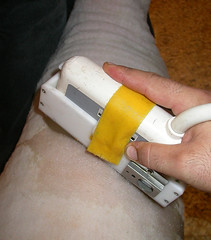
BBC imageThe olor is made from cowhide or a square piece of plastic, and is tied around the belly of the male goat. It prevents the bucks from mating with the female goats.

The herdsmen are using the device to limit the goat population and ensure there are not too many animals grazing on sparse vegetation. The device helps the herdsmen to restrict kidding to the period during and after the rains.

It is recommended that bucks be kept separate from the does, but that is an added cost that requires two herders. The device will play the part of the herdsman. Those who do not use it could face a hefty fine if their bucks are found guilty of impregnating another herder's doe.

Read BBC article

Tuesday, October 28, 2008

Ultrasound accurately predicts carcass measures

172 wethers from the mating of 4 terminal sire breeds with Rambouillet ewes were used to determine the accuracy and repeatability of live-animal ultrasound measures. The lambs were finished in a feedlot to an average body weight of 138.4 +20.9 lbs. (62.9 +9.5 kg.).

Before transport to slaughter, loin eye area, loin depth, and backfat thickness were measured from transverse ultrasound images taken between the 12th and 13th ribs. After slaughter, the same measurements were taken on each carcass. Carcasses were fabricated into subprimal cuts and weights were recorded.

Ultrasound bias approached 0 for loin eye area. Backfat thickness was overestimated by only 0.69 mm (0.03 in.). At a standardized body weight and backfat thickness, wethers with larger loin eye area and loin depth depth yielded larger and more valuable carcasses, and these relationships were detectable with ultrasound.

The data indicate biological and economical incentives for increasing loin eye area in wethers, and live-animal ultrasound can provide reliable estimates of carcass measures. These results are applicable to terminal sire breeders and producers who market sheep using carcass-merit pricing systems.

Source:Journal of Animal Science, November 2008. Read abstract

Thursday, October 23, 2008

Quarterly Scrapie Newsletter

The goal of the American Sheep Industry Association (ASI) and the U.S. sheep and goat industry is to eradicate scrapie from our borders and to have the World Organization for Animal Health declare the United States free from scrapie in 2017.

ASI publishes a quarterly newsletter that provides current information from all 50 states, as well as from the U.S. Department of Agriculture and other organizations. The newsletter provides up-to-date information on scrapie eradication efforts in the U.S.

The September 2008 issue of the newsletter includes a brochure for youth involvement. If you have information that you would like to have included in the newsletter, contact ASI at becky@sheepusa.org.

Download September 2008 Scrapie newsletter

Thursday, October 2, 2008

Buck and doe sale on Saturday

The 1st Western Maryland Performance Tested Buck and Invitational Doe Sale and Field Day will be held this Saturday, October 4, at the Washington County Agricultural Education Center near Boonsboro, MD.

The top buck in this year's test, a Kiko buck consigned by John Smith (VA)The field day portion of the program will get underway at 10 a.m. The featured speaker will be Dr. Dan Waldron from Texas A&M University in San Angelo, TX. Dr. Waldron will discuss different aspects of performance testing (on-farm, central, and EPD's). He will also give an update on the Texas meat goat industry.

At noon, lunch (chevon burgers) will be available for purchase from the MPWV Meat Goat Producers Association. The sale will start at 2 p.m. The top 10 bucks from the Western Maryland Pasture-Based Meat Goat Performance Test will be sold in random order. The ten next best bucks from the test will then sell. Forty-one (41) Kiko and percentage Kiko does have been consigned to the sale. Most of the does are half-siblings to the bucks on test.

Download list of sale bucks
Download list of doe consignments

Wednesday, October 1, 2008

Maryland hosts Katahdin Expo

The 2008 Katahdin Hair Sheep International (KHSI) Expo & Sale was held recently at the Washington County Agricultural Education Center near Boonsboro, MD.

Approximately 160 Katahdin enthusiasts from 23 states and Mexico attended the educational program on September 26. Representatives from Virginia Tech, Virginia State University, West Virginia University, and the University of Maryland and Delaware State University briefly discussed their small ruminant programs and how Katahdin sheep were being used.

Todd Morren from the Hagerstown Canteen carves a lamb for dinner Other speakers focused on the pasture production of Katahdin lambs, genetic improvement of Katahdin sheep, including selection for parasite resistance; and marketing Katahdin sheep and lambs. Two speakers addressed the ethnic markets. Representatives from the Scott County Hair Sheep Association shared their experiences marketing Katahdin lamb through a multi-state supermarket chain (Food City).

Lunch was taco salad made from lamb. Two whole lambs were roasted for dinner. The Hagerstown Canteen did an excellent job on the meals. Entertainment was provided by a local country and western band: Don and the Starlighters.

High selling Katahdin:  (L-R) David Maddox (buyer), Marcia and Carl Ginapp (consigners)On the second day of the Expo, participants had the opportunity to tour the nearby Western Maryland Research & Education Center, home of the Western Maryland Pasture-Based Meat Goat Performance Test. The tour also highlighted pumpkins, forages, and vineyards.

Fifty-five registered Katahdin sheep were sold in the National Katahdin Sale on September 27. The high-selling sheep was a yearling ram consigned by Carl Ginapp from Iowa. The ram sold on the strength of his outstanding EPD's and brought $3,100. The buyer was Dave Maddox from Georgia.

Katahdins are an American breed of hair sheep. They are known for their outstanding reproductive qualities and easy-care nature: no shearing or docking and minimal deworming. Katahdins are the sixth most popular breed of registered sheep in the United States.